

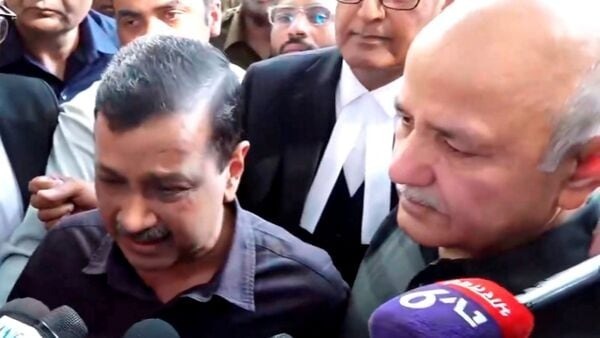
In a major legal boost for the Aam Aadmi Party, a Delhi trial court today discharged former Chief Minister Arvind Kejriwal and former Deputy CM Manish Sisodia in the corruption case filed by the Central Bureau of Investigation (CBI). The court found insufficient evidence to proceed with a trial against the leaders regarding the controversial Delhi Excise Policy 2021-22.
The ruling comes nearly four years after the initial report by the Delhi Chief Secretary set off a chain reaction of arrests that reshaped the political landscape of the national capital.
Also Read | Imran Khan and Bushra Bibi Sentenced to 17 Years in Jail
Understanding “Discharged”: What the Ruling Means
In legal terms, being “discharged” is a critical pre-trial victory.
-
No Trial: It means the judge believes that even if all the evidence presented by the CBI is taken at face value, there isn’t enough to frame charges or sustain a conviction.
-
Insufficient Grounds: The court effectively ruled that the CBI failed to establish a prima facie case of criminal conspiracy or corruption against Kejriwal and Sisodia in this specific probe.
The ₹580 Crore Allegation: A Brief History
The CBI case was built on the premise that the 2021-22 liquor policy was designed to benefit a specific “South Group” of liquor traders.
-
The Loss: The Chief Secretary’s report estimated a loss of ₹580 crore to the exchequer due to “arbitrary and unilateral” decisions.
-
The Kickbacks: It was alleged that the AAP received kickbacks to fund election campaigns in Punjab and Goa.
-
The Timeline: The policy was implemented in November 2021 but was scrapped in July 2022 amidst the growing controversy.
Also Read | Imran Khan and Bushra Bibi Sentenced to 17 Years in Jail
The Looming ED Case: Why the Battle Isn’t Over
While the AAP is celebrating the CBI discharge, their legal troubles have not entirely vanished.
-
The ED Parallel: The Enforcement Directorate (ED) is investigating the same policy under the Prevention of Money Laundering Act (PMLA).
-
The Difference: Unlike the CBI, which focuses on the act of corruption, the ED focuses on the “proceeds of crime.” * Strict Bail Norms: The PMLA has much stricter bail and discharge conditions. Therefore, until the ED case reaches a similar conclusion, the threat of legal action and potential re-arrest remains a shadow over the party.
Reality Check
This discharge is a “half-victory.” Still, it significantly weakens the narrative of a “proven” scam. Therefore, while the CBI’s corruption charges have hit a wall, the ED’s money laundering trial will be the true “litmus test” for the AAP leadership. In fact, if the corruption (predicate) offense by CBI is dismissed, the ED case often becomes legally harder to sustain, but under current Indian laws, they can continue independently for a long time.
The Loopholes
The court discharged the leaders in the CBI case. In fact, this is a “Prosecution Loophole”—it suggests the CBI may have relied too heavily on “approver statements” (witnesses who turned) without sufficient documentary backing. Therefore, the agency will likely challenge this discharge in the High Court within 90 days. Still, the “Dual Agency Loophole” means the AAP cannot claim total innocence until the ED case is also resolved, as the two agencies operate under different sets of evidence and laws.
Also Read | Imran Khan and Bushra Bibi Sentenced to 17 Years in Jail
What This Means for You
If you are a supporter or a voter in Delhi, this ruling will dominate the political discourse for the 2026 assembly cycle. First, realize that the “liquor scam” label just lost its primary legal pillar. Then, if you are looking at the 2026 Delhi elections, understand that this gives the AAP a powerful “victim card” to play against the central government.
Finally, understand that administrative work in Delhi might see a surge in speed as the leadership is no longer bogged down by CBI hearings. You should watch for the CBI’s appeal in the coming weeks, which will indicate if they have “new evidence” to keep the case alive. Before you conclude the case is over, check the status of the ED’s supplementary charge sheet, which is expected to be filed next month.
What’s Next
The CBI is expected to file an appeal in the Delhi High Court by mid-March. Then, the focus will shift entirely to the special ED court, where Manish Sisodia’s lawyers will likely file for a “mirror discharge” based on the CBI ruling. Finally, look for Arvind Kejriwal to ramp up his “Jan Sampark” (public outreach) campaign, using this court order as proof of what he calls a “political witch-hunt.”
Also Read | Imran Khan and Bushra Bibi Sentenced to 17 Years in Jail
End…

