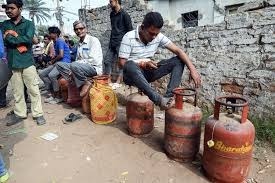
As the West Asia conflict enters its third week, a strange sight has emerged across India: petrol pumps are functioning normally, but gas agencies are under siege. On Saturday, March 14, 2026, despite government assurances of “adequate supply,” the reality on the streets tells a story of a “demand-driven distortion” that has forced several eateries to shut down and households to wait days for a single refill.
The reason India’s kitchens noticed the stress before its private cars lies in a fundamental difference in how we source, store, and consume gas versus liquid fuels.
Also Read | Imran Khan and Bushra Bibi Sentenced to 17 Years in Jail
The Hormuz Choke: Why LPG is the “First Responder”
The Strait of Hormuz is the primary artery for India’s cooking gas.
-
Import Heaviness: India imports roughly 60% of its total LPG.
-
Route Concentration: A staggering 80-90% of those imports must pass through the Strait. When the “choke point” tightened, LPG supplies felt the shock almost instantly.
-
Regional Dependency: Unlike crude oil, which is global, 92% of India’s LPG imports are clustered in the Gulf (UAE, Qatar, Saudi Arabia, Kuwait).
The Buffer Battle: Crude Reserves vs. LPG “Continuous Flow”
India has spent decades building a “safety net” for liquid fuels that simply doesn’t exist for gas.
-
Crude Reserves: India maintains massive underground rock caverns that can sustain the country for weeks.
-
LPG Vulnerability: India’s total LPG cavern capacity (1.4 lakh tonnes) covers less than 48 hours of national consumption. Our gas system is built for “continuous flow,” meaning any delay at the port translates to a delay at your doorstep within 24-48 hours.
Diversification: The Russian Crude Shield
The reason petrol and diesel are stable is largely due to a shift in diplomacy.
-
The 70% Metric: Petroleum Minister Hardeep Singh Puri recently noted that 70% of India’s crude now comes from sources outside the Strait of Hormuz.
-
The Russian Factor: Russia is now India’s largest supplier. A recent 30-day US waiver allowed India to pick up 30 million barrels of Russian crude already at sea, providing a massive buffer that LPG doesn’t have.
Also Read | Imran Khan and Bushra Bibi Sentenced to 17 Years in Jail
The “Ujjwala” Weight: 33 Crore Reasons for Stress
The success of the Pradhan Mantri Ujjwala Yojana has made India more energy-dependent than ever.
-
The Explosion of Demand: Connections jumped from 14.5 crore in 2014 to 33 crore in 2025.
-
Public Health vs. Energy Risk: While moving millions away from toxic biomass was a health win, it created a massive, centralized dependency on a fuel that India cannot yet store in bulk.
Reality Check
The government’s claim of a “demand-driven distortion” is partially true—panic booking does worsen the bottleneck. Still, the lack of strategic gas reserves is the underlying structural failure. Therefore, while we can survive a month of high oil prices without a fuel hike, we cannot survive even 72 hours of a total Hormuz blockade without a kitchen crisis. In fact, the “2.5-day delivery cycle” is currently a goal, not a reality, for many rural districts.
The Loopholes
The government says they are “maximizing LPG recovery” from refineries. In fact, this is a “Feedstock Loophole”—by diverting propane and butane away from petrochemical plants to make cooking gas, the government is hurting the plastics and chemicals industry to save the kitchens. Therefore, while your stove stays on, the price of plastic goods and industrial components is set to skyrocket. Still, the “Waiver Loophole” remains; the US waiver for Russian crude is temporary, and if it isn’t extended, the “petrol pump stability” could vanish by mid-April.
Also Read | Imran Khan and Bushra Bibi Sentenced to 17 Years in Jail
What This Means for You
If you are a domestic consumer, understand the “Continuous Flow” problem. First, realize that your local agency has almost zero “backstock”; they rely on daily truck arrivals. Then, if you are a business owner, understand that commercial LPG is being cannibalized to save domestic voters; you should investigate induction or biomass backups immediately.
Finally, understand that petrol/diesel stability is a “buffer,” not a “fix.” You should still avoid long road trips or unnecessary fuel use, as the strategic reserves are finite. Before you pay a ₹500 “premium” for a black-market cylinder, remember that diversified shipments from the US and West Africa are currently navigating around the Cape of Good Hope and will arrive within 10-15 days.
What’s Next
Expect the Ministry of Petroleum to fast-track the “Underground Gas Storage” feasibility study (estimated at $1-2 billion) following this crisis. Then, look for state-level rationing where single-cylinder households get priority over multi-cylinder ones. Finally, expect Hardeep Singh Puri to seek a permanent “energy corridor” status for Indian ships in the Persian Gulf during his next diplomatic mission.
Also Read | Imran Khan and Bushra Bibi Sentenced to 17 Years in Jail
End…