

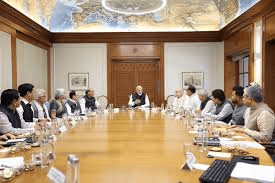
Amidst the escalating West Asia conflict and President Trump’s “Stone Age” ultimatum to Iran, Prime Minister Narendra Modi chaired a high-level meeting of the Cabinet Committee on Security (CCS) on Wednesday, April 1, 2026. The Prime Minister directed all departments to take “all possible measures” to insulate the common man from global supply shocks, particularly focusing on energy security and agricultural stability.
This was the second emergency CCS meeting in ten days, signaling the gravity of the Strait of Hormuz maritime blockade.
Also Read | Imran Khan and Bushra Bibi Sentenced to 17 Years in Jail
The Energy Strategy: Diversification and Anti-Hoarding
With the Middle East under fire, the government is moving to break its traditional import dependencies.
-
LPG & LNG Sourcing: India is actively diversifying procurement, seeking new inflows from non-Middle Eastern nations to stabilize the domestic cooking gas supply.
-
Price Shield: The Cabinet Secretary confirmed that while Commercial LPG prices rose by ₹195.50 today, Domestic LPG prices remain frozen to protect household budgets.
-
Anti-Diversion: A national crackdown on hoarding and black-marketing of cylinders has been launched, alongside a mandate to expand Piped Natural Gas (PNG) connections to reduce reliance on bottled gas.
-
Power Security: To prevent summer blackouts, 7-8 GW of gas-based power plants have been exempted from the gas pooling mechanism to boost immediate generation.
Agriculture: Ensuring the Food Chain
The Prime Minister emphasized that the Kharif and Rabi seasons must not suffer from the “input inflation” currently hitting the global chemical markets.
-
Fertilizer Buffer: The government is coordinating with overseas suppliers for DAP/NPK and maintaining maximum domestic Urea production.
-
State Coordination: States have been asked to conduct daily raids and monitor fertilizer movement to stop illegal diversion.
-
Food Inflation: Control rooms have been established to monitor the retail prices of essential commodities, vegetables, and fruits under the Essential Commodities Act.
Structural Response: The Seven Empowered Groups (EGs)
The government has moved beyond ad-hoc measures, implementing a permanent crisis-management structure:
Also Read | Imran Khan and Bushra Bibi Sentenced to 17 Years in Jail
| Task Force | Primary Responsibility |
| EG 1-3: Energy | Securing alternative oil/gas routes; monitoring the Strait of Hormuz. |
| EG 4: Logistics | Ensuring safe passage for Indian vessels; coordinating with global navies. |
| EG 5: Agriculture | Fertilizer sourcing and domestic food price monitoring. |
| EG 6: Civil Aviation | Managing the ₹1.04 lakh/kl ATF price impact on domestic carriers. |
| EG 7: Communication | Disseminating “authentic information” to prevent rumor-mongering. |
Investigative Insight: The “Hidden” LPG Order
The PMO statement subtly references a controversial new policy: “Households must switch to piped gas where available, else lose LPG supply.” This indicates that the government is facing a genuine physical shortage of LPG cylinders due to the Hormuz blockade. By forcing urban households onto the PNG network, the government is trying to “save” the remaining cylinder stock for rural India (the Ujjwala base).
Furthermore, the briefing to the CCS reveals that while domestic prices are stable, the under-recoveries (losses) for Oil Marketing Companies (OMCs) are mounting to dangerous levels. By “diversifying sources,” the government is likely buying more expensive gas from the US and West Africa. This “Whole of Government” approach is essentially a fiscal dam; if the war doesn’t end within the 2-3 week timeline set by the US President, the government may be forced to choose between a massive budget deficit or a sharp hike in domestic cooking gas prices.
Also Read | Imran Khan and Bushra Bibi Sentenced to 17 Years in Jail
End…

