

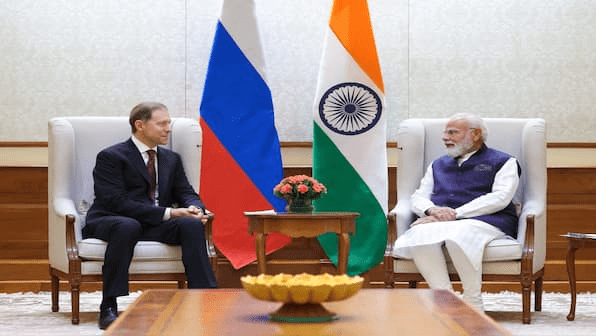
As the West Asia war destabilizes global energy markets, India and Russia have solidified a massive economic and defense pivot. On Thursday, April 2, 2026, Russian First Deputy PM Denis Manturov met Prime Minister Narendra Modi in New Delhi, resulting in a landmark five-year roadmap to catapult annual bilateral trade to $100 billion (approx. ₹8.4 lakh crore) by 2030.
The high-stakes visit also saw the formal clearance for India to procure an additional five S-400 missile systems, doubling down on Russian defense tech despite the looming shadow of US CAATSA sanctions.
Also Read | Imran Khan and Bushra Bibi Sentenced to 17 Years in Jail
The Strategic “Triple-Pillar” Agenda
The discussions between Modi, Manturov, and NSA Ajit Doval focused on three critical areas of immediate concern for the Indian economy:
-
Energy Security: With the Strait of Hormuz currently a high-risk zone, Russia has committed to “steady increases” in crude and LNG supplies via the INSTC (International North-South Transport Corridor) to bypass the Persian Gulf.
-
Fertilizer Shield: To protect Indian farmers from global price spikes, Russia is increasing mineral fertilizer exports—already up 40%—and collaborating on a new joint carbamide (urea) production facility.
-
Defense Autonomy: The decision to buy more S-400s follows the system’s “battle-proven” performance during Operation Sindoor (the May 2025 conflict with Pakistan), where it provided India with a decisive aerial advantage.
Trade & Investment Roadmap: 2026–2030
The new roadmap marks a shift from “transactional” buying to deep industrial integration.
Also Read | Imran Khan and Bushra Bibi Sentenced to 17 Years in Jail
| Sector | Key Initiative |
| Trade Target | $100 Billion (₹8.4 Lakh Crore) by 2030. |
| Connectivity | Modernizing the INSTC to facilitate faster land-and-sea transit. |
| Currency | Specific steps to create “favorable conditions” for Rupee-Ruble trade. |
| Nuclear | Accelerating reactors at the Kudankulam plant to meet 2026 power demands. |
Breaking Headlines: April 3, 2026
The India-Russia summit is unfolding against a backdrop of intense global and domestic developments:
-
Hormuz “Plan B”: While India talks to Russia, 40 US allies (including the UK and Japan) met virtually to discuss de-mining the Strait of Hormuz if President Trump “walks away” from the conflict.
Also Read | Imran Khan and Bushra Bibi Sentenced to 17 Years in Jail
-
The “Stone Age” Ultimatum: Trump’s threat to hit Iran “extremely hard” for the next 21 days has kept Brent Crude above $105, making Russia’s energy offer even more vital for New Delhi.
-
Sensex Panic: Indian markets suffered a ₹10 lakh crore wipeout yesterday, though IT stocks led a late-session 1,774-point recovery in the Sensex before the Good Friday holiday.
-
Malda Arrest: AIMIM leader Mofakkerul Islam was arrested at Bagdogra Airport today, named as the “mastermind” behind the 9-hour hostage crisis involving judicial officers in Bengal.
Investigative Insight: The “Operation Sindoor” Effect
The decision to acquire five more S-400 batteries is the most significant takeaway from Manturov’s visit. By referencing Operation Sindoor (the 2025 border hostilities), India is signaling to Washington that its defense needs are strictly existential and non-negotiable. While the US has issued a “temporary waiver” for Indian oil purchases from Russia to keep global prices low, the S-400 deal is a much harder pill for the Pentagon to swallow.
However, with the Strait of Hormuz blocked, the US needs India to remain a stable economic anchor in Asia. Russia is capitalizing on this leverage, effectively offering a “Security-for-Energy” package that the US cannot match. The $100 billion trade target is ambitious, but if the INSTC route successfully replaces the Persian Gulf for India’s oil imports, it would represent the most significant shift in Indian foreign policy since the 1971 Indo-Soviet Treaty.
Also Read | Imran Khan and Bushra Bibi Sentenced to 17 Years in Jail
End……

