

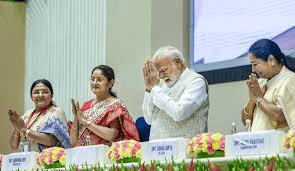
Now the nation stands on the threshold of a transformative era in democratic representation. Addressing the “Nari Shakti Vandan Sammelan” at Vigyan Bhawan this Monday, Prime Minister Narendra Modi described the proposed operationalization of the Women’s Reservation Bill 2026 as the most significant decision of the 21st century. First, the Prime Minister emphasized that this move is a long-awaited tribute to “Nari Shakti” (woman power) and a definitive step toward creating an egalitarian India. Therefore, the decades of waiting for equal representation in State Assemblies and the Parliament are nearing an end. Meanwhile, a comprehensive parliamentary discussion is scheduled to commence on April 16.
Also Read | Imran Khan and Bushra Bibi Sentenced to 17 Years in Jail
A Resolution for the Future: Defining the 21st Century
Now we must analyze the weight of the Prime Minister’s statements regarding the nation’s journey. First, PM Modi stated with “great responsibility” that the Women’s Reservation Bill 2026 is among the most important decisions of our time. Therefore, he is framing this not just as a policy change, but as a foundational shift in India’s democratic identity.
Next, he noted that this decision is entirely dedicated to the veneration of women’s strength. Thus, the move is designed to fulfill the resolutions of a future, egalitarian India.
Meanwhile, the Prime Minister highlighted that the country’s Parliament is close to creating a “new history.” Therefore, the vision of past generations is finally aligning with the legislative capabilities of the present. So the 21st century is being defined by the active participation of women in the highest halls of power.
The Nari Shakti Vandan Sammelan: A National Gathering
So what was the nature of the gathering that prompted these remarks? First, the Nari Shakti Vandan Sammelan was organized at Vigyan Bhawan specifically to support the operationalization of the 2023 Act. Therefore, the event served as a platform to consolidate support for the upcoming constitutional amendment.
Next, the presence of various political leaders signaled a unified front for women’s empowerment. Thus, the atmosphere was one of celebration and high-stakes anticipation.
Key Attendees:
-
PM Narendra Modi: Primary speaker and visionary for the 2029 goal.
-
Rekha Gupta: Chief Minister of Delhi, showing regional support.
-
Annpurna Devi: Union Minister of Women and Child Development.
Meanwhile, the sammelan served as the final public push before the Women’s Reservation Bill 2026 reaches the floor of the House. Therefore, the event was a strategic precursor to the “comprehensive discussion” scheduled for later this week.
Ending the Decades of Waiting: The 16-18 April Timeline
Now the legislative clock is ticking toward a specific set of dates. First, PM Modi identified April 16, 17, and 18 as the critical days when the Parliament will address the reservation issue. Therefore, the “decades of waiting” are being distilled into a concentrated 72-hour window.
Next, this timeline is intended to produce a definitive roadmap for the operationalization of the Adhiniyam. Thus, the state assemblies and the Parliament will soon witness a structural transformation.
Meanwhile, the Prime Minister expressed hope that the dignity of the entire House would reach “new heights” through this process. Therefore, the Women’s Reservation Bill 2026 is being treated as a non-partisan mission. So the 16th of April marks the start of a legislative “sprint” toward equality.
Also Read | Imran Khan and Bushra Bibi Sentenced to 17 Years in Jail
Social Justice vs. Slogans: PM Modi’s Governance Vision
So how does the Prime Minister distinguish this move from previous political rhetoric? First, he asserted that social justice must not be merely a “slogan.” Therefore, the Women’s Reservation Bill 2026 is intended to make equity a natural part of the Indian work culture.
Next, he emphasized that this decision will turn the “concepts of the past” into a concrete reality. Thus, the decision-making process of the nation will finally reflect its true demographics.
PM Modi’s Vision Pillars:
-
Egalitarianism: Moving beyond tokens to institutionalized power.
-
Work Culture: Integrating women’s perspectives into everyday governance.
-
Decision-Making: Ensuring women have a 33% say in legislative outcomes.
Meanwhile, he argued that this decision is a “true tribute” to the strength of womanhood. Therefore, the policy is being framed as an act of reverence rather than just a legal requirement.
The 2029 Deadline: Mutual Cooperation Across Party Lines
Now the focus has shifted to the “at any cost” deadline of 2029. First, PM Modi mentioned a unanimous demand that the Women’s Empowerment Act be implemented by 2029. Therefore, the 2026 discussions are about clearing the technical and administrative hurdles to meet that target.
Next, he stressed the need for “mutual cooperation and participation” among all political parties. Thus, the government is seeking a consensus to avoid the legislative stalemates of the past.
Meanwhile, the Prime Minister noted that every woman in the country would be “happy” to see parties rising above politics. Therefore, the Women’s Reservation Bill 2026 is being positioned as a “nation-first” initiative. So the 2029 deadline is the anchor for all current parliamentary activity.
Vigyan Bhawan: The Stage for Empowering Womanhood
So why was Vigyan Bhawan chosen for this announcement? First, as a premier venue for national conferences, it provided the necessary gravity for a “21st-century decision.” Therefore, the setting matched the monumental nature of the Prime Minister’s speech.
Next, the “Nari Shakti Vandan Sammelan” brought together thousands of women who have been the primary stakeholders of this discourse for forty years. Thus, the venue echoed with the history of the movement.
Meanwhile, the event served to operationalize the “Nari Shakti Vandan Adhiniyam, 2023” in the public consciousness. Therefore, the Women’s Reservation Bill 2026 is no longer just a draft—it is a live project with massive public backing.
Also Read | Imran Khan and Bushra Bibi Sentenced to 17 Years in Jail
Key Leadership: Rekha Gupta and Annpurna Devi’s Roles
Now we must look at the women leading this charge alongside the PM. First, Delhi Chief Minister Rekha Gupta’s presence highlights the regional necessity for this reservation. Therefore, the bill’s impact on state assemblies is a primary focus of the 2026 roadmap.
Next, Union Minister Annpurna Devi continues to drive the implementation from the Ministry of Women and Child Development. Thus, the “operationalize” phase is in experienced hands.
Leadership Impact:
-
Rekha Gupta: Mobilizing urban and regional support for the bill.
-
Annpurna Devi: Managing the technical amendments and departmental coordination.
Meanwhile, their participation underscores the Prime Minister’s claim that this decision is “dedicated to women’s power.” Therefore, the Women’s Reservation Bill 2026 is being championed by those who will see its results firsthand.
Four Decades of Discourse: Reaching a Cross-Party Consensus
So why has it taken this long? First, PM Modi acknowledged that this discourse has been going on for “nearly four decades.” Therefore, he is giving credit to the many generations and parties that have advanced the idea in their own way.
Next, he noted that the time has finally come to “end decades of waiting.” Thus, the 2026 Parliament session is intended to be the final chapter of this long-running debate.
Meanwhile, he expressed his desire that this work be done with “collective efforts.” Therefore, the Women’s Reservation Bill 2026 is the culmination of forty years of struggle and advocacy. So the “new history” being created is a shared victory for the entire nation.
Common Questions Answered
What is the Women’s Reservation Bill 2026 update? Now PM Modi has called it the most important decision of the 21st century. Therefore, the Parliament is moving toward operationalizing the reservation with a 2029 deadline.
When will Parliament discuss the bill? First, a comprehensive discussion is scheduled to take place from April 16 to April 18, 2026. Thus, this week is critical for the legislation’s progress.
What is the goal of the Nari Shakti Vandan Adhiniyam? Next, it aims to provide a 33% reservation for women in the Lok Sabha and State Legislative Assemblies. Therefore, it institutionalizes women’s participation in governance.
Will the reservation be implemented immediately? So there is a unanimous demand to have it implemented by 2029 at any cost. Thus, the 2026 sessions are focused on meeting that timeline.
Who attended the Nari Shakti Vandan Sammelan? Finally, PM Modi was joined by Delhi CM Rekha Gupta and Union Minister Annpurna Devi at Vigyan Bhawan. So it was a high-level show of support.
Why did PM Modi call it a ‘true tribute’ to womanhood? Actually, he believes that moving social justice from a slogan to a work culture is the ultimate way to honor women. Therefore, the bill is more than just a law; it’s a cultural shift.
Also Read | Imran Khan and Bushra Bibi Sentenced to 17 Years in Jail
End….

