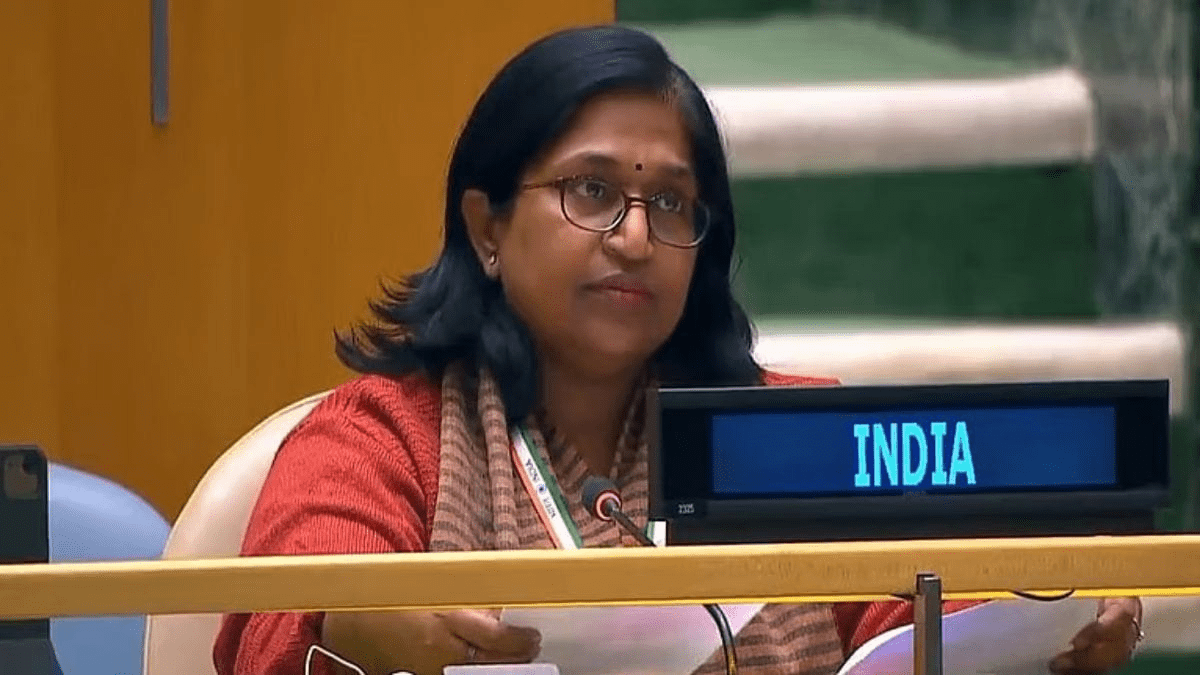
Now the escalating maritime crisis in West Asia has forced a firm diplomatic intervention from New Delhi on the world stage. On Tuesday, April 28, 2026, India’s Deputy Permanent Representative, Yojna Patel, delivered a powerful statement at the United Nations Security Council (UNSC) regarding the deteriorating situation in the Persian Gulf. Therefore, the India UNSC Hormuz shipping condemnation serves as a vital marker for India’s regional interests. Specifically, Patel condemned the attacks on commercial vessels in the “strongest terms,” describing military strikes on civilian trade as “deplorable.”
Meanwhile, although the statement did not explicitly name Iran, it pointedly referred to New Delhi’s co-sponsorship of Resolution 2817—a Bahrain-led motion that condemned Tehran’s recent aggressive maneuvers against its neighbors.
But for India, the crisis is not just a matter of international law; it is a direct threat to the safety of 10 million citizens living in the Gulf and the stability of the nation’s energy supply chains.
Also Read | Imran Khan and Bushra Bibi Sentenced to 17 Years in Jail
Deplorable Attacks: India’s Official Statement at the UNSC
Now we must analyze the weight of Patel’s words. Addressing the Council meeting convened by Bahrain, India emphasized that the targeting of innocent civilian crew members is a violation of international norms. Therefore, the India UNSC Hormuz shipping condemnation is a clear signal that New Delhi’s patience with maritime disruptions is wearing thin.
Upholding Maritime Norms
First, Patel noted that commercial shipping must never be the target of military operations. Then, she underscored that any attempt to impede the freedom of navigation and commerce is inherently “unacceptable.” Thus, India is positioning itself as a defender of the rules-based international order at sea. Next, the statement called for the immediate cessation of hostile activities that endanger global trade. Therefore, India’s intervention highlights the growing consensus that the Hormuz crisis is no longer a localized conflict but a global economic threat.
The Resolution 2817 Connection: Alluding to Tehran’s Role
Now, the diplomatic nuance in India’s statement is worth noting. While Patel did not name Iran directly in her speech on Tuesday, she reminded the Council of India’s past voting record.
The Bahrain-India Partnership
First, India recalled its role as a co-sponsor of Resolution 2817, which was adopted on March 11, 2026. Then, she pointed out that this resolution condemned Tehran’s attacks on its Middle East neighbors. Thus, the allusions to Iranian responsibility were unmistakable to the members of the Council. Next, this partnership with Bahrain—the current Council President—shows a shifting alignment in India’s West Asia policy. Therefore, India is becoming increasingly vocal about the “destructive habits” of regional players who threaten the stability of the Gulf.
Energy Security: Why the Strait of Hormuz is India’s Lifeline
Now we must address the “why” behind this condemnation. The Strait of Hormuz is not just a geographic feature; it is the primary artery for India’s massive energy requirements.
The Economic Chokepoint:
-
Trade Connectivity: Direct maritime link to India’s primary energy suppliers.
-
Energy Volume: Handles a significant percentage of India’s daily crude oil and LNG imports.
-
Supply Chain Impact: Disruptions lead to immediate spikes in domestic fuel prices and logistics costs.
First, Patel noted that unimpeded shipping through the Strait provides India with vital connectivity. Then, she highlighted the “implications for economy and energy security” that arise whenever the waterway is blocked. Thus, any military attack in this region has a direct “ripple effect” on the Indian household budget. Next, the ongoing tensions have already pushed crude prices toward $110. Therefore, the India UNSC Hormuz shipping condemnation is a protective measure for the nation’s 2026 growth targets.
Also Read | Imran Khan and Bushra Bibi Sentenced to 17 Years in Jail
The Diaspora Factor: Protecting 10 Million Indians in the Gulf
Now, beyond the oil, there is the human element. The Middle East is home to the largest concentration of Indian citizens outside of India.
A Key Priority for Delhi
First, almost 10 million Indians live and work in the Gulf region. Then, their “safety and well-being” remain a top-tier priority for the Ministry of External Affairs. Thus, any regional instability puts these millions of lives at risk of displacement or physical harm. Next, the economic remittances from this diaspora are a cornerstone of India’s foreign exchange reserves. Therefore, India’s call for de-escalation is rooted in the survival and prosperity of its citizens living in the eye of the storm.
Casualties at Sea: The Tragic Loss of Indian Sailors
Now the human cost has already become a grim reality. Recent assaults on ships in the region have resulted in the deaths of at least three Indian sailors.
The Personal Toll of the Conflict
First, Iran has been linked to attacks on Indian-owned vessels and ships bound for Indian ports. Then, these incidents have resulted in innocent civilian deaths, which Patel specifically mentioned as “deplorable.” Thus, the India UNSC Hormuz shipping condemnation is backed by the weight of these national tragedies. Next, the targeting of civilian crews—regardless of the ship’s flag—is a war crime under international maritime law. Therefore, India is demanding accountability for those who use merchant sailors as pawns in a geopolitical game.
The US Blockade: A Complicated Maritime Standoff
Now we must consider the other side of the maritime equation. The United States has established its own naval blockade in the Hormuz region to counter Iranian influence.
The Double-Sided Pressure
First, the US blockade aims to prevent the movement of Iranian military assets and oil exports. Then, this increased naval presence—while intended to deter—has contributed to the overall tension in the waterway. Thus, India finds itself in a delicate position, calling for “free navigation” that is currently being squeezed by both Tehran and Washington. Next, India’s emphasis on “restoring” free navigation applies to all military actors in the region. Therefore, Patel’s statement is a plea for the demilitarization of commercial routes to allow trade to flow without fear of seizure or strikes.
Also Read | Imran Khan and Bushra Bibi Sentenced to 17 Years in Jail
Dialogue and Diplomacy: India’s Roadmap for De-escalation
Now, what is the path forward? India has consistently maintained that there is no military solution to the Gulf crisis.
The Call for De-escalation
First, Patel called for “dialogue and diplomacy” as the primary tools for de-escalation. Then, she urged the warring parties to return to the negotiating table in Pakistan to find a sustainable peace. Thus, India is positioning itself as a potential mediator or a supporting voice for regional stability. Next, the emphasis is on a “proximate neighborhood” approach where local stability determines global security. Therefore, the India UNSC Hormuz shipping condemnation concludes with a vision of a peaceful Middle East where energy and trade remain unhindered by conflict.
Proximate Neighborhood: India’s Strategic Stakes in the Middle East
Now, finally, we must realize that India’s geography dictates its diplomacy. The Middle East is not a distant theater; it is India’s “proximate neighborhood.”
Stakeholders in Stability
First, India’s strategic stakes are linked through history, geography, and culture to the Gulf nations. Then, any long-term disruption in the region directly undermines India’s ambition to become a leading global economy. Thus, the security of the Strait of Hormuz is an internal security issue for New Delhi. Next, the co-sponsorship of the resolution with Bahrain shows that India is willing to take a lead in regional security architectures. Therefore, the India UNSC Hormuz shipping condemnation is a declaration that India will no longer remain a silent bystander while its vital lifelines are under attack.
Common Questions Answered
Why did India condemn the attacks in the Strait of Hormuz at the UNSC? Now it is because these attacks target commercial shipping, which is vital for India’s energy security. Therefore, India described them as “deplorable” and “unacceptable.”
Did India name Iran in its UNSC statement? First, no, the statement did not name Iran by name. However, it alluded to Tehran by recalling India’s co-sponsorship of a resolution condemning Iranian attacks. Thus, the target was clear.
How many Indians are affected by the Gulf tensions? Next, there are approximately 10 million Indians living and working in the Gulf region. Therefore, their safety is a “key priority” for the Indian government.
What is Resolution 2817? So, it is a UNSC resolution adopted on March 11, 2026, which condemned attacks by Tehran on its neighbors. India was a co-sponsor of this resolution.
How has the shipping crisis affected Indian sailors? Finally, at least three Indian sailors have died in recent maritime assaults. Thus, the human cost to India has already been significant.
Also Read | Imran Khan and Bushra Bibi Sentenced to 17 Years in Jail
End….