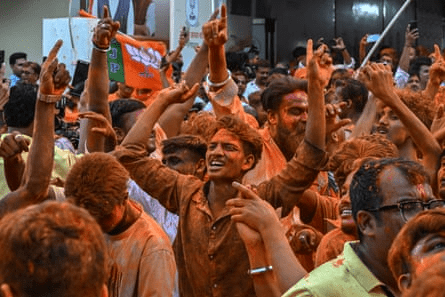
Now the dust has settled on a historic mandate. The West Bengal election result 2026 has delivered a seismic shift, with the Bharatiya Janata Party (BJP) securing 206 seats to form the government. Therefore, analysts are looking closely at the “Special Intensive Revision” (SIR) of the voter list. Before the polls, approximately 91 lakh names were removed, leading to a fierce debate on how these deletions influenced the final tally. Meanwhile, the TMC has been reduced to 80 seats, ending 15 years of incumbency.
Also Read | Imran Khan and Bushra Bibi Sentenced to 17 Years in Jail
What is SIR? The Process That Removed 91 Lakh Voters
Now the Special Intensive Revision (SIR) has become the most scrutinized administrative action of the 2026 cycle. Before the election, authorities removed around 91 lakh names from the voter rolls. Therefore, the list was “cleaned” of deceased individuals, duplicate entries, and those flagged for “logical inconsistencies.”
First, this revision became politically charged as claims emerged that specific communities were disproportionately affected. Next, around 27 lakh voters were removed specifically due to “logical inconsistencies”—roughly 5 percent of the total electorate. Thus, the scale of the revision matched the BJP’s eventual margin of victory.
So while the Election Commission maintained the process was purely administrative, the political fallout was immense. Meanwhile, the deletions occurred in high concentrations across 112 assembly seats. Therefore, SIR became a central pillar of the 2026 campaign narrative.
The Seat Conversion Paradox: 5% Lead vs. 125-Seat Advantage
Now the most striking aspect of the West Bengal election result 2026 is the efficiency of the BJP’s vote-to-seat conversion. The BJP polled 2.92 crore votes against the TMC’s 2.60 crore. Therefore, a lead of 32 lakh votes resulted in a massive 125-seat gap.
First, the BJP secured 46 percent of the vote compared to the TMC’s 41 percent. Next, this 5 percent lead was enough to sweep entire districts due to the concentration of voters. Thus, the TMC’s support base became “inefficient,” winning big in fewer pockets while losing narrowly in many others.
So the margin of 32 lakh votes closely mirrors the 27 lakh names removed via “logical inconsistencies.” Meanwhile, experts attribute the seat gap to a perfect storm of anti-incumbency and voter distribution. Therefore, the BJP’s win was not just about more votes, but about where those votes were cast.
Constituency Analysis: How Deletions Impacted Strongholds
Now the data tells a compelling story of eroding strongholds. In 112 seats where net deletions exceeded 25,000 voters, the political shift was total. Therefore, seats that were once considered TMC “fortresses” crumbled.
First, in 2021, the TMC won 86 of these high-deletion seats. Next, in 2026, the BJP took 72 of them, leaving the TMC with only 39. Thus, the SIR-linked deletions likely influenced the final outcome in at least two dozen close contests.
So the 10 seats with the highest deletions were all TMC-held in 2021. Meanwhile, the BJP successfully flipped key urban and migration-linked zones. Therefore, the narrowing of margins in these seats indicates a widespread erosion of the TMC’s core support.
Also Read | Imran Khan and Bushra Bibi Sentenced to 17 Years in Jail
Muslim Vote Fragmentation: The Shift in Malda and Murshidabad
Now the traditional 27 percent Muslim support base of the TMC showed visible signs of division. For the first time in 15 years, the minority vote split between the TMC, Congress, and the Left-ISF alliance. Therefore, the “TMC sweep” in border districts was halted.
First, in 32 Muslim-majority constituencies, the TMC’s vote share dropped by a staggering 16 percentage points. Next, the party, which held all 32 of these seats in 2021, only managed to keep 23. Thus, the fragmentation in Malda and Murshidabad directly benefited the BJP and the Congress.
So in Murshidabad, the TMC’s tally dropped from 20 seats to just nine. Meanwhile, the BJP gained ground in multiple seats where minority voting patterns were previously consolidated. Therefore, the “voter split” proved as decisive as the “voter deletion.”
Beyond SIR: The Role of Migrant Workers and Anti-Incumbency
Now it is a mistake to view SIR as the only factor in the BJP’s victory. The data shows that voter turnout remained firm in many areas despite the deletions. Therefore, new voters and returning migrants played a critical role in the 2026 mandate.
First, a large number of migrant workers returned to the state to cast their ballots. Next, while the TMC expected their support, the results suggest their votes were split by local governance concerns. Thus, law and order and leadership perceptions proved more powerful than traditional loyalties.
So the 2026 verdict reflects deep-seated anti-incumbency after 15 years of rule. Meanwhile, sweeps in SC/ST belts and urban zones showed a broad-based desire for change. Therefore, SIR was an accelerant, but governance was the fuel for the BJP’s win.
Bhawanipur Case Study: Why the CM Lost Her Seat
Now the loss of Bhawanipur is the most symbolic moment of the West Bengal election result 2026. Chief Minister Mamata Banerjee was defeated in her home turf by Suvendu Adhikari. Therefore, the “Nandigram 2.0” scenario has ended her tenure as an MLA.
First, Bhawanipur was one of the seats that recorded high net deletions during the SIR. Next, the 2-3 percent swing in voting patterns among urban residents proved decisive. Thus, the narrow margin of defeat fell within the range of voter list changes.
So the fall of Bhawanipur signaled a total collapse of the TMC high command’s morale. Meanwhile, the BJP’s 15,000+ vote margin in the seat showed that the shift was not just “technical” but “emotional.” Therefore, the CM’s defeat became the ultimate proof of a state-wide “Badlav.”
Also Read | Imran Khan and Bushra Bibi Sentenced to 17 Years in Jail
Conclusion: A Multi-Dimensional Mandate for Change
Now the 2026 verdict is being recorded as one of the most complex in Indian history. While the Special Intensive Revision (SIR) influenced the margins, it does not fully explain 206 seats. Therefore, the BJP’s victory is the result of multiple electoral dynamics.
First, the consolidation of SC/ST votes provided a rock-solid foundation for the BJP. Next, the fragmentation of the TMC’s minority support base allowed for wins in border districts. Thus, the “party society” of Bengal has been fundamentally restructured.
So the state now moves into a new administrative era. Meanwhile, the SIR will remain a topic of intense debate for political scientists. Therefore, the West Bengal verdict of 2026 proves that in democracy, every name on the list—and every name removed—counts.
FAQ: West Bengal Election Results and SIR Impact
1. What was the final seat count for BJP and TMC? Now, the BJP won 206 seats and the TMC secured 80 seats in the 294-member assembly.
2. How many voters were removed through SIR? First, around 91 lakh names were removed from the voter list. Thus, these included deceased, shifted, and “logically inconsistent” entries.
3. Did Mamata Banerjee win her seat? So no. The outgoing Chief Minister lost the Bhawanipur seat to BJP’s Suvendu Adhikari.
4. What was the difference in vote share? Next, the BJP had a 46% vote share, while the TMC had 41%. This 5% lead resulted in a 125-seat advantage.
5. How did Muslim-majority seats vote? Now, the TMC vote share in 32 Muslim-majority seats dropped by 16%. Therefore, they won 23 seats compared to a clean sweep in 2021.
6. When will the new BJP government take oath? Finally, the BJP government is set to take the oath of office on May 9, 2026, on the occasion of Rabindra Jayanti.
Also Read | Imran Khan and Bushra Bibi Sentenced to 17 Years in Jail
End…