

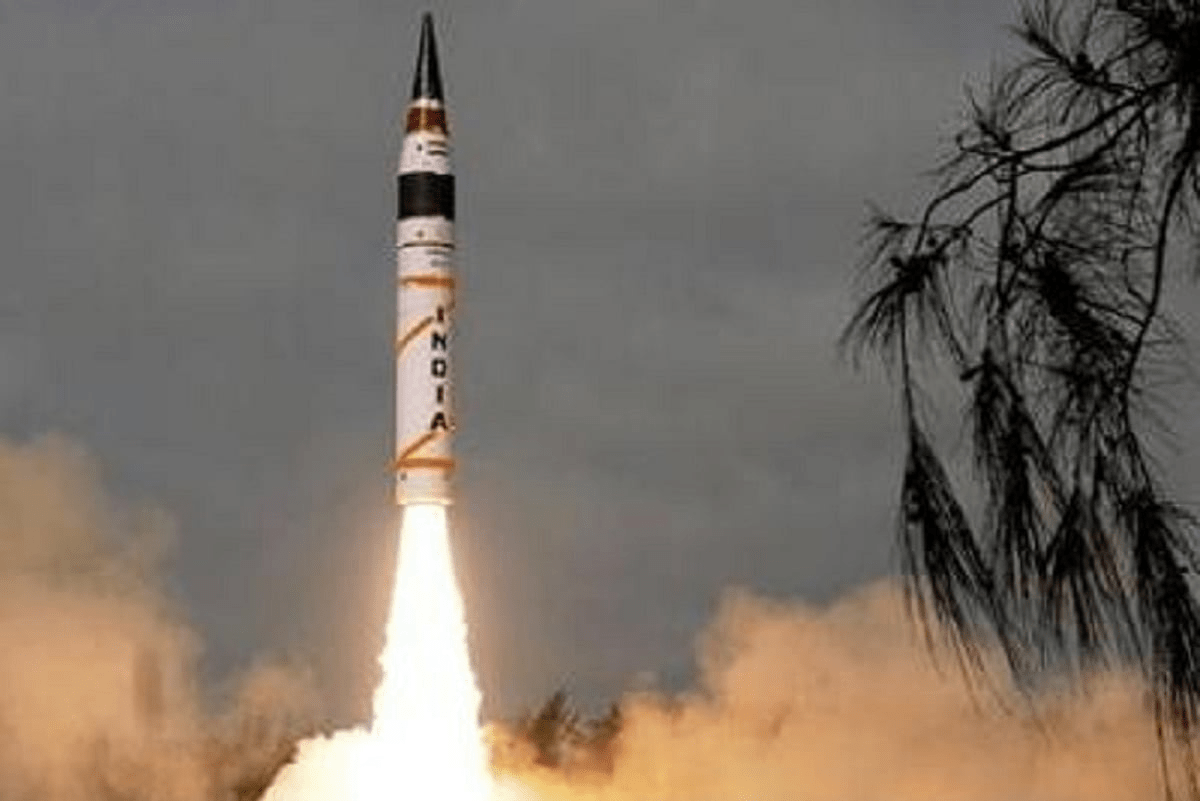
Now the Indian defense landscape has reached a new pinnacle of strategic deterrence. On Saturday, May 8, 2026, India successfully conducted the flight trial of an Advanced Agni missile equipped with Multiple Independently Targeted Re-Entry Vehicle (MIRV) technology. Therefore, launched from Dr. APJ Abdul Kalam Island off the coast of Odisha, the missile successfully deployed multiple warheads across a vast area in the Indian Ocean Region. Meanwhile, this test reaffirms India’s indigenous capability to engage multiple independent targets using a single missile system, significantly complicating enemy defense efforts.
Also Read | Imran Khan and Bushra Bibi Sentenced to 17 Years in Jail
Successful Flight Trial: Precision in the Indian Ocean
Now the technical execution of the Agni trial has been described as flawless by the Defence Research and Development Organisation (DRDO). The Advanced Agni missile was launched with multiple payloads that accurately struck different targets spatially distributed over the Indian Ocean Region. Therefore, the mission successfully demonstrated India’s growing precision in long-range ballistics.
First, the entire flight was monitored using a sophisticated network of ground-based and ship-based tracking stations. Next, these stations recorded the missile’s trajectory from the initial lift-off to the final impact of all individual payloads. Thus, the DRDO confirmed that all mission objectives were successfully achieved during the May 8 test.
So the spatial distribution of the targets proves that the re-entry vehicles can be maneuvered independently. Meanwhile, the data collected will be used to further refine the guidance systems of future Agni variants. Therefore, this test is a clear validation of the “Mission Divyastra” philosophy on a more advanced platform.
Defining MIRV: How Multiple Warheads Change the Game
Now the core of this achievement lies in the Multiple Independently Targeted Re-Entry Vehicle (MIRV) technology. Unlike traditional missiles that carry a single warhead to a single destination, MIRV allows a single missile to carry several warheads. Therefore, each of these warheads can be programmed to hit a completely different, independent target.
First, this technology makes it extremely difficult for enemy anti-ballistic missile (ABM) systems to intercept the threat. Next, even if a defense system stops one warhead, the others can still reach their intended targets. Thus, it acts as a force multiplier that significantly enhances the reach of India’s strategic arsenal.
So the complexity of guidance and re-entry required for MIRV is immense. Meanwhile, India has now joined a select group of nations capable of deploying such sophisticated weaponry. Therefore, the “Advanced Agni” represents a major leap in miniaturization and precision engineering.
Legacy of Mission Divyastra: Progress Since March 2024
Now it is important to note that this is not India’s first encounter with MIRV. In March 2024, India conducted its first successful MIRV test using the Agni-5 platform under the codename Mission Divyastra. Therefore, the 2026 test represents the evolution of that initial success onto an “Advanced” platform.
First, the 2024 test established the baseline for re-entry vehicle technology in India. Next, the recent trial shows significant progress in indigenous guidance and multi-target engagement under realistic operational conditions. Thus, India is rapidly moving from “proof of concept” to “operational readiness.”
So the timeline between these tests suggests a dedicated and accelerated development cycle. Meanwhile, the integration of lessons from previous Agni missions has allowed for a more robust Advanced Agni variant. Therefore, the strategic community views this as a sign of matured defense research.
Also Read | Imran Khan and Bushra Bibi Sentenced to 17 Years in Jail
Indigenous Innovation: The Role of DRDO and Indian Industry
Now the Advanced Agni missile is a shining example of the “Atmanirbhar Bharat” initiative. It has been developed indigenously by DRDO laboratories with active support from the Indian defense industry. Therefore, the entire supply chain—from specialized alloys to the software for multi-target engagement—is homegrown.
First, the trial was witnessed by senior DRDO scientists and high-ranking Indian Army officials. Next, the collaboration with private and public sector industry partners ensured that the production scale could meet future military requirements. Thus, the test is as much a victory for Indian manufacturing as it is for the military.
So the indigenous guidance system used in the MIRV payloads is a critical breakthrough. Meanwhile, the ability to strike targets over a “vast area” in the Indian Ocean demonstrates the power of Indian satellite and ship-based telemetry. Therefore, the success belongs to the entire national defense ecosystem.
Strategic Impact: Enhancing India’s Nuclear and Conventional Deterrence
Now the successful integration of MIRV technology has profound implications for regional security. It significantly enhances the credibility of India’s “No First Use” nuclear doctrine by ensuring a robust second-strike capability. Therefore, the ability to saturate enemy defenses with multiple warheads makes any aggression against India a high-risk venture.
First, the technology provides a versatile platform for both nuclear and conventional deterrence. Next, it allows for a more efficient use of the missile inventory, as one launch can achieve what previously required several. Thus, India’s strategic posture has become more modernized and formidable.
So the test comes at a time of evolving threat perceptions in the Indo-Pacific. Meanwhile, the Indian Ocean has become a focal point for maritime security and power projection. Therefore, having a land-based MIRV capability that covers this region is a vital national security asset.
The Agni Family: Backbone of India’s Land-Based Arsenal
Now the Agni family of missiles remains the primary component of India’s strategic land-based deterrence. Particularly, the Agni-5 and its subsequent variants are known for their intercontinental reach, typically exceeding 5,000 km. Therefore, the addition of MIRV technology makes this family even more potent.
First, the Agni series has evolved from short-range tactical missiles to long-range strategic platforms. Next, the “Advanced” variant tested in 2026 features improved solid-fuel motors and more durable re-entry shielding. Thus, the reliability of the backbone of India’s nuclear triad has been reaffirmed.
So the Agni missiles are designed for quick deployment and high mobility. Meanwhile, the transition to MIRV-capable Agni variants represents the “next generation” of Indian ballistics. Therefore, the 2026 test is a continuation of a decades-long legacy of successful missile development.
Also Read | Imran Khan and Bushra Bibi Sentenced to 17 Years in Jail
National Preparedness: Rajnath Singh’s Congratulatory Message
Now the success of the test was met with high praise from the national leadership. Defence Minister Rajnath Singh took to social media to congratulate the DRDO, the Indian Army, and the industry partners involved. Therefore, the government is highlighting this as a major step in enhancing the country’s defense preparedness.
First, the Minister noted that the test significantly strengthens India’s hands in the face of evolving regional threats. Next, he emphasized the importance of self-reliance in high-end military technology. Thus, the political support for these programs remains steadfast and well-funded.
So the successful test is a morale booster for the scientific and military community. Meanwhile, it sends a clear signal of resolve and capability to the international community. Therefore, the Advanced Agni test is a defining moment for India’s defense policy in 2026.
FAQ: Frequently Asked Questions on MIRV Technology
1. What does MIRV stand for? Now, MIRV stands for Multiple Independently Targeted Re-Entry Vehicle.
2. How is a MIRV missile different from a regular missile? First, a regular missile carries one warhead to one target. Next, a MIRV missile carries multiple warheads, and each can hit a different, independent target.
3. What was ‘Mission Divyastra’? So it was the codename for India’s first successful MIRV test, which took place in March 2024 using the Agni-5 platform.
4. What is the range of the Agni-5 missile? Next, the Agni-5 typically has a range exceeding 5,000 km, placing it in the category of Intercontinental Ballistic Missiles (ICBMs).
5. Why is MIRV technology important for India? Now, it complicates enemy missile defenses and ensures that India can deliver a strong response even against sophisticated defense systems.
6. Who developed the Advanced Agni missile? Finally, it was indigenously developed by DRDO with the help of Indian defense industry partners.
Also Read | Imran Khan and Bushra Bibi Sentenced to 17 Years in Jail
End…

