

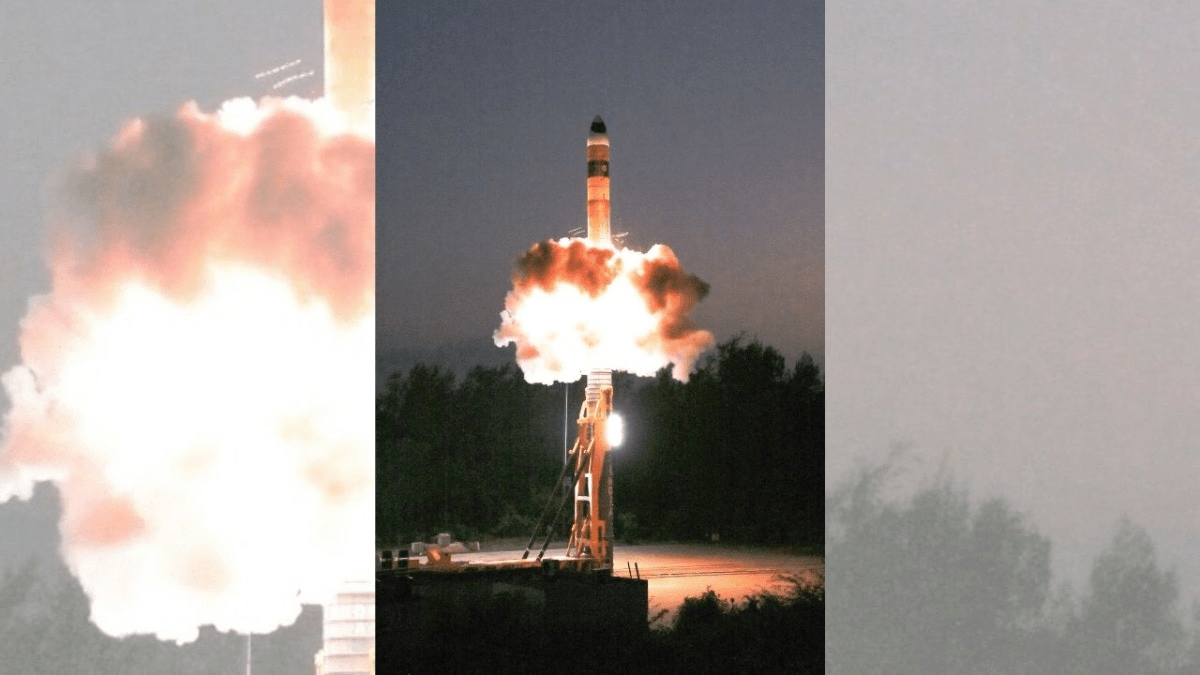
Now the global strategic balance has shifted as India cements its place among the world’s most advanced military powers. The Defence Research and Development Organisation (DRDO) recently conducted a successful test of the advanced MIRV version of the Agni-5 missile from Dr. APJ Abdul Kalam Island. Therefore, this development marks a significant leap in India’s long-range strategic capability, allowing a single missile to engage multiple, independent targets simultaneously. Meanwhile, by mastering this technology, India joins an elite group including the United States, Russia, China, France, and the United Kingdom.
Also Read | Imran Khan and Bushra Bibi Sentenced to 17 Years in Jail
What is MIRV Technology? The End of Single-Target Missiles
Now the fundamental concept of missile warfare has been rewritten. MIRV stands for Multiple Independently Targetable Re-entry Vehicle. Therefore, instead of a single missile carrying one warhead to one city, a single Agni-5 can now carry several nuclear warheads.
First, each of these warheads can be directed toward a separate target located hundreds of kilometers apart. Next, each warhead can weigh up to 400 kilograms, ensuring significant impact. Thus, the current configuration allows for 4-5 warheads, with experts predicting a future expansion to 12.
So this system changes the basic idea of missile use. Meanwhile, the ability to strike multiple spatially distributed locations makes the Agni-5 a versatile asset in any modern conflict. Therefore, the MIRV breakthrough represents a mechanical necessity for modern strategic defense.
Strengthening Second-Strike Capability: Nuclear Deterrence in 2026
Now the primary purpose of the MIRV-enabled Agni-5 is to enhance India’s second-strike capability. This is a core element of nuclear deterrence, ensuring that the country retains the ability to respond even after absorbing an initial strike. Therefore, the presence of multiple warheads ensures that a retaliatory strike is devastating.
First, the system’s resilience is its most impressive feature. Next, even if an enemy intercepts some warheads, others are likely to reach their intended targets. Thus, it becomes nearly impossible for existing missile defense systems to fully neutralize an incoming Agni-5 attack.
So the psychological impact on potential adversaries is immense. Meanwhile, the reliability of the second-strike ensures that the “No First Use” policy remains a credible pillar of national security. Therefore, the MIRV test is a vital step in maintaining regional peace through strength.
The 90-Degree Manoeuvre: Bypassing Advanced Radar Networks
Now during the recent test, the missile executed a sharp 90-degree manoeuvre mid-flight. This complex movement is extremely difficult for conventional interception systems to track or predict. Therefore, the Agni-5 can effectively “dance” through defensive radar networks.
First, this ability to change direction unpredictably adds a layer of stealth to the missile’s trajectory. Next, it allows the payload to bypass known anti-ballistic missile (ABM) batteries. Thus, the technology represents the absolute cutting edge of precision navigation and guidance.
So the manoeuvre ensures that the re-entry vehicles reach their targets regardless of enemy defenses. Meanwhile, the complex algorithms required for such a movement highlight the maturity of India’s aerospace software. Therefore, the Agni-5 is not just a missile; it is a smart, maneuvering platform.
Also Read | Imran Khan and Bushra Bibi Sentenced to 17 Years in Jail
Indigenous Innovation: Carbon Composites and Weight Reduction
Now the success of the MIRV program is rooted in long-term indigenous scientific effort. The DRDO has utilized high-precision sensors and composite materials to reduce the missile’s weight by nearly 20 percent. Therefore, the Agni-5 is faster and more efficient than its predecessors.
First, carbon composites are used to protect the warheads from extreme heat during re-entry. Next, indigenous avionics and pressure systems ensure that the payload separation is highly accurate. Thus, India has reduced its reliance on foreign high-tech components for its strategic arsenal.
So the integration of decoy systems further complicates the enemy’s defense efforts. Meanwhile, the use of oxidizer components developed within India reflects the “Atmanirbhar” approach to defense. Therefore, the Agni-5 is a testament to the engineering prowess of the DRDO laboratories.
Strategic Reach: Covering Northern China and the Indian Ocean
Now the strategic implications of this test are felt across the entire Asian continent. With a range of 5,000 to 8,000 kilometers, the Agni-5 provides India with a reach that covers large parts of the region. Therefore, northern parts of China and the entirety of the Indian Ocean are now within striking distance.
First, the test comes as China’s People’s Liberation Army (PLA) expands its own missile capabilities. Next, the increasing maritime activity in the Indian Ocean requires a land-based deterrent that can reach deep into the sea. Thus, the Agni-5 adds much-needed depth to India’s deterrence posture.
So the missile ensures that India can protect its interests far beyond its immediate borders. Meanwhile, the ability to deliver multiple warheads ensures that a single launch can cover multiple strategic points. Therefore, regional stability is bolstered by India’s newfound strategic reach.
Future Roadmap: From Agni-6 to Hypersonic Glide Vehicles
Now the MIRV Agni-5 is just one part of a much larger defense roadmap. India is simultaneously working on several advanced projects, including the Agni-6 missile. Therefore, the future of Indian ballistics is moving toward intercontinental ranges.
Upcoming Advanced Projects:
-
Agni-6: Projected range of up to 12,000 kilometers.
-
Hypersonic Glide Vehicles: Capable of speeds exceeding Mach 5.
-
K-Series: Advanced submarine-launched ballistic missiles.
-
Anti-Satellite Systems: Protecting India’s assets in space.
First, these programs reflect an approach that includes multi-domain operational readiness. Next, the development of AI-based warfare systems will further enhance these physical platforms. Thus, India is building a defense network that is ready for the challenges of the late 2020s.
Also Read | Imran Khan and Bushra Bibi Sentenced to 17 Years in Jail
Global Geopolitics: Technological Strength Over Conventional Power
Now in today’s geopolitical environment, military strength is no longer defined only by the number of soldiers. Technological capability in areas such as missiles, space systems, and cyber tools is becoming equally important. Therefore, India is working to establish itself in this changing global environment.
First, the MIRV test shows that India is prioritizing strategic capability over mere regional defense. Next, the focus on indigenous technology development ensures long-term sovereignty over the nation’s defense tools. Thus, the 2026 breakthrough is a signal of India’s maturing status as a global power.
So the transition to high-tech warfare is a primary focus for the government. Meanwhile, the synergy between the military, DRDO, and industry partners is at an all-time high. Therefore, the Agni-5 MIRV success is a milestone that defines India’s defense policy for the coming decade.
FAQ: Understanding India’s MIRV Breakthrough
1. What is the main advantage of MIRV technology? Now, the main advantage is that a single missile can hit multiple, independent targets, making it much harder to intercept.
2. How many warheads can the Agni-5 carry? First, the current version can carry 4-5 warheads. Next, experts believe this can be increased to 12 in the future.
3. What is the range of the Agni-5? So the missile has a range between 5,000 and 8,000 kilometers, covering most of Asia and the Indian Ocean.
4. Why did the missile perform a 90-degree manoeuvre? Next, this complex movement allows the missile to bypass radar networks and anti-ballistic missile defenses.
5. Which other countries have MIRV technology? Now, only the US, Russia, China, France, and the UK possess this technology, with India now being the sixth member.
6. What is the Agni-6? Finally, it is a missile currently under development that is expected to have a range of up to 12,000 kilometers.
Also Read | Imran Khan and Bushra Bibi Sentenced to 17 Years in Jail
End..

