

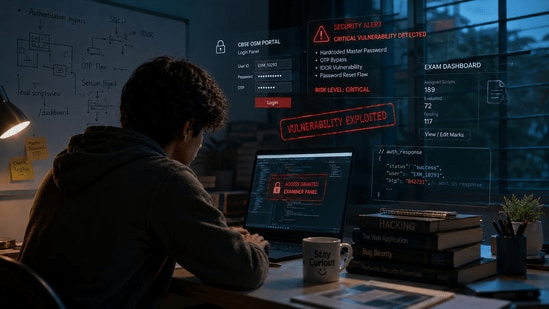
Now the digital safety framework of India’s largest national secondary education board faces a profound institutional legitimacy crisis. A massive cloud storage misconfiguration has exposed confidential student evaluation records to the open internet this weekend. Therefore, the immediate structural fallout has put the entire CBSE data security under the scanner of federal cybersecurity watchdogs.
Meanwhile, this fresh administrative crisis follows widespread student complaints regarding arbitrary marking distributions across high-density academic streams. An ethical hacker publicly demonstrated that millions of scanned answer scripts were floating on public servers completely devoid of basic encryption filters. Still, restoring student data privacy requires executing immediate emergency migrations to secure government infrastructure blocks.
The technical credibility of the country’s premier testing system has hit a multi-year low point.
Also Read | Imran Khan and Bushra Bibi Sentenced to 17 Years in Jail
How an Ethical Hacker Exposed the Cloud Storage Vulnerability
Now central digital safety protocols are undergoing an aggressive public audit by independent research teams. The comfortable assumptions that previously shielded the state-run testing boards from facing deep technical scrutiny have dissolved completely. Therefore, the fast disclosure of open document directories has put the CBSE data security under the scanner of global privacy compliance boards.
So the alarming vulnerability came to light early Sunday morning across public digital communication networks. A prominent security analyst operating under the handle Nisarga printed undeniable visual proof of the system’s structural weaknesses. Meanwhile, the researcher posted 18 exact copies of scanned answer scripts obtained straight from the source. Thus, the exposure left administrative heads with zero room to deny the incident.
“The cloud repositories lacked even the most basic layer of credential verification,” the researcher noted inside his public summary sheets. Therefore, random internet users could scroll through and harvest private student metrics without triggering any automated system defense alerts.
Exposing Institutional Negligence
First, the published data chunks proved that the security failure was not a complex, highly targeted state-sponsored cyber-attack vector. Instead, the incident stemmed from pure, unadulterated engineering carelessness during the initial setup phase of the board’s digital transformation program. Therefore, the network stood completely unprotected for months.
Next, look at the staggering scale of the exposure loop. The shared cloud architecture hosted paper folders belonging to multiple prominent educational institutions concurrently. Thus, a single configuration mistake compromised the private documentation files of nearly eighteen lakh children across states.
Finally, local education unions are organizing emergency coordination camps to evaluate individual student legal choices today. They realize that allowing public access to identity metrics violates baseline student data privacy charters. Therefore, public pressure is scaling up rapidly across major cities. Period.
The Institutional Defensive Crouch
So senior board officials spent the first few hours attempting to minimize the significance of the researcher’s findings. They claimed that the core database mainframes holding final official score sets remained fully insulated from the external cloud leak. Still, losing control of raw answer scripts represents a massive structural compliance failure for any national board.
Now let’s break down the exact software parameters that caused the leak.
The Simple Mechanics of the AWS Bucket Misconfiguration
Now let’s clear up a major public misconception regarding modern cloud storage breaches. Many everyday savers believe that hackers must execute highly complex coding lines to break into secure corporate bank vaults. Wrong.
Instead, the reality that put the CBSE data security under the scanner involves the complete omission of standard access control settings. The board’s technical team utilized an Amazon Web Services S3 resource bucket to store scanned digital copies of Class XII exam books. However, they left the root folder parameters configured to a public settings mode. Therefore, the cloud system treated incoming global internet requests exactly like authorized administrative commands.
Meanwhile, this basic misconfiguration allowed anybody to run the simple ListObjectsV2 command line without entering any password verification tokens.
The Pagination Loophole Explained
First, consider how object-based data architectures manage large quantities of files. Instead of sorting scripts into isolated, protected local system folders, the cloud platform aggregates data into simple independent units called objects. Therefore, when the root remains listable, an outside program can effortlessly map the entire structural sequence of the directory. Period.
Next, look at how the lack of authentication options enabled mass enumeration routines. An automated script could paginate through the entire 2026 data collection systematically, pulling down questions and answer scripts simultaneously. Thus, malicious actors could download entire institutional blocks of booklets within hours.
Finally, the technical documentation reveals that the cloud bucket lacked active transport layer security encryption defenses. The files traveled across open internet pathways as plain media files, leaving them fully vulnerable to local intercept networks. Therefore, the engineering layout violated all standard data protection rules. Period.
The Vendor Selection Disaster
So independent systems engineers are questioning why a major national board trusted such a weak architecture to manage critical merit tokens. The system lacked basic network segregation walls to isolate student files from open web access channels. Thus, the current crisis stems directly from poor platform architecture choices.
The Board Blames Its External Technological Service Provider
Now the administrative leadership is executing rapid damage control maneuvers to redirect public anger away from its own offices. The central board published an official statement late Sunday to clarify its institutional stance regarding the cloud storage failure. Therefore, the organization is placing the absolute bulk of the accountability straight onto its external technology vendor.
Targeting COEMPT Hyderabad
First, the board pointed directly to the Hyderabad-based software firm, COEMPT, which secured the lucrative technical support contract for the current evaluation cycle. The firm developed and managed the custom “OnMark” software portal used by examiners to log candidate marks. Therefore, the board asserts that the cloud storage security lapses belong exclusively to the vendor’s private development teams.
So if we track the official corporate statements:
-
Actively monitoring the precise operational vulnerabilities flagged within the public domain
-
Admitting that the vendor’s platform features exploitable system weaknesses
-
Initiating immediate forensic audits to check for unauthorized data downloads
The response fails to explain why the board’s internal audit teams approved the vendor’s platform layout during early testing phases.
Evading Direct Board Responsibility
Next, look at how the board’s communication desk avoids using words that imply direct institutional guilt. The official social media updates frame the board as a monitoring entity rather than the primary custodian of student files. Thus, they attempt to preserve their legal insulation while the vendor faces intense scrutiny.
So this finger-pointing strategy is drawing immense heat from opposition political leaders. Critics explain that a public board cannot simply outsource its ultimate constitutional duties to a private third-party contractor. Therefore, the political atmosphere surrounding the education ministry remains exceptionally tense.
Also Read | Imran Khan and Bushra Bibi Sentenced to 17 Years in Jail
Government Deploys Special IIT Teams to Secure the Portals
Now the extreme gravity of the cloud data leak has forced top-tier structural interventions from central IT ministries. The state cannot afford to let public panic destroy the legitimacy of the national evaluation metrics completely. Therefore, a specialized team of government cybersecurity professionals has taken full control of the vendor’s infrastructure logs.
The Elite Technical Takeover
First, the Ministry of Education coordinated with the premier Indian Institutes of Technology to deploy their top data scientists to the rescue desk. These computing specialists are manually reviewing every open configuration line inside the OnMark web portal. Therefore, the vendor’s private software teams have been completely sidelined from leading the recovery process.
Next, look at the immediate triage measures executed over the last 24 hours. The joint technical squad successfully deactivated the misconfigured public AWS bucket links to block further data extraction loops. Thus, the identified public vulnerabilities have been safely contained for now.
Then, the team is migrating the entire student data catalog over to the highly secure, state-managed National Informatics Centre servers. This government infrastructure features rigid security walls and constant perimeter monitoring systems. Therefore, the student scripts will finally receive proper enterprise-grade data protection.
Why Computer Science Experts Demand an Institutional Apology
Now leading figures within the country’s technology education community are expressing deep outrage over the board’s casual handling of the crisis. They assert that the official statements fail to respect basic global standards regarding personal data privacy rights. Therefore, academic leaders are demanding a full public apology from the board’s upper management.
The Professor’s Indictment
First, retired IIT Kharagpur computer science professor Rajeev Kumar launched a highly critical review of the board’s handling of the crisis. He explained that the board’s defensive statements do not amount to an honest acceptance of administrative failure. Therefore, the current messaging fails to comfort worried families.
Next, look at the strict privacy parameters that the board systematically ignored during this rollout. The professor highlighted that an answer script functions as a highly sensitive personal data asset that carries an individual’s lifetime merit tokens. Thus, any configuration that lets a random student access another candidate’s script represents a catastrophic systemic breach.
Then, Kumar added that this structural failure reflects incredibly poorly on the nation’s technical leadership capabilities. When a major public school board fails to handle a simple cloud storage permission setting, it damages the country’s global software reputation. Therefore, the academic elite is demanding complete leadership changes at the top desk.
The Mobile Phone Scanning Scandal and Material Faults
Now the ongoing data security investigation has uncovered a secondary, even more shocking operational scandal regarding the physical handling of the scripts. The leaked answer sheet copies posted by online researchers featured distinct visual anomalies like paper folds and heavy drop shadows. Therefore, these material artifacts provide clear proof that the vendor violated the strict terms of the original government contract.
The Shift from Robotic Scanners to Phones
First, senior political leaders disclosed that the board’s initial May 2025 tender documents mandated the exclusive use of automatic robotic scanning machines. The contract rules required keeping book spines intact while capturing images at a crisp minimum resolution of 300 DPI. Therefore, the initial design promised perfect digital copies for on-screen examiners.
Next, a mysterious structural modification happened during the re-issuance of the contract documents in August. The strict robotic machine mandates vanished from the text, and the required scan resolution dropped down to a soft 200 DPI indicator. Thus, the contract framework was systematically altered to accommodate a low-capability vendor.
Then, independent forensic analysis confirms that the contractor ultimately scanned thousands of student answer sheets using cheap mobile phones instead of professional industrial scanners. This manual process generated blurry text zones, dark shadow fields, and completely missed pages across booklets. Therefore, the actual evaluation work was doomed from the start.
Also Read | Imran Khan and Bushra Bibi Sentenced to 17 Years in Jail
The Nightmare of Swapped Scripts and Evaluation Failure
Now the human cost of this multi-layered technological breakdown is hitting hundreds of thousands of student households across the country. The deployment of the blurry mobile scans made accurate evaluation an absolute impossibility for on-screen examiners. Therefore, the country is witnessing an unprecedented, across-the-board collapse in Class XII final scores this term.
The Horror of Swapped Identities
First, at least two separate students have filed formal legal affidavits alleging that their physical answer sheets were completely swapped with other candidates. The board has been forced to acknowledge these catastrophic administrative errors in writing. Therefore, families are living through a true nightmare where their children’s hard work is credited to random strangers.
Next, look at the immense financial and emotional burden falling on ordinary parents today. To protect their children’s university admission chances, families must pay steep fees to request physical copies of their scripts for review. Thus, household savings are draining away into checking basic data errors that the board should have caught internally.
Then, the fear of systemic corruption is destroying the mental wellness of young scholars nationwide. Students feel that their months of intense 14-hour study routines are entirely useless within a broken, vendor-driven framework. Therefore, local child welfare groups are recording record volumes of anxiety distress entries this week.
The Total Paralysis Hitting Re-Evaluation Digital Counters
Now let’s conclude by evaluating the complete operational breakdown of the board’s secondary remediation platforms. Siders attempting to use official online tools to request script reviews are meeting a wall of broken server lines daily. Therefore, the administrative pathways for seeking legal corrections remain completely blocked this morning.
The Dead Re-Evaluation Loop
First, the primary portal designed to let students apply for verified script copies functioned with terrible inconsistency throughout the week. Senders encountered continuous timeout drops and database communication failures right at the payment step. Therefore, thousands of urgent applications failed to register before critical deadlines.
Next, look at the specialized secondary portal built to handle formal marks re-evaluation challenges. That critical system framework has completely failed to launch or begin basic operations since the scores dropped. Thus, the board has effectively locked out students from exercising their statutory rights to challenge unfair marks.
Then, the education ministry’s ongoing silence is transforming public frustration into absolute political rage across states. Citizens demand the immediate removal of the technology vendor alongside a complete cancellation of the current flawed on-screen marking system. Until the state implements ironclad data security walls, the structural credibility of the entire national examination system stays frozen. End of story.
Frequently Asked Questions
Now let’s resolve immediate questions from parents and students regarding the major CBSE data security controversy. These answers explain leaks, scanning metrics, and portal updates clearly. Therefore, read them carefully.
Why is the CBSE data security under the scanner of cybersecurity watchdogs? The board’s security system faced an intense breakdown after an ethical hacker exposed an open, unprotected AWS storage bucket. This engineering mistake allowed anybody on the internet to paginate, view, and download millions of confidential 2026 Class XII answer sheets without entering a password.
What specific software vulnerability enabled the mass download of student scripts? The external technology vendor left the root configuration of their Amazon S3 storage bucket completely listable and public. Because the ListObjectsV2 command lacked any authentication check filters, external script programs could easily enumerate and extract raw booklet files.
Who is the technology vendor responsible for managing the student portal? The board contracted its high-stakes on-screen marking operations to a Hyderabad-based software company called COEMPT. The firm developed the “OnMark” portal, which is now undergoing a full forensic investigation by government cybersecurity units. Therefore, the vendor faces intense heat.
Is it true that student answer sheets were scanned using mobile phones? Yes. Independent analysis of the leaked booklets revealed distinct paper folds and heavy drop shadows associated with mobile phone cameras. This manual process violated early contract rules that required using automated robotic scanners at a high 300 DPI resolution.
What are the primary consequences of poor scan quality on student marks? The blurry mobile images, low 200 DPI resolutions, and dark shadow fields made accurate on-screen evaluation impossible for examiners. This resulted in missed pages, erroneous evaluations, an across-the-board plunge in student scores, and verified instances of swapped scripts.
What steps is the government executing to fix the cloud security leak? The Ministry of Education deployed an expert team of data scientists from various government arms and the IITs to take full control of the infrastructure. They have contained the open bucket links and are moving the entire student database over to secure state-managed servers.
Why are the official online channels for re-evaluation failing to work? The board’s digital remediation infrastructure has suffered a complete operational breakdown under the heavy weight of concurrent traffic. The primary application portal runs with constant database timeout loops, while the formal marks re-evaluation system has completely failed to initiate service.
Also Read | Imran Khan and Bushra Bibi Sentenced to 17 Years in Jail
End…

