

Regional Friction: 23 Opposition Parties Convene for High-Stakes INDIA Bloc Delhi Meeting Under Shadow of Absences
The “Janbandhan” summit at the Constitution Club seeks a unified narrative on household budgets and election integrity, even as the DMK skips the huddle and Left leaders voice open discontent.
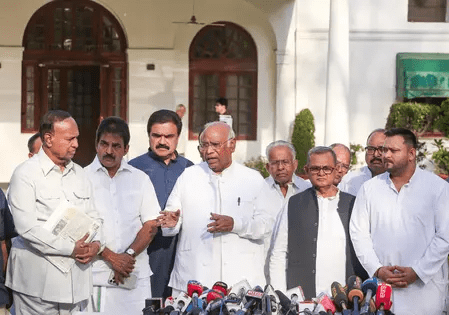
The fragmented architecture of India’s opposition coalition is undergoing a vital stress test today. Representatives from 23 political parties have formally descended upon the Constitution Club in the national capital to participate in the high-stakes INDIA bloc Delhi meeting. Branded officially as the “INDIA janbandhan” session, the emergency huddle was called to establish a shared legislative strategy against the ruling government and map out initial logistical coordination for the distant 2029 Lok Sabha general elections.
However, the display of absolute opposition unity is facing immediate internal headwinds. The Tamil Nadu ruling entity, Dravida Munnetra Kazhagam (DMK), has completely stayed away from the central venue, choosing not to send a senior ministerial delegation. Concurrently, top-tier Left front leaders have openly expressed severe dissatisfaction regarding recent unilateral state-level policy decisions and seat-sharing posturing executed by larger constituent parties within the alliance framework.
Also Read | Imran Khan and Bushra Bibi Sentenced to 17 Years in Jail
Mapping the Friction Axis within the Janbandhan
The central huddle arrives at a deeply polarized juncture for the opposition camp. According to internal party desks, the momentum to call today’s meeting was driven primarily by the Trinamool Congress (TMC). West Bengal Chief Minister Mamata Banerjee and TMC National General Secretary Abhishek Banerjee flew into the capital early Monday morning, proceeding straight to the venue to lead the regional council block.
Attempting to control the narrative regarding the empty seats at the conference table, Congress General Secretary in charge of Communications, Jairam Ramesh, clarified that missing delegations should not be confused with systemic ideological abandonment.
“There are some parties that have expressed their inability to attend this particular meeting for their own reasons,” Ramesh broadcasted via his official account on X. “Even though they have conveyed their strong opposition to the Modi government’s policies, they remain unified with our long-term intent.”
The Collective Policy Grievance Ledger
To build a shared platform that transcends individual state rivalries, the participating leaders have focused their agenda on structural and macroeconomic weaknesses.
| Strategic Policy Vector | Alliance Grievance Matrix | Proposed Joint Legislative Action |
| Electoral Integrity | Allege institutional actions are systematically diluting voting rights across vulnerable demographics. | Demand immediate parliamentary reviews into polling infrastructure. |
| Federal Agency Audits | Continuous deployment of central investigative bureaus against regional opposition heads. | Coordinate joint legal defenses and state-level legislative blockades. |
| Household Macroeconomics | Persistent inflation breaking working-class monthly household budgets. | Launch coordinated pan-India street rallies highlighting price rises. |
| Geopolitical Stance | Accuse the executive of compromising national interests across active international borders. | Push for mandatory, closed-door national security briefings. |
Also Read | Imran Khan and Bushra Bibi Sentenced to 17 Years in Jail
Diversity vs. Operational Consensus
The primary operational challenge for the bloc remains balancing its inherent diversity with the need for a swift, unified national strategy. TMC Rajya Sabha leader Derek O’Brien attempted to highlight this balance, stating that the alliance’s true strength lies in its ability to reflect India’s regional variety. “Meeting with a common purpose and clear intent. INDIA united. Many parties look forward to meeting in the spirit of camaraderie,” O’Brien stated, endorsing the Janbandhan terminology.
Despite the optimistic public statements from the leadership, individual delegates admit that behind-the-scenes discussions are tense. Left party organizers remain deeply concerned that the dominant national parties are ignoring smaller regional entities when finalizing core platform policies.
As the closed-door discussions continue through Monday afternoon, the final resolution will reveal whether the group can build a disciplined, functional command structure capable of turning local state victories into a viable national alternative.
FAQ Section
Why was the INDIA bloc Delhi meeting called today?
The meeting was convened at the Constitution Club in New Delhi to address growing internal strains, re-align the opposition’s common political strategy against the central government, and begin early discussions for the 2029 Lok Sabha elections.
Why did the DMK skip the opposition meet?
While the DMK leadership has not released a formal statement detailing their absence, Congress organizers clarified that the Tamil Nadu ruling party could not attend due to pressing state-level commitments. They emphasized that the DMK remains fully committed to the alliance’s core goals.
What are the main points on the opposition’s agenda?
The Janbandhan agenda focuses on seven key national issues: rising household inflation, protection of constitutional frameworks, alleged misuse of federal investigative agencies against opposition figures, youth unemployment, investment challenges, and perceived lapses in foreign policy.
Also Read | Imran Khan and Bushra Bibi Sentenced to 17 Years in Jail
End…

