

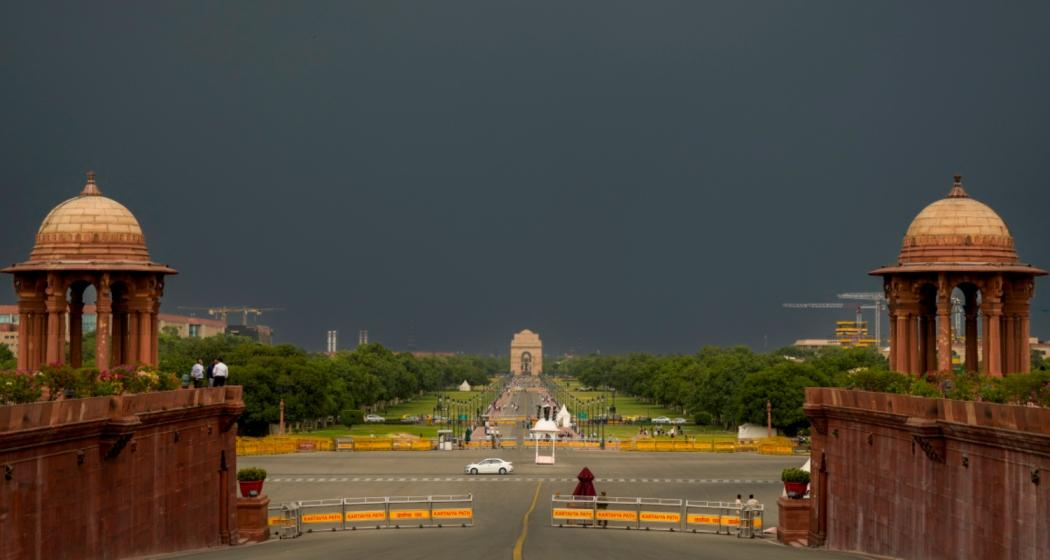
While incoming non-monsoonal storm fronts keep peak daytime temperatures locked at 40°C, stagnant local air cells continue to trap urban dust and vehicle emissions, pinning the city’s regional air quality firmly inside the “poor” category.
The massive subcontinental weather systems and local microclimates that regulate summer heatwaves, manage public utility demands, and impact environmental safety metrics across the capital region have entered an unstable phase. Issuing an urgent morning update on Tuesday, June 23, 2026, the India Meteorological Department (IMD) delivered its latest Delhi weather alert IMD gusty winds dispatch. The warning notes that an active weather system moving over North India will trigger sudden thunderstorms, lightning strikes, and high-speed wind gusts across New Delhi, Noida, Gurugram, and Ghaziabad through June 25.
The multi-day weather alert highlights a complex atmospheric pattern affecting several states.
Beyond the immediate boundaries of the National Capital Region (NCR), the federal advisory extends severe weather tracking to Punjab, Haryana, Chandigarh, Uttarakhand, Andhra Pradesh, Chhattisgarh, Gujarat, Tamil Nadu, and Jammu and Kashmir.
Concurrently, extreme heavy rainfall alerts are in effect across the northeastern hills of Assam and Meghalaya, alongside Sub-Himalayan West Bengal and Sikkim, as intense monsoon currents dump heavy water volumes on mountain communities.
Also Read | Imran Khan and Bushra Bibi Sentenced to 17 Years in Jail
The Climatological Division: Active Mountain Disturbance vs. Peninsular Monsoon
The wind bursts and scattered rain showers hitting the capital this week are not driven by the humid, equatorial winds of the southwest monsoon. Instead, the sudden shifts are fueled by a series of active Western Disturbances—low-pressure storm systems that originate over the Mediterranean Sea and travel across northern India along high-altitude jet streams.
While these northern storm systems bring welcome relief from intense summer sun, they lack the sustained, moisture-heavy energy needed to break the seasonal heat permanently.
The IMD projects that daytime maximum temperatures at the Safdarjung base station will climb to 40°C on Tuesday, while nighttime minimums settle comfortably around 25°C.
The persistent cloud cover will successfully block extreme heatwaves, but the dry, gusty winds will continue to whip up loose topsoil before the true monsoon arrives.
Slicing Through the Regional Temperature and Air Quality Grid
Because the isolated showers are scattered unevenly, air quality tracking stations show a highly fragmented pollution pattern across various residential and industrial sectors:
| Monitored Capital Sector Hub | Recorded Air Quality Index (AQI) | Active Local Pollution Category | Targeted 48-Hour Microclimate Outlook |
| Anand Vihar Transport Hub | 246 Absolute Score | Poor Quality Status | Heavy dust tracking; high risk of sudden evening wind storms. |
| Wazirpur Industrial Area | 185 Absolute Score | Moderate Quality Status | Cloudy skies with brief, gusty wind bursts toward midnight. |
| Pusa Research Farms | 173 Absolute Score | Moderate Quality Status | Light passing sprinkles; high humidity loops across crops. |
| IIT Delhi Campus Zone | 166 Absolute Score | Moderate Quality Status | Partly cloudy layout; minor local drops in daytime heat. |
| RK Puram Residential | 165 Absolute Score | Moderate Quality Status | Mild evening gusts; temperature capped near 38°C baseline. |
| Patparganj Sector Zone | 154 Lowest Score Recorded | Moderate Quality Status | Cleanest sector air profile; benefits from fast ridge winds. |
Also Read | Imran Khan and Bushra Bibi Sentenced to 17 Years in Jail
The Monsoon Disconnect: Mumbai Soaks While Delhi Waits
While the capital relies on mountain-driven winds for temporary relief, the southwest monsoon has successfully regained its footing along the western coast.
After a concerning two-week stall that threatened subcontinental crop planting schedules, the primary rain system has charged across Maharashtra.
The underlying text of the IMD tracking logs shows that Mumbai has been hit by steady, heavy showers since early morning, bringing much-needed relief to the coastal metropolis.
However, this coastal surge has not yet translated into northern progress.
With the monsoonal front still stuck down country, Delhi’s seasonal deficit continues to expand, forcing city planners to carefully manage local water networks as the official arrival date shifts into early July.
Five Sequence Steps Residents Must Execute to Secure Homes Against High Winds
To protect your property from sudden wind damage, preserve your health during dusty pollution cycles, and manage your household utilities through this turbulent pre-monsoon phase, apply this safety routine:
Ultimately, navigating the volatile weather patterns detailed in the Delhi weather alert IMD gusty winds update requires keeping a close, realistic eye on changing environmental trends. While digital innovators design smart, independent networks to protect corporate data assets, regional weather scientists are focused on re-mapping shifting air currents to protect public safety.
By tracking local air quality updates, setting up power backups early, and following official safety guidelines, we can cross this extended dry spell safely.
Staying alert, optimizing your home utilities early, and adapting before the heavy storms hit ensures you can protect your property and family, keeping your household completely safe as the capital awaits its true monsoon revival.
FAQ Section
What is the core warning highlighted in the latest Delhi weather alert IMD gusty winds dispatch?
The India Meteorological Department has issued a severe weather alert for Delhi-NCR running through June 25, 2026. The regional forecast warns of sudden thunderstorms, frequent lightning strikes, and high-speed wind gusts at isolated locations, offering temporary relief from the summer heat.
Why is the capital region’s air quality staying poor despite the forecast of thunderstorms?
The current air pollution issue stems from a lack of continuous, heavy rain. The passing western disturbances bring brief wind storms and light, scattered showers, which stir up fine topsoil and trap vehicle emissions close to the ground rather than delivering the thorough, heavy wash needed to clear out the regional air basin.
How is the southwest monsoon progressing across the rest of the country?
The southwest monsoon has successfully broken out of its two-week stall, gaining significant momentum across western India. While Mumbai and broader Maharashtra are receiving steady, heavy morning showers, the main rain front remains far south of the capital, pushing Delhi’s true monsoon arrival into early July 2026.
Also Read | Imran Khan and Bushra Bibi Sentenced to 17 Years in Jail
End…

