

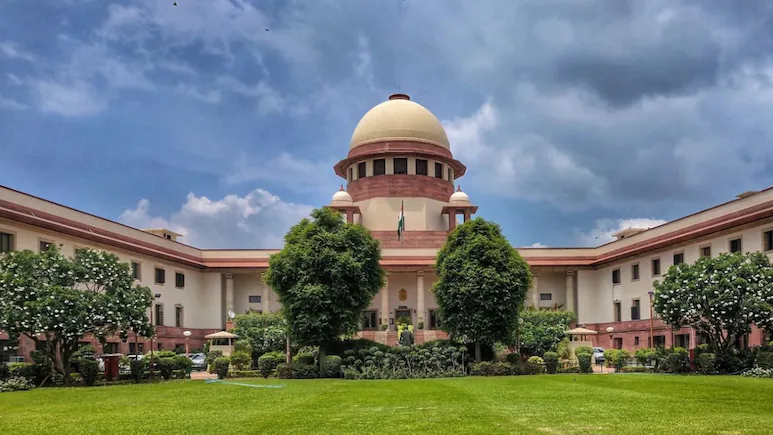
A two-judge bench stays a Madras High Court directive that completely bypassed the state’s existing statutory framework, restoring the provisions of the 1958 state animal preservation law.
NEW DELHI — In a major legal and political victory for the newly formed state government, the Supreme Court of India on Monday granted interim relief by staying a Madras High Court directive that sought to enforce a total prohibition on the slaughter of cows and calves across Tamil Nadu.
Also Read | “Ghar Ki Baat Ghar Pe Rakho”: Sunita Ahuja Quits ‘Lock Upp 2’ and Drops a Massive Bollywood Launch Bomb!
A division bench comprising Justice Vikram Nath and Justice Sandeep Mehta issued notices to the original respondents after admitting the state government’s challenge. The apex court explicitly observed that the High Court’s previous sweeping directive required immediate “correction” and put its enforcement on hold until further judicial proceedings.
1. The Core Conflict: Statutory Law vs. Judicial Overreach
The legal dispute stems from a petition filed by Surya, the state general secretary of the Indu Makkal Katchi, who approached the Madras High Court seeking to prevent unauthorized animal slaughter in public spaces.
However, on May 27, a High Court bench composed of Justice GR Swaminathan and Justice V Lakshminarayan went significantly further than the initial prayer. While ruling that animal slaughter must only take place in officially authorized facilities, the bench unexpectedly ordered state authorities to guarantee that no cow or calf be slaughtered on the eve of Bakrid “or on any other day.”
The Contradiction Flagged by Tamil Nadu:
⚖️ State Law (1958 Act) ➔ Allows regulated slaughter under strict statutory exemptions.
🚫 High Court Order ➔ Imposed an absolute, blanket prohibition bypassing those exemptions.
The state government approached the Supreme Court roughly two weeks ago, arguing that the High Court’s total ban directly conflicted with pre-existing state legislation.
Also Read | “Ghar Ki Baat Ghar Pe Rakho”: Sunita Ahuja Quits ‘Lock Upp 2’ and Drops a Massive Bollywood Launch Bomb!
2. Understanding the Tamil Nadu Animal Preservation Act, 1958
In its appeal to the top court, the state administration argued that the High Court had exceeded its jurisdiction by rendering an established state law completely obsolete. Under Section 4 of the Tamil Nadu Animal Preservation Act, 1958, the slaughter of cattle is not under a blanket ban but is explicitly permitted under specific, strictly monitored conditions.
Statutory Framework: When Cattle Slaughter is Legally Permitted in TN
| Legal Criteria under 1958 Act | Required Official Documentation | Constitutional Context Assessed |
| Age Threshold: The animal must be verified as over 10 years of age. | Competent Authority Certificate: A formal, certified authorization must be issued by state inspectors prior to any processing. | Article 48 (DPSP): Directs the state to organize agriculture and animal husbandry, advising the prohibition of milch and draught cattle slaughter. |
| Agricultural Fitness: The animal must be certified as completely unfit for breeding or intensive farm work. | Strict Compliance: The High Court observed that these certifications are mandatory and cannot be bypassed under any circumstances. | Enforceability: Legal experts note that Directive Principles (DPSPs) serve as governance guidelines but are not directly enforceable by courts. |
3. Political Implications for the State Administration
The timely intervention by the top court serves as a major administrative victory for the state government. The state’s legal counsel argued that the High Court’s sweeping order created an “internally contradictory” situation, attempting to regulate slaughterhouse protocols on one hand while completely forbidding the underlying activity on the other.
Procedural Timeline of the Legal Challenge
The path of the litigation outlines how a localized public petition quickly transformed into a landmark constitutional evaluation at the Supreme Court.
Also Read | “Ghar Ki Baat Ghar Pe Rakho”: Sunita Ahuja Quits ‘Lock Upp 2’ and Drops a Massive Bollywood Launch Bomb!
By putting the High Court’s decision on hold, the Supreme Court has successfully restored the legal status quo in Tamil Nadu. The state will continue to be governed by the regulatory checks and certification balances established under its 1958 animal preservation legislation while the apex court reviews the broader merits of the case.
Also Read | “Ghar Ki Baat Ghar Pe Rakho”: Sunita Ahuja Quits ‘Lock Upp 2’ and Drops a Massive Bollywood Launch Bomb!

