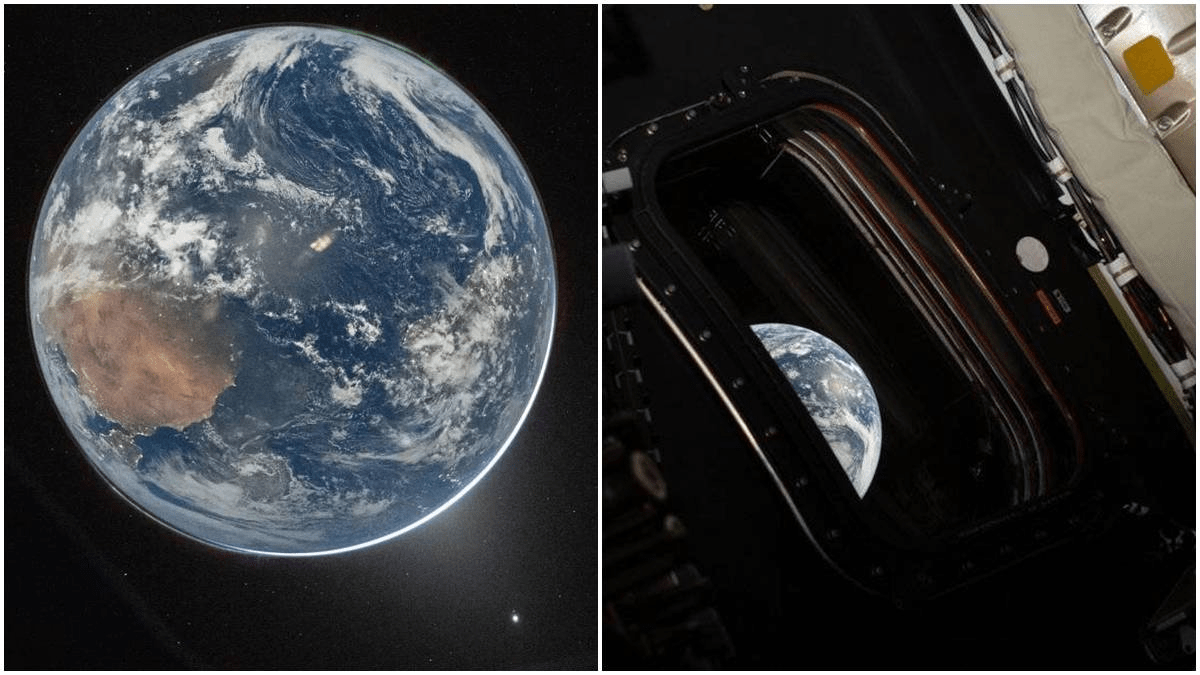
Now the Artemis II mission is rewriting the history of space photography. The Orion spacecraft recently sent back a series of breathtaking visuals that feel like science fiction. Therefore, GoPro is making massive headlines alongside NASA today. These cameras captured a rare solar eclipse featuring the Moon, Saturn, and Mars in a single frame. Meanwhile, the crew provided a humbling view of Earth as a tiny crescent. These Artemis II GoPro moon photos tell a story of a journey very few will ever take.
Also Read | Imran Khan and Bushra Bibi Sentenced to 17 Years in Jail
A Solar Eclipse Like Never Before
Now let’s talk about the standout image from the collection. One photo shows the Moon during a spectacular solar eclipse. First, the sun’s light wraps softly around the lunar edges. Therefore, the Moon appears to glow with a hauntingly beautiful halo.
Next, GoPro revealed that Saturn and Mars also made a rare appearance. They sit quietly in the same frame as the eclipsed Moon. Thus, this shot is a once-in-a-lifetime alignment.
Meanwhile, space enthusiasts are calling it the “photo of the decade.” It shows the vastness of our solar system in a single glance. Therefore, it proves that space can put on a magnificent show for those who travel deep enough.
Earth and Moon: A Perspective Shift
So how does our home look from 238,000 miles away? Another image captures both Earth and the Moon together in a single shot. First, Earth appears as a tiny, fragile crescent. Therefore, it sits quietly near the dark horizon of the Moon.
Next, this visual serves as a powerful reminder of our planet’s smallness. It is beautiful but also deeply humbling for everyone who sees it. Thus, it reinforces the “Overview Effect” often described by astronauts.
Meanwhile, the contrast between the grey lunar surface and the blue Earth is striking. It highlights the life-sustaining beauty of our world against the void. Therefore, these photos are as much about Earth as they are about the Moon.
Meteoroid Impact Flashes: Rare Lunar Phenomena
Now things got even more interesting during the mission’s eclipse phase. The crew witnessed a phenomenon that rarely gets recorded. First, they spotted multiple impact flashes on the Moon’s dark side. Therefore, these are brief bursts of light caused by meteoroid crashes.
So what causes these flashes? Meteoroids hit the lunar surface at extreme speeds because there is no atmosphere to slow them down. Thus, the kinetic energy transforms into a visible burst of heat and light.
Meanwhile, GoPro cameras were rolling during these events. Capturing these flashes provides vital data for future lunar bases. Therefore, we now know more about the frequency of space debris hits on the Moon.
Also Read | Imran Khan and Bushra Bibi Sentenced to 17 Years in Jail
The Orientale Basin: Exploring the Lunar Far Side
Now the final set of visuals looks at the Moon’s rugged terrain. The cameras focused on the massive Orientale basin in high detail. First, this ancient crater is one of the most striking features on the Moon. Therefore, seeing it clearly is a treat for geologists.
Next, the basin stretches across both the near and far sides of the Moon. It looks like a giant bullseye made of rock. Thus, it offers a glimpse into the Moon’s violent volcanic past.
Meanwhile, the level of detail in these GoPro shots is unprecedented. You can see individual ridges and shadows inside the crater walls. Therefore, these images help mapping teams prepare for the Artemis III landing.
GoPro’s Role in Deep Space Documentation
So why use GoPro for a multi-billion dollar NASA mission? The answer lies in durability and size. First, these cameras are light enough to mount on the Orion spacecraft’s exterior. Therefore, they don’t add significant weight to the vessel.
Next, GoPro specializes in extreme environments. They can handle the intense radiation and temperature swings of deep space. Thus, they are the perfect tool for documenting the journey.
Meanwhile, the partnership allows the public to see space in 4K resolution. Most NASA cameras are built for science, not social media. Therefore, GoPro helps bridge the gap between researchers and the general public.
Artemis II: The Journey Home Begins
Now the mission has officially entered its final chapter. The Orion spacecraft has exited the Moon’s gravitational zone. Therefore, the crew is officially on its way back to Earth.
First, they used the Moon’s own gravity as a natural boost. This “slingshot” maneuver saves fuel and increases speed. Thus, the spacecraft is now cruising through the void toward a splashdown.
Meanwhile, the crew is busy analyzing the data they collected. They have completed one of the most significant space missions in decades. Therefore, the mood inside the cabin is likely one of relief and pride.
Also Read | Imran Khan and Bushra Bibi Sentenced to 17 Years in Jail
Scientific Value of High-Definition Space Imagery
So are these just “pretty space photos”? Not at all. First, every pixel provides data on the Orion spacecraft’s exterior health. Therefore, engineers can see how the hull handled the lunar environment.
Next, the images of the far side help identify potential landing sites. We need high-resolution maps for the upcoming lunar base. Thus, these photos serve a very practical purpose.
Meanwhile, the impact flash data is crucial for astronaut safety. Knowing where and when meteoroids hit helps us build better habitats. Therefore, these Artemis II GoPro moon photos are a win for science and photography alike.
What’s Next for the Artemis Program?
Now that Artemis II is almost over, eyes turn to the future. First, the success of this mission paves the way for Artemis III. Therefore, we are one step closer to putting humans back on the surface.
Next, NASA plans to establish a long-term presence on the Moon. This includes the Gateway station and a surface base camp. Thus, the lessons learned this week are vital for the next decade.
Meanwhile, international partners are joining the effort. Countries like India, Japan, and the UK are part of the Artemis Accords. Therefore, the next photos we see might feature a truly global team of explorers.
Common Questions Answered
Were these photos taken by a standard GoPro? Now no. These were specialized versions of GoPro cameras. Therefore, they were modified to survive the vacuum and radiation of space.
What is the Orientale basin? First, it is a massive multi-ring impact crater on the Moon. It looks like a target or bullseye from above.
Can we see Mars and Saturn in the eclipse photo? Next, yes. According to GoPro, both planets are visible in the background of the solar eclipse shot.
Is the Artemis II crew coming back now? So yes. The Orion spacecraft has left the Moon’s orbit. Therefore, they are currently traveling home to Earth.
How far away is the Moon in these photos? Finally, the Moon is about 238,000 miles away from Earth. Thus, the perspective makes Earth look very small.
Why did they see flashes on the Moon? These were meteoroid impacts. Since the Moon has no atmosphere, the crashes create a visible burst of light.
Also Read | Imran Khan and Bushra Bibi Sentenced to 17 Years in Jail
End….