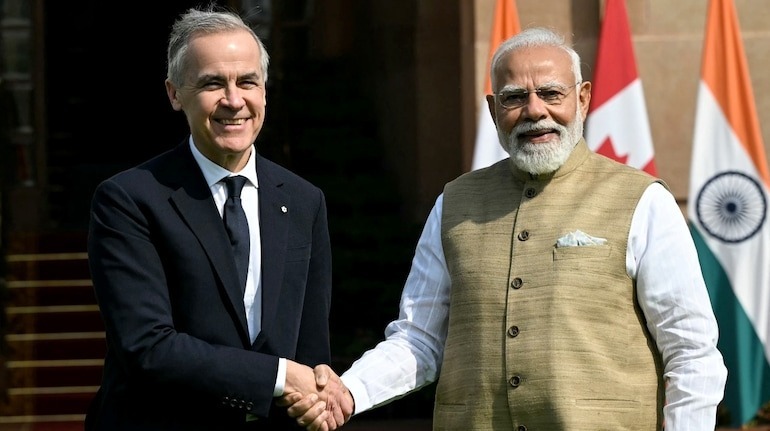
The diplomatic “free-freeze” that characterized India-Canada relations for nearly three years has officially thawed. The transition from the era of Justin Trudeau to the pragmatism of Mark Carney was solidified this week in New Delhi. Where once there were accusations and recalled diplomats, there is now a 10-year strategic roadmap focused on the “hard” sectors of the economy: nuclear energy, critical minerals, and advanced technology.
The reset is not merely a matter of personal chemistry between Prime Minister Narendra Modi and Prime Minister Carney; it is a calculated response to a global order that is rapidly becoming more fragmented and unpredictable.
Also Read | Imran Khan and Bushra Bibi Sentenced to 17 Years in Jail
From Rupture to Renaissance: The Carney Factor
Since taking office in 2025, Mark Carney has worked to decouple the “Nijjar Crisis” from the broader economic and strategic potential of the relationship.
Diplomatic Tone: Eschewing the public confrontational style of his predecessor, Carney has adopted a “steady hand” approach, focusing on shared interests like the rule of law and sovereignty.
Cultural Bridge: In a symbolic gesture, Carney referenced Swami Vivekananda’s travels in Canada, a move that resonated deeply with the Indian leadership’s vision of cultural heritage.
The $2.6 Billion Uranium Deal: Fueling India’s Future
The centerpiece of the visit was a massive commercial agreement between Saskatchewan-based Cameco and India’s Department of Atomic Energy.
The Volume: Canada will supply 22 million pounds (10,000 tonnes) of uranium ore concentrate.
Strategic Significance: This deal is critical for India’s goal to increase nuclear capacity from 9 GW to 100 GW by 2047, providing a stable supply of high-grade ore that domestic mines cannot currently match.
Also Read | Imran Khan and Bushra Bibi Sentenced to 17 Years in Jail
Trade & Technology: The CEPA and AI Initiatives
The two leaders set an ambitious target of $50 billion in bilateral trade by 2030.
CEPA Fast-Track: Terms of Reference were signed to conclude the Comprehensive Economic Partnership Agreement by December 2026.
AI & Education: A new AICTE-Mitacs MoU will fund 300 Indian students annually for research internships in Canada, while Canadian universities prepare to open satellite campuses in India.
The Trump and Iran Factors: Navigating a “Disorderly World”
Geopolitics acted as a powerful “force multiplier” for this reconciliation.
The “Trump” Pressure: Both nations are facing aggressive tariff threats from the Donald Trump administration. Carney’s recent trade maneuvers with China have drawn 100% tariff threats from the US, pushing Canada toward “middle power” allies like India.
The Iran Crisis: As the US-Israel-Iran war disrupts the Strait of Hormuz and global oil prices, the need for diversified energy (nuclear/solar) and resilient supply chains has become an existential priority for both New Delhi and Ottawa.
Also Read | Imran Khan and Bushra Bibi Sentenced to 17 Years in Jail
Reality Check
The “Renaissance” is real, but the scars of the past 30 months remain. Still, the Khalistan issue has not vanished; it has simply been moved to a specialized “security and law enforcement liaison” track. Therefore, while the economic engine is firing, any flare-up in diaspora politics could still act as a speed-breaker. In fact, the $2.6 billion deal is as much about Canada needing a market for its resources amid US trade uncertainty as it is about India needing fuel.
The Loopholes
The CEPA negotiations have a target of end-2026. In fact, this is a “Deadline Loophole”—trade deals of this complexity rarely conclude in 10 months. Therefore, expect a “limited” or “interim” trade agreement first, with the full pact pushed into 2027. Still, the “Uranium Loophole” remains; the deal is for civil nuclear use. India must keep these supplies strictly separate from its weapons program, a condition that will involve rigorous international monitoring that New Delhi has historically found sensitive.
Also Read | Imran Khan and Bushra Bibi Sentenced to 17 Years in Jail
What This Means for You
If you are a student or a tech professional, the Canada route is reopening with a focus on “high-skill” migration. First, realize that the new MoUs prioritize AI, quantum, and green energy sectors. Then, if you are an investor, understand that Canadian pension funds (which already have $110 billion in India) are now looking at highways and solar plants with renewed institutional backing.
Finally, understand that nuclear energy is the new growth pillar. You should watch for job opportunities in India’s expanding nuclear corridors in Tamil Nadu, Rajasthan, and Gujarat. Before you apply for a Canadian visa, check for the updated Indo-Pacific Scholarships announced this week, which provide significant funding for research mobility.
What’s Next
The India-Canada Renewable Energy and Storage Summit will be held later in 2026. Then, look for the first shipment of Saskatchewan uranium to arrive at Indian ports by early 2027. Finally, expect a high-level Indian industrial delegation to visit Canada in Summer 2026 to finalize the critical minerals supply chain for India’s domestic EV manufacturing.
Also Read | Imran Khan and Bushra Bibi Sentenced to 17 Years in Jail
End….