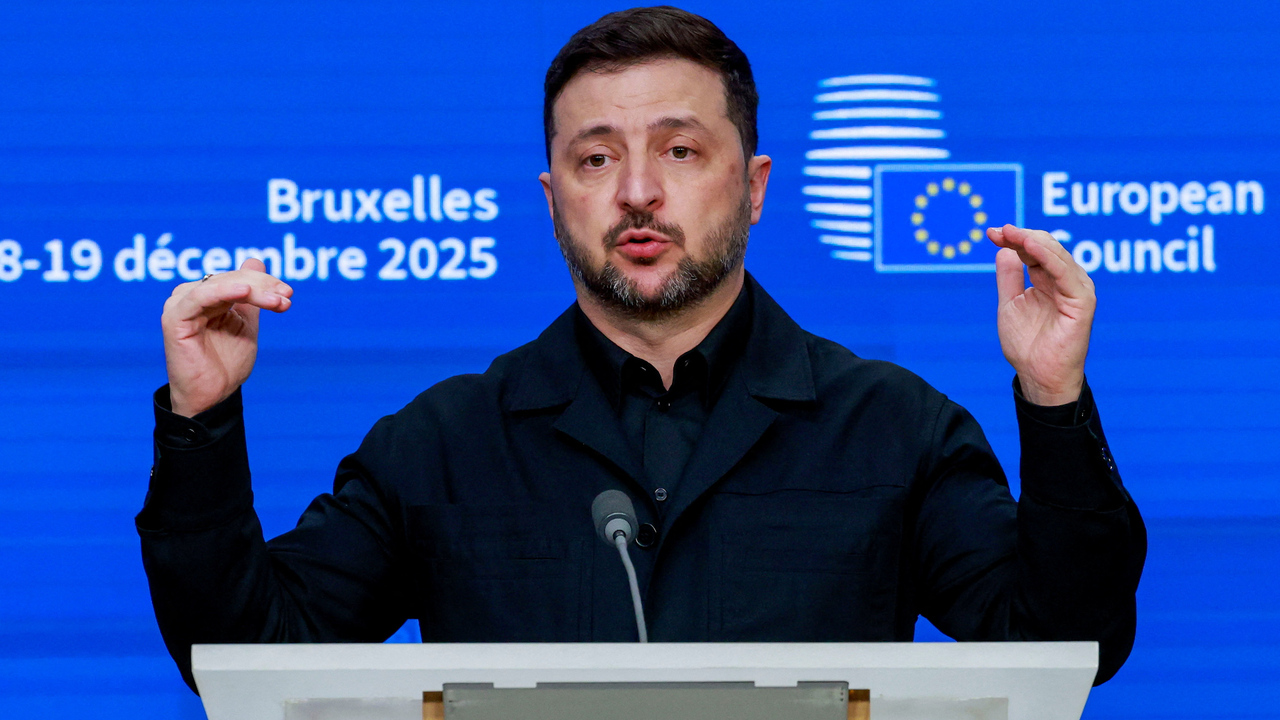
Financial Lifeline: EU Approves €90 Billion Interest-Free Loan for Ukraine Through 2027
Also Read | BSNL 300-Day Plan: Keep Your SIM Active for Just ₹5 Per Day
-
Reparations Loan “Light”: Why the EU is Borrowing Against Its Own Budget Instead of Seizing Assets
- Advertisement - -
The “Young Swine” Rhetoric: Putin’s Crude Verbal Assault on European Sovereignty
-
The “Merz Formula”: How German Chancellor Friedrich Merz Brokered the Compromise Deal
-
Ukraine’s Drone Dilemma: Zelenskyy’s Warning Over the April “Cash Crunch”
-
Internal Fissures: Hungary, Slovakia, and the Czech Republic Secure Guarantees “Carve-Outs”
The European Union has finally blinked in its standoff over frozen Russian assets, but it hasn’t walked away empty-handed.
The thing is, after 18 hours of grueling negotiations in Brussels, leaders approved a €90 billion ($106 billion) interest-free loan to keep Ukraine’s economy and military afloat through 2027.
Also Read | BSNL 300-Day Plan: Keep Your SIM Active for Just ₹5 Per Day
Actually, the deal is a massive compromise. Specifically, the EU will borrow this money from capital markets using “budget headroom”—basically a financial buffer—as security. As a result, the plan to directly tap into the €210 billion of frozen Russian assets held at Euroclear has been shelved for now due to legal fears in Belgium.
Consequently, European Council President Antonio Costa was able to post a victory message on X: “We committed, we delivered” (those too).
And here’s the kicker. The rhetoric from Moscow has reached a bizarre new low.
Basically, Russian President Vladimir Putin used his annual year-end addresses to dismiss EU leaders as “young swine” (or “little pigs”), claiming they are merely puppets of a failed US strategy. Instead of backing down, he reiterated that Russia will take more land—specifically the remainder of the Donetsk region—if peace talks don’t go his way. In fact, he warned that any attempt to use Russian money would be met with “massive legal action.”
And then Y followed. German Chancellor Friedrich Merz, who was instrumental in pushing the loan through, shot back by stating this sends a “clear signal” that Putin’s war will not be worth it (I checked this twice).
Also Read | BSNL 300-Day Plan: Keep Your SIM Active for Just ₹5 Per Day
[Table: EU Ukraine Funding Package vs. Russian Assets (Dec 2025)]
| Feature | New EU Loan Deal | Frozen Russian Assets (EU) |
| Total Amount | €90 Billion | ~ €210 Billion |
| Funding Source | EU Capital Markets / Taxpayers | Immobilized Central Bank Funds |
| Repayment Plan | Once Russia pays reparations | Potentially seized for “Reparations Loan” |
| Availability | January 2026 | Tied up in legal disputes |
| Key Opponent | Hungary / Slovakia (Guarantees) | Belgium / Italy (Legal Risks) |
Moreover, President Zelenskyy didn’t leave the summit entirely happy, but he got what he needed for survival. Specifically, he warned that without this “tranche” by spring, Ukraine’s domestic drone production would be slashed several-fold.
Actually, the US has essentially turned off the cash tap, placing the entire financial burden on Europe. As a result, the EU had to scramble to find a way to fund Ukraine without triggering a veto from Hungary’s Viktor Orbán. Consequently, a “deal of 24” was struck, where countries like Hungary and Slovakia are part of the agreement but won’t have to contribute to the loan guarantees.
Also Read | BSNL 300-Day Plan: Keep Your SIM Active for Just ₹5 Per Day
And then Y followed. Poland’s Donald Tusk framed the choice as “money today or blood tomorrow,” emphasizing that Europe’s own security is at stake (let’s be real, the unity is holding, but the cracks are getting wider).
The thing is, the “reparations” label on this loan is mostly symbolic for now. In fact, the EU text states it “reserves the right” to use the frozen assets to pay back the loan if Russia refuses to compensate Ukraine later.
Basically, the assets remain frozen indefinitely, but the EU is still scared to actually spend them. Instead of a tidy wrap-up, just keep in mind that Ukraine still faces a $50 billion+ shortfall for 2026 even with this loan.
And then Y followed. As the full-scale invasion nears its fourth anniversary in February, the focus is shifting from “winning” to “predictability.” This €90 billion buys Ukraine time, but it doesn’t buy a victory.
Also Read | BSNL 300-Day Plan: Keep Your SIM Active for Just ₹5 Per Day