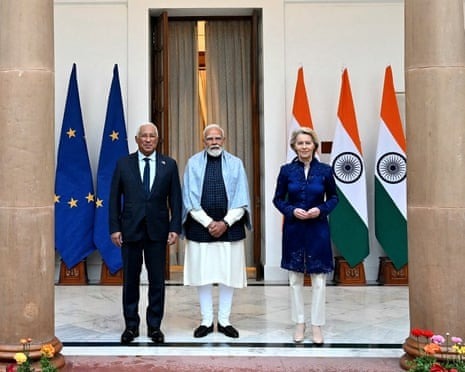
After 18 years of “on-off” negotiations, India and the European Union have finally unveiled the blueprint for what leaders are calling the “Mother of All Trade Deals.” The draft text released on Friday, February 27, 2026, formalizes a strategic economic partnership that brings together two of the world’s largest diverse economies, accounting for a quarter of the global GDP.
At the heart of this draft is the Most Favoured Nation (MFN) status, a commitment designed to “lock in” the preferential access both sides have fought for over two decades.
Also Read | Imran Khan and Bushra Bibi Sentenced to 17 Years in Jail
What “Most Favoured Nation” (MFN) Status Actually Means
While the name sounds like “special treatment,” in the world of the WTO, MFN is actually about non-discrimination.
-
The Five-Year Lock: For the first five years of the FTA, if India offers a better tariff deal to another country (say, the US or UK), it must automatically extend that same deal to the EU.
-
Parity Guarantee: This ensures that neither side’s businesses are “undercut” by future trade deals signed with third parties during the initial implementation phase.
Key Highlights: What Gets Cheaper?
The FTA aims to eliminate duties on over 96% of traded goods by value, creating a free trade zone for nearly two billion people.
| Sector | Impact for India | Impact for the EU |
| Automobiles | EU luxury car tariffs drop from 110% to 10% (under quotas). | Preferential access for Indian auto components. |
| Alcohol | Duties on European wines/spirits drop from 150% to 20-40%. | N/A |
| Textiles/Leather | Zero-duty access to the 27-nation EU market immediately. | N/A |
| Industrial | Cheaper machinery, chemicals, and pharma imports. | Removal of tariffs on 90% of industrial exports to India. |
Digital Trade and Data Sovereignty
In a significant departure from older trade deals, the 2026 pact includes a robust Digital Trade Chapter.
Also Read | Imran Khan and Bushra Bibi Sentenced to 17 Years in Jail
-
E-Commerce: Both sides have pledged to remove “unjustified barriers” to online trade, facilitating cross-border data flows.
-
Privacy First: Crucially, India has maintained its regulatory autonomy over personal data. The deal recognizes privacy as a fundamental right, meaning EU GDPR standards and Indian data laws remain the supreme authority.
The Mediation Mechanism: Resolving Disputes
To avoid the “adversarial” nature of international courts, the draft includes a structured mediation process.
-
Mutual Consent: Either side can request mediation if they feel a new measure (like a technical barrier or tax) unfairly impacts trade.
-
Speed: The goal is to provide a faster alternative to formal WTO-style dispute settlements, keeping the $140 billion trade corridor flowing smoothly.
Reality Check
The 7.6% growth forecast and this trade deal are major wins. Still, the “MFN” status only lasts for five years. Therefore, while it provides immediate stability, it also puts pressure on both sides to finalize deeper regulatory alignments quickly. In fact, while 93% of Indian exports will enter the EU duty-free, Indian exporters still face the EU’s Carbon Border Adjustment Mechanism (CBAM), which could act as a “green tax” even if the tariff is zero.
The Loopholes
The MFN pledge is “embedded” in the draft. In fact, this is a “Ratification Loophole”—the deal is concluded but not yet legally binding. Therefore, until the European Parliament and the Indian Parliament ratify the text, current MFN-WTO rates still apply. Still, the “Agricultural Exclusion”—leaving out dairy and beef—is a clear political safeguard to prevent farmer protests in both the EU and India.
Also Read | Imran Khan and Bushra Bibi Sentenced to 17 Years in Jail
What This Means for You
If you are an exporter in the textile, leather, or jewelry sectors, prepare for a massive volume surge. First, realize that your products will become 10-15% cheaper in Europe overnight once the deal is ratified. Then, if you are a consumer in India, understand that luxury cars (BMW, Mercedes, Audi) and premium wines will see significant price drops throughout 2027.
Finally, understand that the “Milk and Sugar” prices won’t change. You should not expect cheaper European cheese or dairy, as these were kept out of the deal. Before you plan any major business shifts, wait for the “Rules of Origin” guidelines, which will dictate exactly how much “Indian-made” content is required for your products to qualify for zero-duty entry into Europe.
What’s Next
The agreement will undergo legal vetting and translation over the next few months. Then, look for a formal signing ceremony in late 2026. Finally, the deal is expected to come into force by early 2027, marking the official start of the five-year MFN window and the phased reduction of car and wine duties.
Also Read | Imran Khan and Bushra Bibi Sentenced to 17 Years in Jail
End….