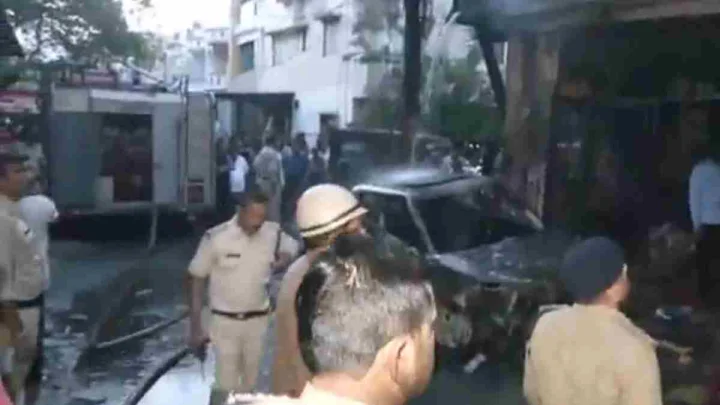
What began as a routine overnight vehicle charge ended in one of Indore’s deadliest residential fires in recent memory. On Wednesday, March 18, 2026, between 3:30 am and 4:30 am, a massive fire tore through the home of polymer trader Manoj Pugalia.
Police Commissioner Santosh Kumar Singh confirmed that the fire was sparked by an explosion at the EV charging point where a car was plugged in outside the house. The resulting inferno quickly spread from the driveway to the main structure, leading to a series of secondary explosions that made rescue nearly impossible.
Also Read | Imran Khan and Bushra Bibi Sentenced to 17 Years in Jail
The Timeline: From Charging to Catastrophe
-
03:30 AM: An electric vehicle charging outside the house experiences a suspected short circuit or thermal runaway at the charging point.
-
04:00 AM: The charging point explodes, igniting the vehicle. Flames quickly reach the ground floor of the three-story building.
-
04:15 AM: The intense heat causes nearly 10 cooking gas (LPG) cylinders inside the house to explode, creating a “fireball” effect that gutted all three floors.
-
04:30 AM: Fire tenders arrive, but are hindered by narrow roads and vehicles parked on both sides of the colony streets.
The Victims: A Family Devastated
The fire claimed eight members of the Sethia and Pugalia families. Medical officials at Mahatma Gandhi Memorial Medical College identified the deceased as:
-
Minors: Tanmay (6) and Rashi Sethia (12).
-
Women: Simran (30), Tinu (35), and Suman Sethia (60).
-
Men: Vijay Sethia (65), Chhotu Sethia (22), and Manoj Pugalia (65).
Three other residents were rescued by firefighters who accessed the building through a neighbor’s roof, but they remain in critical condition due to smoke inhalation.
Technical Failures: Electronic Locks & Cylinder Blasts
Two factors turned this fire from a localized accident into a mass-casualty event:
-
Electronic Locks: The house was equipped with high-tech electronic security locks. When the fire caused a short circuit and power failure, the locks reportedly failed to release, effectively trapping the family inside as smoke filled the bedrooms.
-
Inflammable Storage: As a polymer trader, Manoj Pugalia reportedly had some inflammable chemicals and a high number of LPG cylinders on site, which served as fuel for the fire.
Also Read | Imran Khan and Bushra Bibi Sentenced to 17 Years in Jail
Official Response: New EV Safety Mandates
State Minister Kailash Vijayvargiya visited the site and called the incident an “alarming wake-up call” for the EV era.
-
Expert Committee: A team of technical experts will investigate whether the fault lay with the vehicle’s battery, the charging hardware, or the home’s electrical load capacity.
-
New SOPs: The government will now frame a Standard Operating Procedure (SOP) for installing EV chargers in residential colonies, which may include mandatory fire-safety audits and dedicated ventilation requirements.
Reality Check
The push for EVs is driven by rising fuel prices and environmental goals, but residential infrastructure is struggling to keep up. Still, most EV fires are preventable with proper electrical earthing and the use of certified chargers. Therefore, while this tragedy is linked to an EV, it was the combination of electronic locks and stored cylinders that escalated the death toll. In fact, this incident highlights a major flaw in “smart home” design: the lack of mechanical manual overrides for electronic locks during a power-cut emergency.
The Loopholes
The government is promising a “detailed investigation.” In fact, this is a “Regulation Loophole”—currently, there are very few enforced laws regarding how an individual can install a charger at home. Therefore, many users use “extension-cord” setups or uncertified sockets that cannot handle the 15-20 amp draw of an EV for 8 hours straight. Still, the “Insurance Loophole” remains; most standard home insurance policies in India do not explicitly cover damage caused by EV charging unless a specific “fire and peril” rider is added.
Also Read | Imran Khan and Bushra Bibi Sentenced to 17 Years in Jail
What This Means for You
If you own an EV or are planning to buy one, audit your charging setup today. First, realize that a standard 5-amp or 15-amp home socket might not be enough; you should have a dedicated industrial-grade circuit with its own ELCB (Earth Leakage Circuit Breaker). Then, if you have electronic locks, understand that they must have a physical key backup that is easily accessible in the dark.
Finally, understand that LPG storage is a silent killer. You should never store more than the permitted number of cylinders inside a residence. Before you plug in your car tonight, check for any heat or “burning smell” from the socket, as these are the first signs of a looming electrical failure.
What’s Next
Expect Indore’s municipal body to start inspections of residential EV charging points in high-density colonies. Then, look for the expert committee report to be released within 15 days, which will likely recommend mandatory fire extinguishers for all EV owners. Finally, expect car manufacturers to issue new guidelines on “home-charging safety” to avoid legal liability following the Indore tragedy.
Also Read | Imran Khan and Bushra Bibi Sentenced to 17 Years in Jail
End……