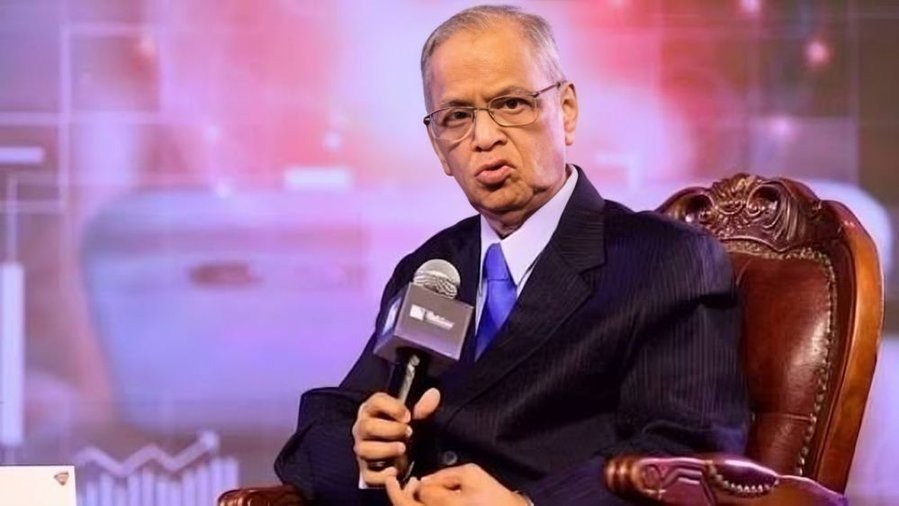
Months after sparking a national debate on the 70-hour workweek, Infosys founder Narayana Murthy has offered a fresh perspective on the anxiety surrounding Artificial Intelligence. Speaking on the future of employment in India, Murthy argues that the world “will not end” for those willing to adapt. According to him, the fear of job loss is best countered by becoming a master of the very tools people are afraid of.
Murthy’s comments highlight a shift in narrative from AI as a “competitor” to AI as an “amplifier” of human potential.
Also Read | Imran Khan and Bushra Bibi Sentenced to 17 Years in Jail
The “Smarter Mind” Advantage: Murthy’s Experiments
Murthy revealed that he has been personally experimenting with Generative AI to understand its impact on productivity.
-
Not a Leveler: He argues that AI doesn’t make everyone equal; instead, it provides a massive advantage to those who can think critically.
-
The Quote: “A smarter mind will get better quality and better level of productivity from using these assistive technologies,” Murthy noted, suggesting that the “output” is only as good as the human “input.”
Debunking the Hype: Aditya Puri on Disruption Pace
Former HDFC Bank CEO Aditya Puri joined the discussion, providing a sobering take on the timeline of AI disruption.
-
Overstated Fear: Puri believes both the utopian hype and the dystopian fear of mass joblessness are exaggerated.
-
The Human Element: He emphasizes the rise of Agentic AI—systems that can perform tasks semi-autonomously—but maintains that the human “is not going anywhere.”
-
Timeline: Unlike many who predict immediate chaos, Puri suggests the full impact of these transitions will take one to two decades to materialize.
Also Read | Imran Khan and Bushra Bibi Sentenced to 17 Years in Jail
The Economic Warning: The Geoffrey Hinton Perspective
While Indian industry leaders are optimistic, the “Godfather of AI,” Geoffrey Hinton, offers a darker outlook.
-
Wealth Concentration: Hinton warns that AI could allow corporations to maintain or increase profits while needing fewer workers, potentially funneling wealth strictly to the top.
-
Inequality: The concern is that while productivity goes up, the benefits may not be shared with the workforce being displaced.
Reality Check
Narayana Murthy’s advice to “master the technology” is sound. Still, history shows that while technology creates new jobs, it doesn’t always create them for the same people who lost theirs. Therefore, while “the smart and hardworking” will survive, there is a legitimate concern for middle-management and entry-level clerical roles that are easily automated. In fact, Murthy’s own industry (IT services) is already seeing a slowdown in “bench” hiring as AI takes over basic coding tasks.
The Loopholes
Murthy says “all they need to do is” learn. In fact, this is a “Skill-Gap Loophole”—access to high-level AI training isn’t universal, and the cost of staying updated can be high. Therefore, the “level playing field” Murthy mentions is actually more of a hurdle for those without premium access to the latest models. Still, the “Pace Loophole” identified by Aditya Puri—that this takes decades—is what gives the current generation a “buffer” to pivot their careers before full automation hits.
Also Read | Imran Khan and Bushra Bibi Sentenced to 17 Years in Jail
What This Means for You
If you are a young professional in India, stop ignoring AI tools. First, realize that using AI as an assistant is no longer “cheating”—it is a requirement for competitive productivity. Then, if you are in a technical field, focus on System Design and Critical Thinking, as these are the hardest areas for Agentic AI to replicate.
Finally, understand that discipline is your greatest asset. Murthy emphasizes “smart and hard work.” You should integrate AI into your daily workflow—whether it’s for summarizing reports, drafting emails, or debugging code—to ensure you are the “Smarter Mind” driving the machine. Before you worry about the “AI Apocalypse,” check if your company offers upskilling credits, as many Indian firms are now paying for their employees to get AI-certified.
What’s Next
Expect Infosys and TCS to announce massive “AI-First” training mandates for all new recruits by mid-2026. Then, look for the rollout of localized Agentic AI tools designed specifically for Indian languages and business contexts. Finally, the Ministry of Electronics and IT (MeitY) is expected to release a “Job Transition Framework” by late 2026 to address the displacement of workers in the BPO and IT sectors.
Also Read | Imran Khan and Bushra Bibi Sentenced to 17 Years in Jail
End….