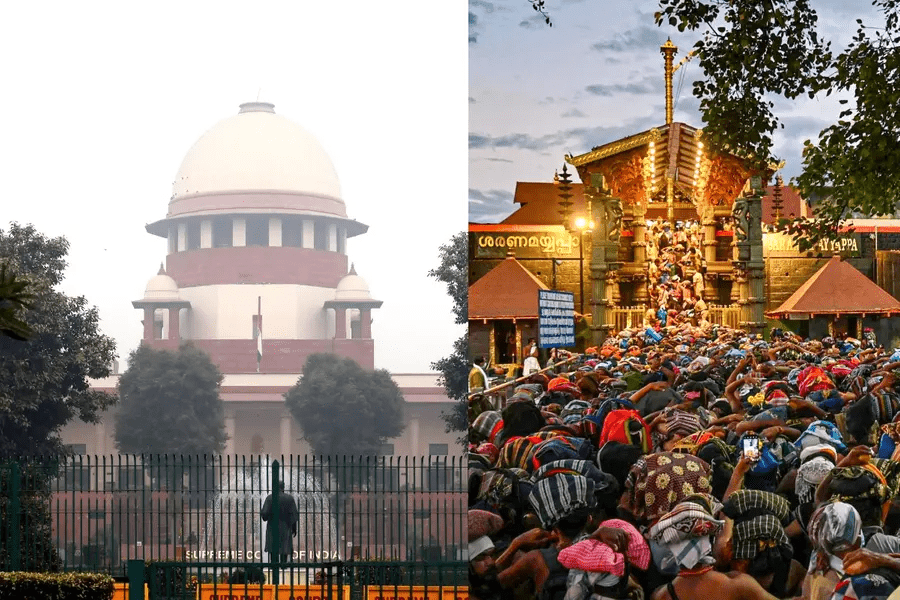
In a landmark legal submission, the Union Government has urged a nine-judge Supreme Court bench to uphold the entry restrictions for women of menstruating age at the Sabarimala Temple. The government argues that the deity’s attributes and religious faith are “beyond the scope of judicial review.”
The hearing, which began on Tuesday, April 7, 2026, marks the return of this constitutional controversy after six years in “cold storage.”
Also Read | Imran Khan and Bushra Bibi Sentenced to 17 Years in Jail
The Core Arguments: Faith vs. Judicial Review
The Centre’s written submissions, filed through Solicitor General Tushar Mehta, caution the court against applying “modern” or “scientific” standards to religious traditions.
Deity’s Character: The government contends that Lord Ayyappan’s form as a Naisthika Brahmachari (eternal celibate) is a juristic personality that courts cannot “reform” or reinterpret.
Denominational Autonomy: It argues that whether a practice is “essential” must be decided by the religious denomination itself, not by judges who are not “institutionally equipped” to adjudicate theology.
Constitutional Morality: The Centre attacked this concept as “vague and indeterminate,” claiming it allows judges to substitute their personal philosophical views for settled law.
Beyond Sabarimala: The Joseph Shine Challenge
In a surprising move, the government also urged the bench to declare the 2018 Joseph Shine judgment (which decriminalized adultery) as “not good law.”
Also Read | Imran Khan and Bushra Bibi Sentenced to 17 Years in Jail
Subjectivity: The Centre claims the adultery ruling rested on an overbroad application of autonomy that lacks a clear textual basis in the Constitution.
Extra-Judicial Influence: The government took a sharp dig at the use of academic writings, podcasts, and lectures in shaping judicial opinions, insisting that binding precedents must stay strictly within constitutional text and established legal principles.
The Nine-Judge Bench
The outcome of this case will define the limits of how far courts can interfere in religious customs, impacting everything from women’s entry into mosques to the rights of diverse religious communities.
| Role | Justice |
| Presiding | Chief Justice of India Surya Kant |
| Key Members | Justices BV Nagarathna, MM Sundresh, Ashanuddin Amanullah |
| Additional Members | Aravind Kumar, AG Masih, R Mahadevan, Prasanna B Varale, Joymalya Bagchi |
Investigative Insight: A “Constitutional Reckoning”
The timing of this hearing is significant. By challenging the very foundation of “Constitutional Morality,” the government is seeking a massive recalibration of power between the Judiciary and Religious Institutions.
If the court agrees with the Centre, it could set a precedent where religious practices—regardless of gender equality concerns—are shielded from the court as long as they don’t violate “public order, health, or morality.” This would effectively “freeze” many ongoing social reforms. As the Artemis II mission films Earth from the stillness of space, the ground below is bracing for a legal earthquake that could redefine the “essential” character of Indian secularism.
Also Read | Imran Khan and Bushra Bibi Sentenced to 17 Years in Jail
End…