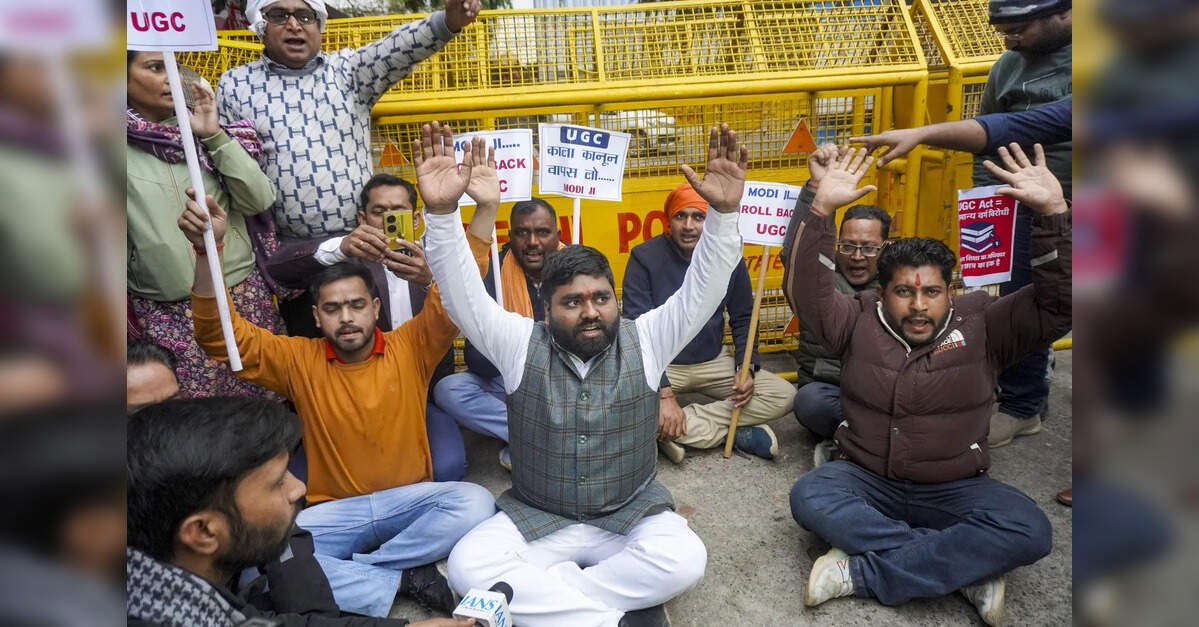
It’s Thursday morning, January 29, 2026, and if you’re a student or faculty member in an Indian university, your eyes are probably glued to the Supreme Court’s live-law feed. Later today, a bench led by CJI Surya Kant is taking up a firecracker of a case: the challenge to the UGC’s new Equity Regulations 2026.
The thing is, what started as a policy to make campuses safer has turned into a massive legal battle over who gets to be called a “victim.” Or nothing.
Also Read | Imran Khan and Bushra Bibi Sentenced to 17 Years in Jail
The UGC Equity Row: Field Notes
It’s an ongoing situation where a single definition in a 20-page document has set the internet on fire. Here’s the ground reality:
-
The “3(c)” Problem: The core of the fight is Regulation 3(c). It defines “caste-based discrimination” as something that happens only to SC, ST, and OBC members. The thing is, petitioners like Advocate Vineet Jindal and activist Rahul Dewan argue this creates a “hierarchy of victimhood.”
-
“Reverse Discrimination” Allegations: The petitions claim that by excluding the general category, the UGC is basically saying you can’t be a victim if you’re from the upper caste. The plea points to recent graffiti at JNU (those “Brahmins Leave” slogans) as proof that hostility can be bi-directional. Let’s be real—on a 2026 campus, politics are messy. Those too.
-
The CJI’s “We Know” Remark: When the matter was mentioned for urgent listing yesterday, CJI Surya Kant didn’t mince words. He said, “We know what’s happening,” acknowledging the widespread student protests and the sensitivity of the issue.
-
Binding Teeth: Unlike the old 2012 rules, these 2026 regulations have teeth. If a college doesn’t set up an Equal Opportunity Centre or an Equity Helpline, the UGC can literally pull their funding or stop them from giving out degrees. It’s a serious power move. Or nothing.
Also Read | Imran Khan and Bushra Bibi Sentenced to 17 Years in Jail
UGC 2026 Regulations: Legal Snapshot
| Key Provision | What the 2026 Rules Say | The Petitioner’s Challenge |
| Definition 3(c) | Discrimination against SC/ST/OBC only. | “Asymmetric & unconstitutional.” |
| Mechanism | Equity Committees & Equity Squads. | “General category denied redressal.” |
| Accountability | Head of Institution is directly liable. | “Risk of weaponization of complaints.” |
| Timeline | Action on complaints within 24-48 hours. | “Presumption of guilt without safeguards.” |
And Here’s the Kicker…
The timing couldn’t be more intense. While the court hears this, the Education Ministry has already ruled out a rollback, saying the framework is “designed to protect the most vulnerable.” The thing is, if the SC decides to “read down” the law to make it caste-neutral, it would be a massive pivot in Indian reservation-related jurisprudence. Those too.
One side comment—keep an eye on the Equity Helpline numbers. Some universities in Uttar Pradesh and Delhi have already started displaying them, despite the ongoing court case. It’s an ongoing situation where the law is already “on the ground” while the judges are still looking at the papers. Or nothing.
Also Read | Imran Khan and Bushra Bibi Sentenced to 17 Years in Jail
End…