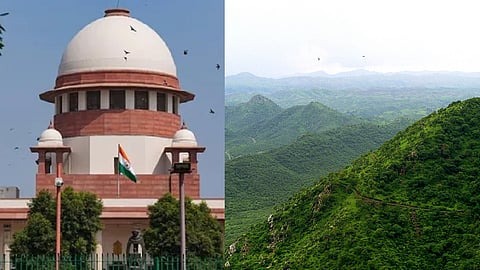
The Supreme Court has effectively hit the “pause” button on a decision that could have reshaped the future of India’s oldest mountain range. As of Monday, December 29, 2025, a vacation bench led by Chief Justice Surya Kant has kept in abeyance its own November order that accepted a controversial new definition of the Aravalli Hills.
The thing is, the court isn’t just double-checking some paperwork. Or nothing. Let’s be real, they realized that the “uniform definition” they approved last month might actually be a death warrant for most of the range. Those too.
Also Read | Imran Khan and Bushra Bibi Sentenced to 17 Years in Jail
The Definition Drama: What’s at Stake?
In November, the court agreed with the Centre’s proposal to simplify what counts as a protected “hill.”
-
The “100-Meter Rule”: Only landforms rising 100 meters or more from the local ground would be officially called “Aravalli Hills.”
-
The “Range” Rule: A “Range” would only exist if two such hills were within 500 meters of each other.
-
The Backlash: Environmentalists—and even the court’s own Central Empowered Committee (CEC)—warned this was a “fatally flawed” metric.
Also Read | Imran Khan and Bushra Bibi Sentenced to 17 Years in Jail
Why 100 Meters is the “Danger Zone”
And here’s the kicker: according to the Forest Survey of India (FSI), less than 9% of the Aravalli hills in Rajasthan actually meet that 100-meter height requirement.
-
The “Invisible” Hills: Thousands of lower, scrub-covered hills that recharge groundwater and stop the Thar Desert from swallowing Delhi-NCR would lose their legal protection.
-
The Mining Loophole: If a hill isn’t “legally” a hill, you don’t need the same environmental clearances to mine it.
-
The “Strategic” Exception: The government also wanted to allow mining for “strategic and atomic” minerals even in protected zones, which added fuel to the fire.
Also Read | Imran Khan and Bushra Bibi Sentenced to 17 Years in Jail
What Happens Now?
The court has admitted that “clarifications are necessary.” It’s an ongoing situation where:
-
New Expert Committee: A high-powered panel of domain experts will now be formed to conduct a fresh survey.
-
Abeyance: The November order is “frozen.” The status quo of protection remains for now.
-
Next Hearing: The bench will take this up again on January 21, 2026.
The Congress party and activists like Neelam Ahluwalia have hailed this as a victory for the “green lungs” of North India. But let’s be honest—until a definition is set in stone that accounts for ecological value rather than just height, the Aravallis are still on thin ice.
Also Read | Imran Khan and Bushra Bibi Sentenced to 17 Years in Jail
End…