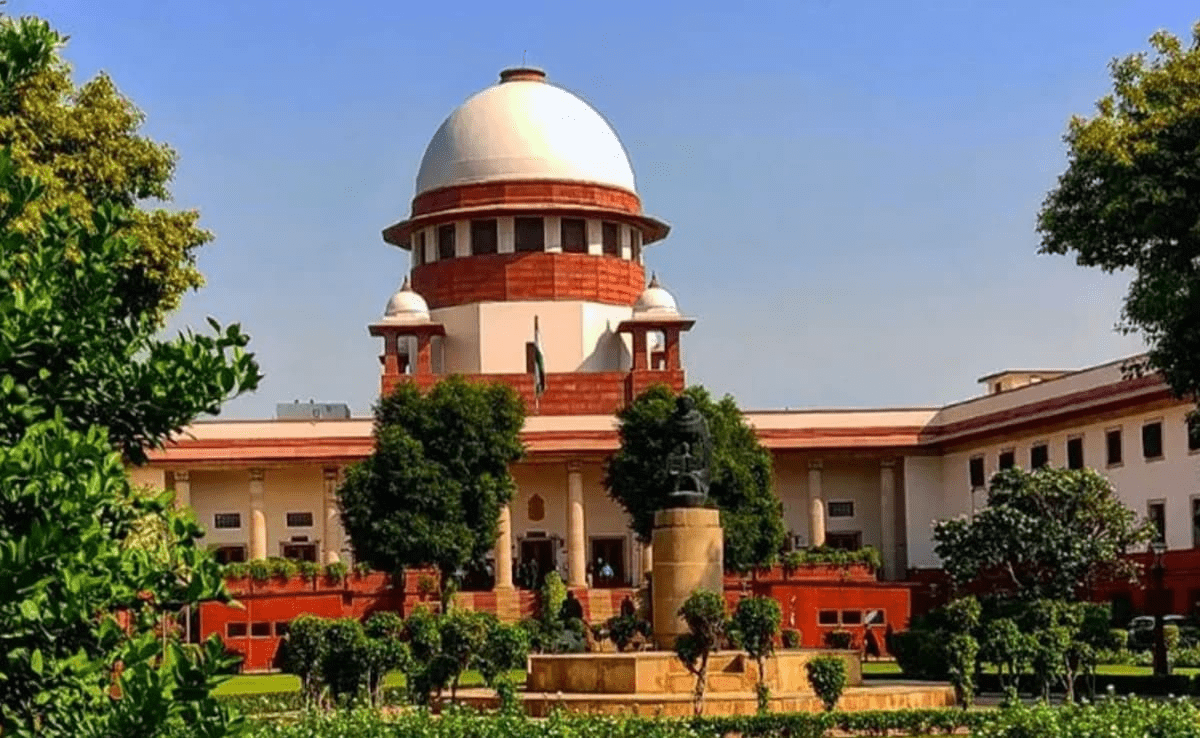
In a stinging rebuke of the Union government’s legal strategy, the Supreme Court on Tuesday, March 31, 2026, imposed a penalty of ₹25,000 on the Centre for filing an “avoidable” appeal against a junior constable. A bench of Justices BV Nagarathna and Ujjal Bhuyan dismissed the Special Leave Petition (SLP), questioning why the government continues to “feed the backlog” it publicly decries.
The case involved a CISF constable who was dismissed over an 11-day unauthorized absence and a family dispute, despite the Punjab and Haryana High Court already ruling his punishment as disproportionate.
Also Read | Imran Khan and Bushra Bibi Sentenced to 17 Years in Jail
The “Case of 11 Days”: Facts vs. Bureaucracy
The Union challenged a High Court order to reinstate the constable, who had served for ten years. The Supreme Court found the government’s pursuit of the case “unfathomable” given the trivial nature of the charges:
The Absence: The constable was away for 11 days to manage a family crisis involving an elopement and marriage.
The Misconduct: Allegations regarding the elopement were dropped after the woman involved testified she had no grievance and had married the constable’s brother voluntarily.
The High Court Verdict: Both a single judge and a division bench found the dismissal “disproportionate” and ordered reinstatement with back wages.
The SC’s Stand: Justice Nagarathna noted the human element, stating, “He had to set right his family… and he returned after that.”
Judicial Backlog: The Government Paradox
The hearing served as a platform for Justice Nagarathna to address the structural drivers of judicial congestion in India.
Also Read | Imran Khan and Bushra Bibi Sentenced to 17 Years in Jail
| Judicial Critique | The Government’s “Dual Role” |
| The Contradiction | Publicly voices concern over pendency while acting as the largest generator of litigation. |
| Bureaucratic “Safety” | Officers file routine appeals to avoid audit or vigilance scrutiny rather than exercising legal restraint. |
| Filtration Failure | Lack of an internal mechanism where law officers can advise against pursuing meritless appeals. |
| The Penalty | A symbolic ₹25,000 cost imposed to signal that the court’s time is not an infinite resource. |
“Not Just a Resort Trip”: SCBA Conference Echoes
The bench’s remarks were a direct follow-up to the Supreme Court Bar Association (SCBA) national conference held days earlier. Justice Nagarathna emphasized that the judiciary’s “homework” at the conference was intended to trigger institutional change, not just provide a scenic getaway for judges.
“We have been shouting. Keep aside your argument. Pendency, pendency; who is the biggest litigant?”
— Justice BV Nagarathna
Investigative Insight: The “Vigilance Fear” Trap
The Supreme Court has touched upon a systemic nerve: the “Vigilance Culture” of the Indian bureaucracy. Most government law officers and department heads prefer to lose a case in the Supreme Court rather than settle it at the High Court level. Settling a case—even a clear-cut one involving an 11-day absence—can trigger a “Performance Audit” or an inquiry into why “the interests of the state” weren’t defended to the end. By imposing costs, the Supreme Court is attempting to change the “Safe Choice” for bureaucrats from “Always Appeal” to “Only Appeal When Merited.” However, until the government protects its officers from departmental backlash for not litigating, the ₹25,000 fine remains a minor tax on a much larger systemic failure.
Also Read | Imran Khan and Bushra Bibi Sentenced to 17 Years in Jail
End….