

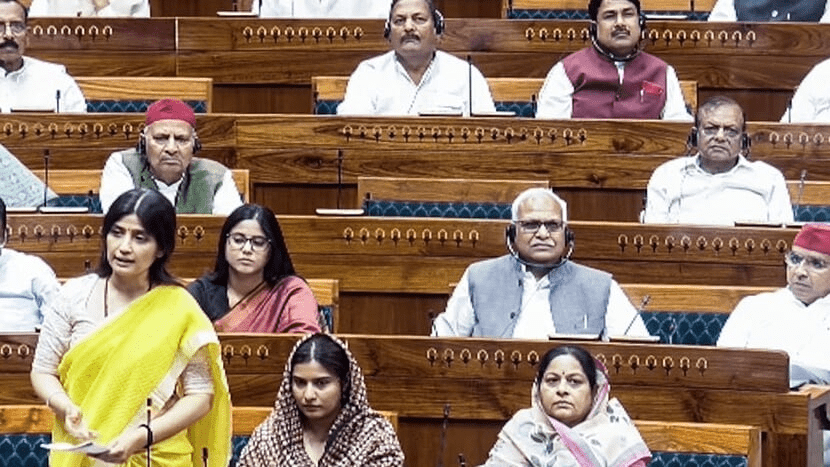
Now the Indian Parliament has witnessed a historic legislative defeat. The Constitution (131st Amendment) Bill, 2026 fell in the Lok Sabha on Friday night. Therefore, the women’s quota delimitation link remains the most debated topic in the country. This was the first major defeat for Prime Minister Narendra Modi in his 12-year tenure. Specifically, the bill failed the two-thirds majority test required for constitutional amendments.
Meanwhile, citizens are asking a simple question. Why can’t the 33% reservation for women be implemented in the existing 543-seat House right now?
But the legal and political answers are far from simple.
Also Read | Imran Khan and Bushra Bibi Sentenced to 17 Years in Jail
The Legal Reality of the 2023 Quota Law
Now we must acknowledge that the women’s quota is already a reality on paper. The Nari Shakti Vandan Adhiniyam was passed in September 2023. Therefore, it exists as Article 334A of the Constitution. Specifically, the government notified it in the gazette just this week, on April 16, 2026.
The Activation Sequence
First, the law contains a specific “sunset clause” and activation trigger. It states that a fresh census must be completed first. Then, a delimitation exercise must redraw constituencies. Thus, only after these two steps can the 33% reservation come into force.
Next, under this original timeline, women would have to wait until 2034. Therefore, the government proposed the 131st Amendment to speed things up using 2011 data.
“The conditions were not something we asked for,” Sonia Gandhi wrote.
Why the Seat Expansion Plan Failed
Now the government’s latest plan involved a massive seat increase. They proposed expanding the Lok Sabha by 50% to roughly 816 seats. Therefore, they could add women without taking seats from current male MPs.
Opposition Resistance
First, the Opposition rejected the use of 2011 Census data. They argued that using 15-year-old figures to redraw 850 seats is unfair. Then, they claimed the expansion was a “gerrymandering” attempt. Thus, the bill failed to secure the 360 votes needed for passage.
Next, the related bills for Delhi and Jammu and Kashmir were never presented. Therefore, the entire legislative package collapsed once the mother bill fell.
So the women’s quota delimitation link has become a permanent roadblock.
The Arithmetical Argument vs. Constitutional Logic
Now Home Minister Amit Shah provided an arithmetical explanation for the delay. He argued that increasing seats makes the quota “painless” for everyone. Therefore, the government’s case is about avoiding internal conflict among MPs.
The Tamil Nadu Example
First, consider Tamil Nadu’s current 39 seats. A 33% quota would leave only 26 open seats for men. Then, if you increase the total to 59, 39 seats stay open while 20 go to women. Thus, the math suggests everyone wins.
Next, the Opposition countered this logic. They argued that the government has not proven it is “constitutionally impossible” to use 543 seats. Therefore, the only hurdle is the text of the 2023 law itself.
“Bring the old bill back and we will pass it now,” Rahul Gandhi offered.
Also Read | Imran Khan and Bushra Bibi Sentenced to 17 Years in Jail
OBC Reservation: The Missing Piece of the Puzzle
Now the biggest silent hurdle is the Other Backward Classes (OBCs). Currently, OBCs have no political reservation in Parliament. Therefore, providing a sub-quota for OBC women is legally impossible right now.
The Constitutional Gap
First, Articles 330 and 332 provide seats for SCs and STs only. Then, the 2023 law provides reservation for women within these existing community quotas. Thus, SC and ST women get seats.
Next, OBC women get nothing equivalent. This is because there is no “mother quota” for OBCs to draw from. Therefore, parties like the SP and RJD are blocking the bill until this is fixed.
“Muslim and OBC women must get reservations,” Akhilesh Yadav demanded.
Southern States and the Federalism Crisis
Now the women’s quota delimitation link triggers a deep federal fear. Southern states like Tamil Nadu and Kerala have controlled their population. Therefore, they fear a new delimitation will punish them.
Political Demonetisation
First, delimitation based on population gives more seats to the North. States like UP and Bihar would gain massive influence. Then, the South would lose its proportional share in national policy. Thus, Shashi Tharoor called it “political demonetisation.”
Next, Chief Minister MK Stalin even burned copies of the bills in protest. Therefore, the South demands a debate on the delimitation “basis” before any seats are added.
Meanwhile, the government promised to protect state-wise shares.
Priyanka Gandhi’s ‘Be Brave’ Call to the House
Now Priyanka Gandhi Vadra made a striking impression during the debate. She urged the male-dominated House to “be brave” regarding their seats. Therefore, she addressed the fear of losing power directly.
The Sacrifice Argument
First, she acknowledged that some male leaders would have to step down. This is the natural result of implementing a 33% quota in 543 seats. Then, she assured the House that Indian women are ready for the responsibility. Thus, she dismissed the need for a seat expansion.
Next, she pointed out that the 2024 elections were a missed opportunity. Therefore, she blamed the government for inserting the “census-delimitation” condition in the first place.
So the smile on her face hid a very sharp political barb.
Also Read | Imran Khan and Bushra Bibi Sentenced to 17 Years in Jail
The Role of the Ongoing 2026 Caste Census
Now everything hinges on the data currently being collected. The 2026 census includes caste enumeration for the first time in 95 years. Therefore, the results will redefine the OBC debate.
The Road to 2028
First, the census results are expected in roughly two years. Then, the demographic basis for OBC political reservation can be established. Thus, a sub-quota for women can only be debated after this data is public.
Next, surveys in Bihar show OBCs might be over 50% of the population. Therefore, the demand for more than 27% quota will likely rise.
Meanwhile, the government is accused of “running away” from this latest data by using 2011 figures instead.
What Happens Next for Women’s Reservation?
Now the women’s quota delimitation link has stalled the progress of 2026. The 2023 law remains on the books, but it is effectively frozen. Therefore, a new consensus must be built.
Potential Pathways
First, the government could amend the 2023 law to remove the delimitation requirement. This would allow implementation in the current 543 seats by 2029. Then, they could address the OBC reservation separately after the 2026 census.
Next, the Opposition demands a full debate on the delimitation method. They want to protect the federal structure of India. Therefore, the 850-seat plan is likely dead for the foreseeable future.
Finally, the aspirations of Indian women remain tethered to these complex administrative hurdles.
Common Questions Answered
Why is the women’s quota linked to delimitation? Now the 2023 law specifically states that a fresh census and delimitation must occur before implementation. The government claims this makes the seat transition easier for everyone.
Why did the 131st Amendment fail? First, the Opposition rejected using 2011 Census data for a 2026 expansion. Then, the bill failed to get a two-thirds majority in the Lok Sabha.
Can the quota be implemented in 543 seats? Next, yes. Many Opposition leaders and legal experts say it is possible. It only requires an amendment to the 2023 Nari Shakti Vandan Adhiniyam.
What is the OBC sub-quota issue? So there is no political reservation for OBCs in the Constitution yet. Therefore, giving OBC women a sub-quota requires a prior amendment for general OBC political seats.
Why are Southern states protesting? Finally, they fear losing proportional representation in Parliament. Delimitation based on population favors high-population Hindi-belt states.
Also Read | Imran Khan and Bushra Bibi Sentenced to 17 Years in Jail
End….

