

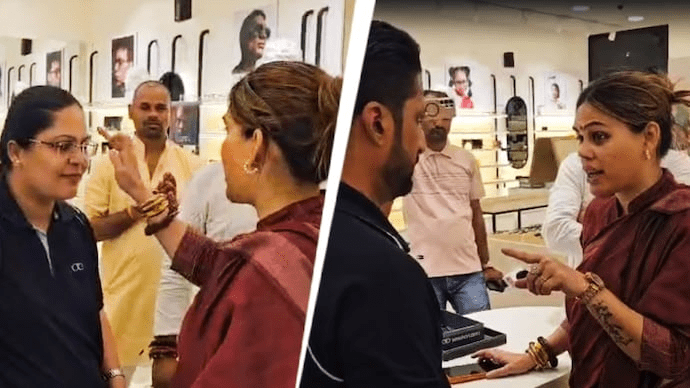
Now the eyewear giant Lenskart is facing a massive public relations crisis in Maharashtra. A Lenskart showroom in Mumbai became the site of a high-voltage protest led by a Muslim BJP leader. Therefore, the ongoing “Lenskart bindi hijab row Mumbai” has escalated from a social media debate to a physical confrontation. Members of Hindu organizations, led by BJP Minority Morcha leader Nazia Elahi, entered the store to protest alleged restrictions on Hindu religious symbols.
Meanwhile, the company has issued a formal apology and updated its in-store style guide to address the outrage.
But for many activists on the ground, the verbal clarification is not enough.
Also Read | Imran Khan and Bushra Bibi Sentenced to 17 Years in Jail
Nazia Elahi and the Mumbai Lenskart Confrontation
Now the protest in Mumbai was marked by aggressive rhetoric and symbolic actions. Nazia Elahi, a prominent Muslim leader within the BJP, led the charge into the showroom. Therefore, the “Lenskart bindi hijab row Mumbai” took on a unique inter-faith political dimension.
First, the group entered the premises and began chanting “Jai Shri Ram.” Then, Elahi directly confronted the floor manager, Mohsin Khan. Thus, she questioned whether his religious identity played a role in the alleged restriction of Hindu symbols.
Next, she spoke to the media outside, warning of a nationwide boycott. Therefore, she positioned the issue as a defense of the nation’s cultural identity.
“Lenskart will either be boycotted or its outlets shut unless the owner apologizes,” Elahi stated.
Applying Tilak: The Escalation Inside the Showroom
Now the situation became physically confrontational when the activists took matters into their own hands. They insisted on applying tilak to every employee present. Therefore, the store was temporarily transformed into a site of religious ritual.
Expressing Identity
First, the floor manager called the Hindu employees forward as requested. Then, activists applied tilak on their foreheads and tied kalawa on their wrists. Thus, they intended to demonstrate that there should be “no shame” in expressing one’s faith.
Next, video footage showed employees appearing visibly uncomfortable during the process. Therefore, the incident has sparked a secondary debate about the safety and autonomy of retail workers during political protests.
Employee Claims: Allegations of Mandatory Symbol Removal
Now the anger of the protesters was fueled by claims from a current employee. He alleged that during company training, staff were explicitly told to remove certain items. Therefore, the “Lenskart bindi hijab row Mumbai” is grounded in specific internal testimony.
Prohibited Symbols
First, the employee claimed that wearing a tilak and sacred thread was strictly prohibited. Then, he alleged that even married female employees were barred from wearing a mangalsutra. Thus, the protesters viewed this as a direct attack on Hindu traditions.
Next, the activists demanded an immediate explanation from the management. Therefore, the outlet faced calls for closure until a thorough investigation could be completed.
Also Read | Imran Khan and Bushra Bibi Sentenced to 17 Years in Jail
The Viral Document: Outdated Note or Hidden Policy?
Now we must look at the root of the controversy. An internal document allegedly permitted the hijab but restricted bindis and tilaks. Therefore, Lenskart found itself at the center of a “discrimination” storm.
Inaccurate Training Notes
First, the document began circulating on social media platforms like X and WhatsApp. Then, it quickly drew the attention of Hindu organizations and political leaders. Thus, the perception of a religious double standard at Lenskart took hold of the public imagination.
Next, the company was forced to respond to thousands of angry messages. Therefore, the “Lenskart bindi hijab row Mumbai” became a national trending topic within hours.
CEO Peyush Bansal’s Official Apology and Clarification
Now the CEO of Lenskart, Peyush Bansal, has personally intervened to de-escalate the situation. He issued a detailed apology to the public. Therefore, the company is in full “damage control” mode to protect its brand reputation.
Setting the Record Straight
First, Bansal clarified that the viral document was “inaccurate.” Then, he explained that it was an outdated training note and not a part of the official HR policy. Thus, he claimed that any references to bindi and tilak restrictions had already been removed.
Next, he emphasized that Lenskart values diversity and inclusion. Therefore, he urged the public not to judge the entire organization based on an old document.
Lenskart’s New Inclusive Style Guide (April 2026)
Now the company has backed its words with a new official policy. They have released a detailed in-store style guide to all outlets. Therefore, there should no longer be any confusion among floor managers.
Permitted Cultural Symbols
-
Bindi & Tilak: Explicitly permitted for all employees.
-
Hijab & Turban: Allowed as symbols of faith and culture.
-
Mangalsutra & Kalawa: No longer under any restriction.
First, this guide has been distributed to every Lenskart store across India. Then, managers have been instructed to ensure that no employee is harassed for their religious identity. Thus, the company hopes to prevent a repeat of the Mumbai incident.
Political Fallout: Demands for National Boycotts
Now the political pressure remains high despite the apology. Several groups are still calling for a boycott of the brand. Therefore, the “Lenskart bindi hijab row Mumbai” could have long-term financial consequences.
A Hindu Nation Narrative
First, leaders like Nazia Elahi have framed the issue as a test of the company’s respect for the majority community. Then, they have argued that “one-way secularism” will not be tolerated. Thus, the brand is being forced to prove its cultural alignment with its customer base.
Next, rival eyewear brands are being promoted by some activists on social media. Therefore, Lenskart must work hard to regain the trust of its conservative audience.
Also Read | Imran Khan and Bushra Bibi Sentenced to 17 Years in Jail
Workplace Secularism vs. Religious Expression in India
Now this incident highlights a larger debate in corporate India. How should a modern company balance professional “branding” with personal religious expression? Therefore, the Lenskart case is a precedent for other retailers.
The Neutrality Trap
First, some companies aim for a “neutral” look to appeal to all customers. Then, this often clashes with the deep-seated religious traditions of their employees. Thus, “style guides” often become accidental battlegrounds for cultural wars.
Next, legal experts suggest that companies should avoid any policy that discriminates between religions. Therefore, the key to avoiding a “bindi-hijab row” is a truly universal policy of expression.
Common Questions Answered
What happened at the Lenskart store in Mumbai? Now a group led by a BJP leader stormed the store to protest alleged bans on bindis and tilaks, eventually applying tilak on the staff.
Did Lenskart actually ban the bindi? First, an outdated training note suggested restrictions. Then, CEO Peyush Bansal clarified that this does not reflect the current company policy.
What is Nazia Elahi’s role in this? Next, she is a BJP Minority Morcha leader who spearheaded the protest in Mumbai to defend Hindu religious identity.
What does the new Lenskart style guide say? So it explicitly permits symbols of all faiths, including bindis, tilaks, hijabs, and turbans, across all its stores.
Has Peyush Bansal apologized? Finally, yes. He issued a formal apology and clarified that the viral document was inaccurate and not part of HR guidelines.
Also Read | Imran Khan and Bushra Bibi Sentenced to 17 Years in Jail
End…

