

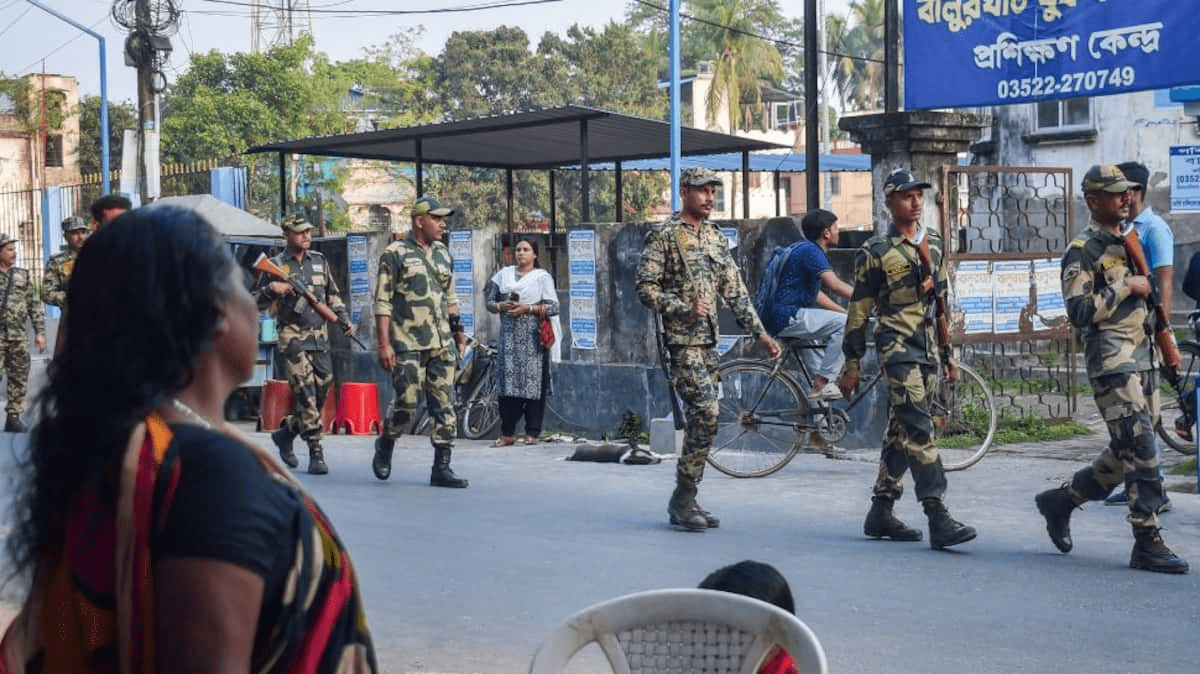
Now the first major chapter of the 2026 democratic saga has begun in the East. West Bengal Phase 1 polling security has been elevated to historic levels as 152 constituencies go to the booths this Thursday morning. Therefore, the Election Commission of India (ECI) has deployed a massive force of 2.4 lakh personnel, combining Central Armed Police Forces (CAPF) and state police. Specifically, the strategy focuses on eliminating voter intimidation through a new “inner-ring” guarding system that hands total control of the immediate polling area to central forces.
Meanwhile, a central control room at the Chief Electoral Officer’s (CEO) office in Kolkata is monitoring every booth in real-time.
But despite the heavy guard, early reports of localized skirmishes and EVM glitches have already begun to emerge from sensitive districts.
Also Read | Imran Khan and Bushra Bibi Sentenced to 17 Years in Jail
The CAPF 100-Metre Mandate: A First in Bengal History
Now we must examine the tactical shift in how booths are being guarded. In a significant departure from previous elections, the ECI has given CAPF personnel sole charge of security up to 100 metres around polling stations. Therefore, the West Bengal Phase 1 polling security plan aims to create a “neutral zone” where state influence is minimized.
Excluding Local Volunteers
First, no civic volunteers or contractual staff from either the state or central government have been assigned polling duties. Then, this decision was made to address long-standing allegations of local bias during the voting process. Thus, the CAPF acts as the primary shield for voters entering the booths. Next, state police have been relegated to “outer ring” duties and traffic management. Therefore, the responsibility for a peaceful environment rests squarely on the shoulders of the central forces.
Central Control Room: Real-Time Monitoring from Kolkata
Now the brain of the operation is located at the CEO office in Kolkata. A sophisticated central control room has been operationalized to oversee the 44,376 booths active in this phase. Therefore, any disruption can be addressed within minutes.
Digital Surveillance
First, the ECI has arranged for 100% webcasting at all polling stations. Then, senior officials, including CEO Manoj Agarwal, are reviewing live feeds to spot irregularities. Thus, the “digital eye” provides a layer of accountability that was previously impossible. Next, 152 general observers and 58 police observers are reporting directly to this hub. Therefore, the West Bengal Phase 1 polling security is as much about data as it is about boots on the ground.
Mock Polls and Early Turnout: Women Lead the Queues
Now the day started early for election officials. Mock polls began at 5 AM across all 16 poll-bound districts to ensure the machines were functioning correctly. Therefore, the formal voting commenced smoothly at 7 AM.
Voter Enthusiasm
First, long queues were visible even before the gates opened. Then, in several districts, women voters were seen in significant numbers, outstripping their male counterparts in the early hours. Thus, the enthusiasm for the 2026 assembly polls remains remarkably high despite the intense heatwave alerts. Next, the inclusion of 139 late electors brought the total count for Phase 1 to over 3.6 crore. Therefore, the sheer scale of the logistical exercise is being met with a robust public response.
Also Read | Imran Khan and Bushra Bibi Sentenced to 17 Years in Jail
Key Candidates: Suvendu Adhikari and Dilip Ghosh in the Fray
Now the political stakes for Phase 1 are gargantuan. A total of 1,478 candidates are testing their luck today. Therefore, the results of this phase will likely set the tone for the entire state election.
The Heavyweights:
-
BJP: Suvendu Adhikari, Dilip Ghosh, Shankar Ghosh, and Nisith Pramanik.
-
TMC: Udayan Guha, Kajal Sheikh, Goutam Dev, and Arpita Ghosh.
-
Congress: Adhir Ranjan Chowdhury and Mausam Benazir Noor.
First, the fate of Suvendu Adhikari is being closely watched as he leads the opposition’s charge. Then, TMC’s local strongmen are fighting to maintain their grip on traditional strongholds. Thus, the first phase covers several “prestige seats” where the margins are expected to be razor-thin. Next, the diversity of candidates—from veteran Adhir Ranjan to younger faces—reflects a changing political landscape. Therefore, the West Bengal Phase 1 polling security must remain tight to protect these high-profile participants.
EVM Malfunctions: Brief Delays in Mothabari
Now, as is common in an exercise of this magnitude, technical issues have been reported. Polling was briefly delayed at a specific booth in Mothabari due to an EVM malfunction. Therefore, technicians were rushed to the spot to resolve the matter.
Quick Response Teams
First, the ECI has stationed technical staff in every block to handle such glitches. Then, the faulty machine in Mothabari was replaced within the hour, allowing voting to resume. Thus, the “buffer” of extra machines has proven essential. Next, similar minor delays were reported from two other booths in Murshidabad. Therefore, while annoying for voters in the heat, these technical hiccups have not yet impacted the overall turnout.
Reports of Violence: Sitalkuchi and Naoda Incidents
Now we must address the “darker” side of the morning. Despite the 2.4 lakh personnel, incidents of violence have been reported from historically sensitive areas. Therefore, the West Bengal Phase 1 polling security is being tested in real-time.
The Sitalkuchi Flashpoint
First, in Sitalkuchi, a BJP Kisan Morcha leader was reportedly seriously injured after an alleged assault. Then, in Naoda, TMC candidate Sahina Mumtaj claimed she was attacked by supporters of the Aam Janata Unnayan Party. Thus, political tempers are flaring in the competitive rural belts. Next, clashes between CPI(M) and TMC supporters on Wednesday night left four people injured. Therefore, the CAPF has increased patrolling in these specific zones to prevent an escalation of hostilities.
Also Read | Imran Khan and Bushra Bibi Sentenced to 17 Years in Jail
Webcasting and Observers: Ensuring Fair Play
Now the ECI is doubling down on “transparency.” To ensure free and fair polling, the commission has appointed a record number of observers for a single phase.
The Oversight Grid:
-
General Observers: 152 officials monitoring the conduct of polls.
-
Police Observers: 58 officials ensuring security protocols are followed.
-
Micro-Observers: Stationed inside sensitive booths to watch for “ghost voting.”
First, every polling station is equipped with webcasting that feeds into the Kolkata control room. Then, observers are conducting surprise inspections to ensure the “100-metre rule” is being strictly enforced. Thus, any deviation from the SOP is being recorded and reported. Next, Manoj Agarwal is holding hourly reviews with district magistrates. Therefore, the focus is on a “zero-tolerance” policy toward electoral malpractice.
Voter Demographics: Samsherganj to Daspur
Now the sheer numbers of Phase 1 are fascinating. The voter count for this phase stands at a massive 3.6 crore. Therefore, the demographics of the 16 districts are as varied as the candidates themselves.
By the Numbers:
First, Cooch Behar Dakshin and Karandighi have the highest number of candidates (15 each). Then, Chandrakona has the lowest, with only five candidates. Thus, some voters have a much more complex ballot to navigate. Next, Daspur in West Medinipur holds the record for the highest number of voters at 2,90,045. Therefore, polling booths in these high-voter areas are seeing the longest queues.
Common Questions Answered
How many security personnel are deployed for Bengal Phase 1? Now a total of 2.4 lakh personnel, including CAPF and state police, are overseeing the first phase.
What is the new CAPF rule for this election? First, for the first time, CAPF is in charge of security up to 100 metres around polling stations. Therefore, state police cannot enter the immediate voting area.
Who are the key candidates in this phase? Next, high-profile figures like Suvendu Adhikari, Dilip Ghosh, Adhir Ranjan Chowdhury, and Nisith Pramanik are among the 1,478 candidates.
Where can I report polling irregularities? So you can contact the central control room at the CEO office in Kolkata or speak to the general observer stationed at your booth.
Were there any delays in voting? Finally, yes. Brief delays were reported in Mothabari and parts of Murshidabad due to minor EVM malfunctions, but these were quickly resolved.
Also Read | Imran Khan and Bushra Bibi Sentenced to 17 Years in Jail
End…

