

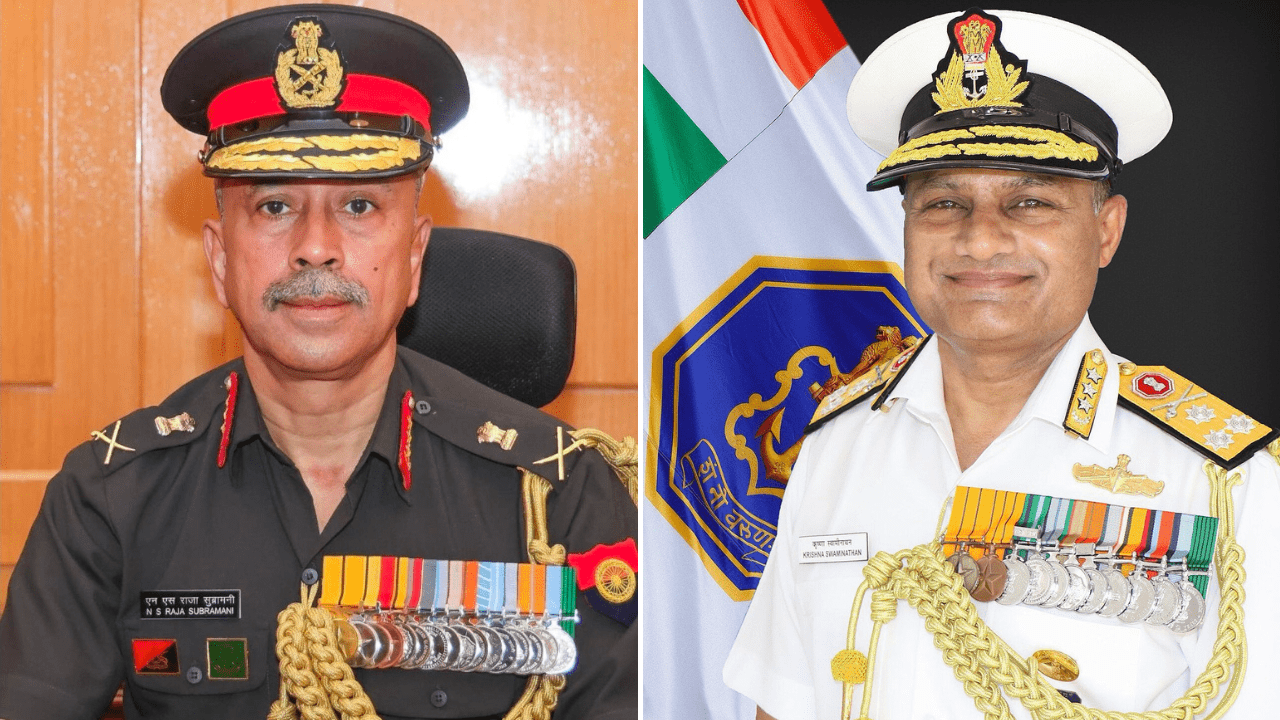
Now a significant transition is underway at the pinnacle of India’s military hierarchy. The Government of India has officially appointed Lt Gen N S Raja Subramani (Retd.) as the country’s next Chief of Defence Staff (CDS). Therefore, this landmark appointment marks a critical phase in the restructuring of the armed forces, aimed at enhancing tri-service coordination. Meanwhile, the retired officer will also assume the role of Secretary of the Department of Military Affairs, overseeing vital procurement and organizational reforms.
Also Read | Imran Khan and Bushra Bibi Sentenced to 17 Years in Jail
Succession Timetable: The Handover from General Anil Chauhan
Now the transition process has been clearly outlined to ensure administrative continuity. Lt Gen N S Raja Subramani is expected to assume office at the end of this month. Therefore, the handover coincides with the conclusion of General Anil Chauhan’s tenure on May 30, 2026.
First, the government announced the selection ahead of time to facilitate a smooth briefing period. Next, the new CDS will take charge as India’s highest-ranking military officer. Thus, the month of May serves as a pivotal period for the Ministry of Defence as it finalizes these top-brass changes.
So the timetable ensures that there is no leadership vacuum during ongoing regional security challenges. Meanwhile, the outgoing CDS is expected to provide a comprehensive review of current restructuring projects. Therefore, the military hierarchy remains stable as the new leadership steps in.
Lt Gen N S Raja Subramani: A Profile of India’s Next CDS
Now the incoming CDS brings nearly four decades of distinguished service to the table. An alumnus of both the National Defence Academy (NDA) and the Indian Military Academy (IMA), his career is a testament to military excellence. Therefore, his appointment is seen as a reward for long-standing dedication and strategic insight.
First, he was commissioned into the Garhwal Rifles in 1985. Next, he climbed the ranks to serve in critical roles, including Vice Chief of Army Staff and the Chief of Central Army Command in Lucknow. Thus, he possesses a granular understanding of both field operations and high-level military administration.
So his most recent role as the military adviser to the National Security Council Secretariat has provided him with a unique bird’s-eye view of national threats. Meanwhile, his experience across diverse commands makes him a versatile choice for the tri-service role. Therefore, the armed forces are gaining a leader with balanced operational and bureaucratic experience.
Operational Dynamics: Expertise on Western and Northern Frontiers
Now the selection of Lt Gen Subramani is particularly strategic given India’s current border landscape. He is widely recognized for his profound insight into operational dynamics on the Western and Northern frontiers. Therefore, his leadership will be critical in managing tensions along the Line of Actual Control (LAC) and the Line of Control (LoC).
First, his time at the Central Army Command allowed him to oversee critical logistical and tactical preparations. Next, his deep understanding of high-altitude warfare and counter-insurgency is an asset for the Department of Military Affairs. Thus, the Ministry of Defence is prioritizing leaders who have “boots-on-the-ground” experience in these sensitive zones.
So his tactical acumen is expected to influence future procurement of specialized mountain warfare equipment. Meanwhile, his focus on intelligence-led operations aligns with modern battlefield requirements. Therefore, the appointment reinforces India’s proactive stance on border security.
Also Read | Imran Khan and Bushra Bibi Sentenced to 17 Years in Jail
Strategic Reforms: Theatreisation and Tri-Service Coordination
Now the primary mandate for the new CDS will be the structural reform of the Indian Armed Forces. The Ministry of Defence is giving top priority to the concept of theatreisation. Therefore, Lt Gen Subramani will lead the effort to integrate the Army, Navy, and Air Force into unified theater commands.
First, this reorganization aims to create a more efficient and lethal combat force. Next, as the Secretary of the Department of Military Affairs, he will have the legislative power to streamline tri-service procurement. Thus, the “siloed” approach of the different wings is expected to be replaced by a cohesive joint-warfare doctrine.
So this is arguably the most significant overhaul in the history of the Indian military. Meanwhile, the new CDS must balance the varying requirements of the three services during this transition. Therefore, his success will be measured by how effectively he bridges the gap between traditional structures and a unified command.
Educational Background: From NDA to King’s College London
Now the academic credentials of the incoming CDS reflect a global perspective on security. Besides his foundational training at India’s premier academies, he has sought advanced education abroad. Therefore, his strategic thought process is influenced by both Indian and international military doctrines.
First, he is an alumnus of King’s College London and Madras University. Next, he has undergone extensive specialized training at reputed defense academies in the United Kingdom. Thus, his approach to military strategy is informed by modern, globalized standards of defense management.
So this international exposure is vital for a CDS who must interact with foreign military leaders and defense partners. Meanwhile, his ability to integrate complex technological trends into military policy is well-documented. Therefore, his intellectual rigor is expected to match his operational grit.
The New Navy Chief: Admiral Krishna Swaminathan’s Appointment
Now the military leadership shift is not limited to the CDS position. Admiral Krishna Swaminathan has been appointed to succeed Admiral Dinesh K. Tripathi as the Chief of the Naval Staff. Therefore, May 31, 2026, will see a fresh face leading India’s maritime interests.
First, the Admiral currently serves as the Commander-in-Chief of the Western Naval Command in Mumbai. Next, he is widely regarded as an expert in communications and electronic warfare. Thus, his appointment signals a focus on the technological modernization of the fleet.
So the coordination between the new CDS and the new Navy Chief will be essential for India’s Indo-Pacific strategy. Meanwhile, the Navy is currently in the midst of expanding its carrier capabilities and submarine fleet. Therefore, the naval leadership transition is a critical component of the broader national security update.
Also Read | Imran Khan and Bushra Bibi Sentenced to 17 Years in Jail
Naval Career Highlights: Command of INS Vikramaditya
Now Admiral Swaminathan’s career is marked by several prestigious sea commands. Commissioned in 1987, he has been at the helm of some of India’s most powerful vessels. Therefore, his rise to the top of the Navy is backed by significant “blue-water” experience.
First, he famously commanded the aircraft carrier INS Vikramaditya and the guided-missile destroyer INS Mysore. Next, he spearheaded the formation of the Indian Naval Safety Team, emphasizing operational discipline. Thus, his leadership style is defined by a commitment to safety and high-tech efficiency.
So his educational stints at the United States Naval War College and the UK’s Joint Services Command and Staff College have honed his maritime strategy. Meanwhile, his previous roles as Vice Chief of Navy and Chief of Personnel provided him with deep administrative expertise. Therefore, the Navy is in experienced hands as it navigates a changing maritime order.
FAQ: Understanding the 2026 Military Leadership Shifts
1. Who is the new Chief of Defence Staff (CDS) of India? Now, the government has appointed Lt Gen N S Raja Subramani (Retd.) as the new CDS.
2. When will the new CDS assume office? First, he is scheduled to succeed General Anil Chauhan on May 30, 2026.
3. What are the key responsibilities of the CDS? So the CDS serves as the permanent Chairman of the Chiefs of Staff Committee and Secretary of the Department of Military Affairs. Next, he oversees tri-service coordination and theatreisation.
4. Who is the incoming Chief of the Naval Staff? Next, Admiral Krishna Swaminathan will take over as the Navy Chief on May 31, 2026.
5. What is the military background of Lt Gen Subramani? Now, he was commissioned into the Garhwal Rifles in 1985 and has served as Vice Chief of Army Staff.
6. What is “theatreisation”? Finally, it is a structural reform aimed at integrating the Army, Navy, and Air Force into unified commands for improved combat efficiency.
Also Read | Imran Khan and Bushra Bibi Sentenced to 17 Years in Jail
End…

