

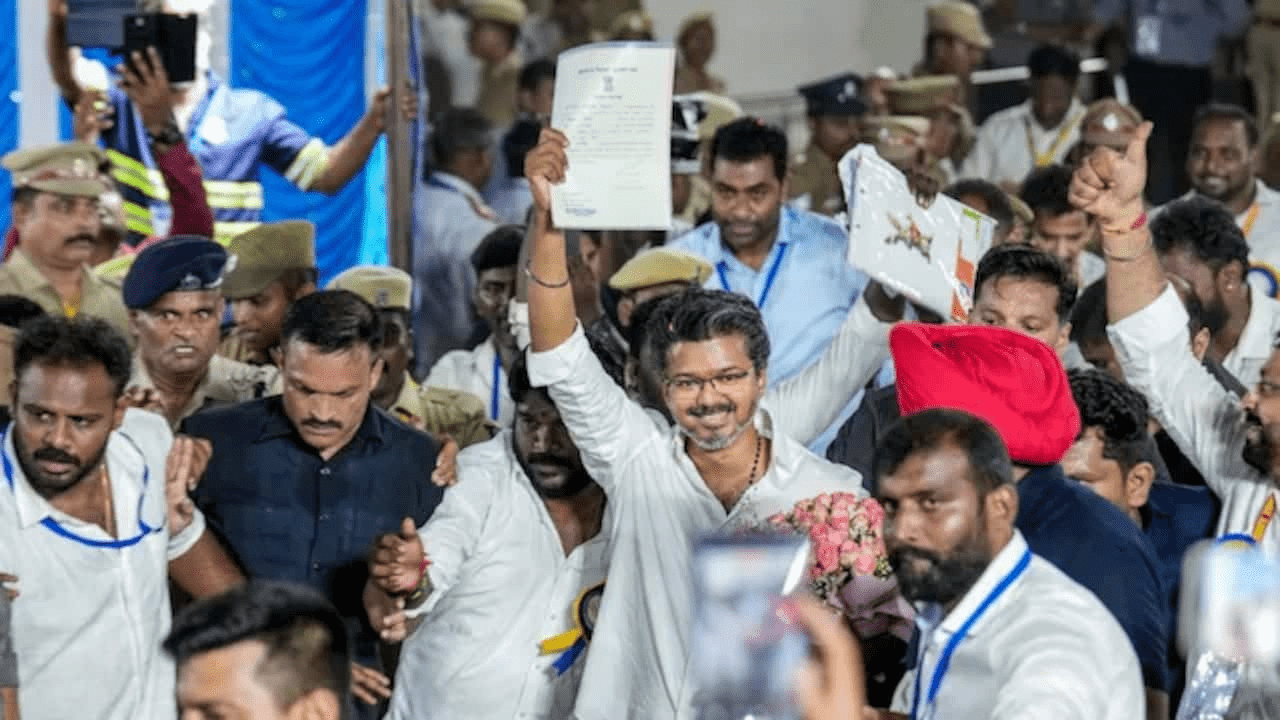
Now the post-election atmosphere in Chennai has shifted from celebration to a potential constitutional standoff. Actor-politician Vijay’s Tamilaga Vettri Kazhagam (TVK) has issued a stark warning: all 107 newly elected MLAs will resign if the DMK or AIADMK attempts to form the government by ignoring the TVK’s status as the single largest party. Therefore, the state is looking at a “nuclear option” that could trigger Article 356 and force a massive wave of by-elections. Meanwhile, legal experts are debating the Speaker’s role in verifying such a massive move.
Also Read | Imran Khan and Bushra Bibi Sentenced to 17 Years in Jail
Article 190: The Speaker’s Power Over Mass Resignations
Now a resignation in the legislative assembly is not a mere “rubber stamp” process. Under Article 190 of the Indian Constitution, an MLA must submit their resignation in writing to the Speaker. Therefore, the Speaker is constitutionally obligated to verify that the resignation is both voluntary and genuine.
First, the Speaker has the authority to hold inquiries and summon each member in person. Next, if there is any reason to believe a member is acting under duress or party pressure, the Speaker can reject the resignation. Thus, the process for 107 MLAs could take weeks, if not months, leading to prolonged political limbo.
So this administrative check serves as a safeguard against forced political maneuvers. Meanwhile, any rejection by the Speaker would almost certainly be challenged in the High Court or Supreme Court. Therefore, the “mass resignation” would first be a battle of legal paperwork before it becomes a battle of ballots.
The By-Election Nightmare: 107 Simultaneous Polls
Now if the resignations are accepted, the Representation of the People Act, 1951, takes center stage. Therefore, the law mandates that by-elections for vacant seats must be held within six months. First, with 107 seats falling vacant, nearly half of the 234-member assembly would be up for grabs again.
Next, the Election Commission of India (ECI) would have to organize what is effectively a “mini-general election” across the state. Thus, the logistics of security, electronic voting machines (EVMs), and personnel would be an extraordinary exercise.
So this move would effectively turn the by-elections into a second referendum on the April 2026 mandate. Meanwhile, the state’s exchequer would bear a massive financial burden for a repeat poll. Therefore, the threat is designed to signal that TVK is ready to return to the people rather than allow a rival coalition.
Article 356: When the Governor Recommends President’s Rule
Now a situation where 107 seats are vacant creates a fundamental breakdown of constitutional governance. Therefore, the Governor would likely find that the state can no longer be run according to the provisions of the Constitution. First, this would lead to a recommendation for President’s Rule under Article 356.
Next, the Union Cabinet would need to approve this recommendation, followed by ratification from both houses of Parliament within two months. Thus, Tamil Nadu would be governed from New Delhi until the by-elections restore a working majority.
So imposing President’s Rule in a state with a strong sense of regional identity would be a “political firestorm.” Meanwhile, the assembly would remain in suspended animation, preventing any other party from passing bills or budgets. Therefore, the TVK’s threat is a direct challenge to the state’s autonomy under a rival’s potential rule.
Also Read | Imran Khan and Bushra Bibi Sentenced to 17 Years in Jail
Fractured Mandate: Why 118 is the Magic (and Elusive) Number
Now the current political math is the root of the crisis. TVK won 108 seats, but since Vijay must vacate one of the two seats he won, the party’s strength is 107. Therefore, even with the Congress’s support of 5 MLAs, the total is 112.
First, the alliance is six seats short of the 118-majority mark in the 234-member House. Next, the potential “Kingmakers” like the VCK and Left parties hold the necessary balance. Thus, the TVK is in a race against time to secure these partners before the DMK or AIADMK can lure them away.
So the refusal of the IUML to move without the DMK’s consent has stalled the TVK’s momentum. Meanwhile, the DMK and AIADMK together hold 106 seats—fewer than the TVK-Congress front. Therefore, the TVK functionaries argue that the largest single group cannot be constitutionally ignored in favor of a smaller combine.
The IUML Factor: The Backchannel Talks Infuriating TVK
Now the Indian Union Muslim League (IUML) has become a critical pivot in this standoff. Despite the TVK’s outreach, the IUML has remained loyal to its three-decade alliance with the DMK. Therefore, the six seats that Vijay needs are currently tied to the DMK’s sphere of influence.
First, reports of “backchannel talks” between the DMK and AIADMK have infuriated the TVK leadership. Next, the idea of the two traditional rivals joining hands to block a newcomer is being seen as a “betrayal of the mandate.” Thus, the mass resignation threat is a preemptive strike against any such coalition.
So the TVK’s senior functionaries describe the move as a signal of “ideological purity.” Meanwhile, the IUML’s decision is being watched by other minority-focused parties. Therefore, the next 48 hours of negotiations will determine if the assembly survives in its current form.
Constitutional Breakdown: Can a State Function with Half an Assembly?
Now the question of whether an assembly can function with only 127 members (234 minus 107) is a legal gray area. Therefore, while a “quorum” might exist, the democratic legitimacy of the house would be severely compromised. First, passing budgets and critical legislation would be met with intense public and legal scrutiny.
Next, a government formed with such a large chunk of the assembly missing would struggle to claim it represents the “will of the people.” Thus, the Governor might be hesitant to invite any leader who cannot command a house that includes all constituencies.
So the potential for a constitutional vacuum is real. Meanwhile, the caretaker government under MK Stalin continues to manage day-to-day affairs. Therefore, the “mass resignation” is a move designed to make the state ungovernable for anyone other than the TVK.
Also Read | Imran Khan and Bushra Bibi Sentenced to 17 Years in Jail
Vijay’s Signal: A Second Referendum Strategy
Now the strategy behind the resignation threat is clear: it is an appeal to the court of public opinion. By threatening to walk away, Vijay is telling the voters that he would rather quit than compromise on his principles. Therefore, the “Thalapathy” wave is being sustained through a narrative of sacrifice.
First, a second referendum via 107 by-elections would likely favor the party that appears “victimized” by the old guard. Next, it forces the DMK and AIADMK to defend their attempt to form a government with fewer seats than the TVK. Thus, the political risk for the rivals is just as high as it is for Vijay.
So the mass resignation would be unprecedented in Tamil Nadu’s 62-year political history. Meanwhile, the youth vote that propelled the TVK to 108 seats is expected to consolidate further in the event of a re-poll. Therefore, the “threat” is a high-stakes gamble for ultimate power.
FAQ: The TVK Mass Resignation Crisis 2026
1. Can 107 MLAs resign at the same time? Now, yes. However, the Speaker must verify each resignation individually to ensure they are voluntary under Article 190.
2. Will there be re-elections if they resign? First, by-elections must be held for each vacant seat within six months. Next, since 107 seats is nearly half the house, it would effectively be a partial state election.
3. What is President’s Rule in this context? So if the state cannot form a stable government due to the vacancies, the Governor can recommend President’s Rule under Article 356.
4. Why is the TVK 6 seats short of a majority? Next, the TVK-Congress alliance has 112 seats. Thus, they need 6 more to reach the 118-majority mark.
5. Which seat will Vijay vacate? Now, since he won two seats (Perambur and Trichy East), he is constitutionally required to vacate one. Reports suggest he may retain Perambur.
6. Can the DMK and AIADMK form the government together? Finally, they have a combined 106 seats. While technically possible with smaller allies, it would have fewer seats than the TVK-Congress bloc.
Also Read | Imran Khan and Bushra Bibi Sentenced to 17 Years in Jail
End…

