

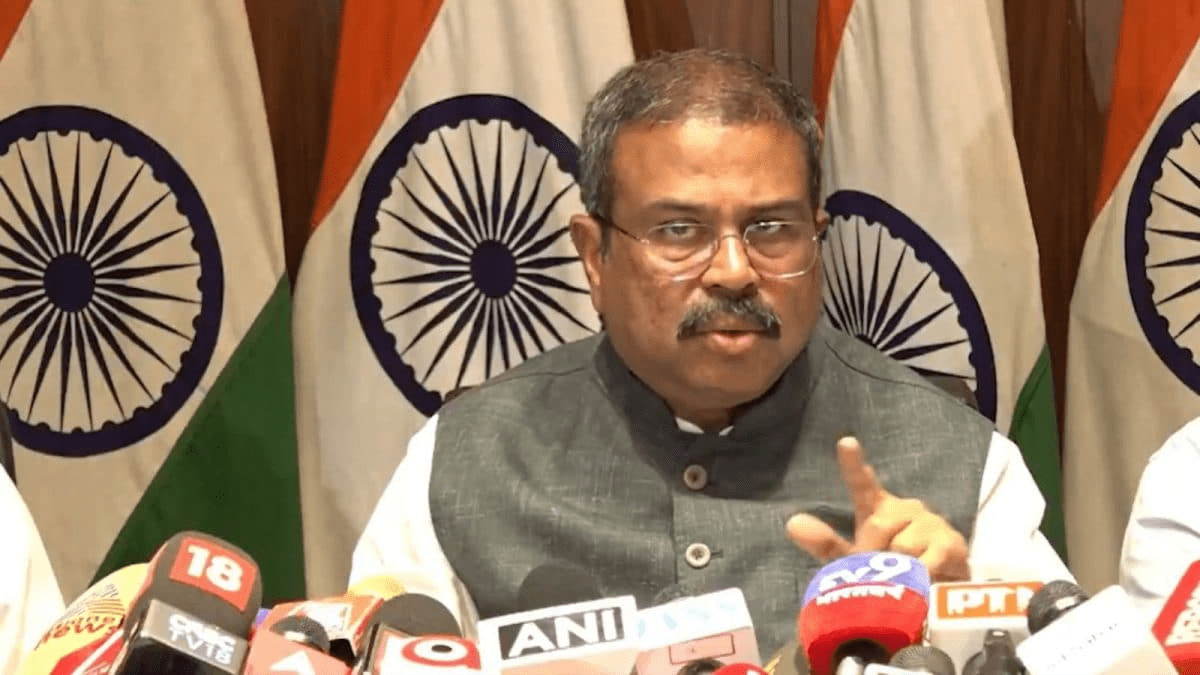
Now the landscape of India’s most competitive medical entrance exam is set for a historic transformation. During a high-level press conference, Union Minister Dharmendra Pradhan officially announced that the National Eligibility cum Entrance Test (NEET-UG) will transition from its traditional pen-and-paper OMR format to a Computer-Based Test (CBT) mode starting next year. Therefore, this structural overhaul is a direct response to the recent paper leak controversy that has shaken the National Testing Agency (NTA). Meanwhile, the government has accepted full responsibility for the system’s lapses and promised strict action against all individuals involved. Following the findings of the CBI, June 21 remains the critical date for students awaiting the 2026 re-examination.
Also Read | Imran Khan and Bushra Bibi Sentenced to 17 Years in Jail
The End of OMR: Transitioning to Computer-Based Testing (CBT)
Now the traditional “bubble-filling” era for medical aspirants is coming to an end. Union Minister Dharmendra Pradhan has confirmed that the NEET exam will officially ditch the paper-based OMR format starting next year. Therefore, the 2027 cycle will be the first to feature a fully digital interface.
First, the move to a Computer-Based Test (CBT) is designed to minimize the physical movement of question papers. Next, digital testing allows for randomized question delivery, making mass leaks significantly harder to execute. Thus, the mechanical necessity of an online shift has become undeniable following the recent security breaches.
So while the change is significant, it aligns with other major national exams like JEE Main and CUET. Meanwhile, the NTA is already working on the technical infrastructure to support nearly 25 lakh simultaneous users. Therefore, the “CBT era” is being fast-tracked to restore trust in the medical admission process.
Radhakrishnan Committee: The Blueprint for a Secure System
Now the decision to shift online follows the rigorous recommendations of the High-Level Committee headed by former ISRO Chairman K. Radhakrishnan. The committee had earlier identified the command chain in the pen-and-paper format as the most vulnerable point for leaks. Therefore, a structural overhaul was their primary suggestion for reform.
First, the committee’s report emphasized that digital testing improves both transparency and security. Next, it highlighted that the current manual logistics for OMR sheets are prone to human interference. Thus, the transition to CBT is a direct implementation of the “Radhakrishnan Blueprint.”
So the government has admitted that despite following these initial recommendations, a breach in the command chain still occurred this year. Meanwhile, the committee is now helping the NTA design a more robust encryption system for digital papers. Therefore, the 2027 reform is a data-driven response to current failures.
CBI Probe Update: Identifying the Source of the Leak
Now the Central Bureau of Investigation (CBI) has provided a critical update to a Delhi court regarding the leak. According to the agency, the question paper breach appears to have originated from a source closely linked to the NTA. Therefore, the investigation is moving beyond external solvers to look at internal vulnerabilities.
First, the CBI is currently working to identify specific officials and government personnel who may have facilitated the leak. Next, digital forensics are being used to trace the point at which the paper was accessed before the exam. Thus, the agency’s findings are reinforcing the need for a total structural change.
So while the probe continues, several arrests are expected in the coming days. Meanwhile, the NTA’s internal processes are being audited to find the exact “link” that broke. Therefore, the 2026 re-exam is being conducted under the shadow of this active criminal investigation.
Also Read | Imran Khan and Bushra Bibi Sentenced to 17 Years in Jail
Ministerial Accountability: Dharmendra Pradhan on System Failures
Now Union Minister Dharmendra Pradhan has taken a firm stance on ministerial and organizational accountability. At the press briefing, he admitted the failure of the system and stated that the government takes full responsibility. Therefore, he was clear that no lapse would be overlooked in the correction process.
First, the Minister promised that strict action will be taken against every individual found guilty, regardless of their rank. Next, he emphasized that the system will be corrected wherever it is broken to protect the future of students. Thus, the “zero-tolerance” policy is being led directly from the Ministry of Education.
So the Minister’s acknowledgement of a breach in the command chain is seen as a major step toward reform. Meanwhile, the public’s demand for accountability has put the NTA under unprecedented pressure. Therefore, the structural overhaul is being treated as an urgent national priority.
The June 21 Re-Exam: Logistics and Final Preparations
Now for the lakh of students caught in the controversy, June 21 is the most important date on the calendar. The NEET-UG re-examination is officially confirmed for this Sunday. Therefore, students are being advised to download their new admit cards and verify their exam centers immediately.
First, the re-exam will be conducted under significantly heightened security measures compared to the May session. Next, the NTA is using new protocols for paper distribution to ensure a leak-proof experience. Thus, the mechanical necessity of a successful re-test is vital for the 2026 academic cycle.
So while the controversy has been distracting, students must now pivot back to active preparation. Meanwhile, the results of this re-test will be used for the final merit list for MBBS and BDS admissions. Therefore, June 21 represents a “fresh start” for the affected candidates.
Extra Time for Aspirants: The Proposed 15-Minute Buffer
Now in a move to support students who have faced immense mental stress, authorities are considering a one-time relief measure. There is a proposal to give candidates an additional 15 minutes during the June 21 re-exam. Therefore, the total exam duration could be extended to accommodate the psychological toll of the situation.
First, this extra time is being looked at as a way to ensure that no student is disadvantaged by the disruption. Next, it may help students manage the typically lengthy and dense NEET question papers more effectively. Thus, the proposal is a gesture of empathy toward the 2026 batch.
So while the final confirmation will come through official guidelines, the sentiment is widely welcomed by parents and educators. Meanwhile, students should continue to practice within the standard time limits to stay prepared. Therefore, the 15-minute buffer is a potential “cushion” for a very high-pressure day.
Also Read | Imran Khan and Bushra Bibi Sentenced to 17 Years in Jail
Internal Scrutiny: Investigating NTA Officials and Insiders
Now the probe into the leak has turned inward toward the NTA itself. During the press conference, Minister Pradhan did not dismiss the possibility of insider involvement. Therefore, every official who had access to the question paper chain is currently under scrutiny.
First, the government is looking to identify “official insiders” who may have leaked the digital or physical paper. Next, the roles of personnel involved in printing and logistics are being mapped by the CBI. Thus, the structural overhaul is accompanied by a massive “cleaning” of the current administrative ranks.
So the Minister stated that wherever the NTA is found lacking, it will be held accountable without exception. Meanwhile, the agency’s top leadership is overseeing the new protocols for the June 21 test. Therefore, the internal probe is a mechanical necessity for restoring the agency’s credibility.
FAQ: Understanding the NEET 2027 Online Shift
1. Will NEET 2026 be online or pen-and-paper? Now, the 2026 re-exam on June 21 will still be in the pen-and-paper OMR format. The switch to online (CBT) mode begins from next year (2027).
2. Why is NEET moving to an online (CBT) mode? First, to improve transparency, prevent paper leaks, and streamline the security of the command chain as recommended by the Radhakrishnan Committee.
3. Will there be extra time for the June 21 re-exam? So, authorities are currently considering giving students 15 extra minutes, though final confirmation is still pending in the official guidelines.
4. What did the CBI find about the paper leak? Next, the CBI informed the court that the source of the leak appears to be linked to the NTA itself, and they are investigating internal officials.
5. Who recommended the switch to online testing? Now, the High-Level Committee headed by former ISRO Chairman K. Radhakrishnan strongly recommended this structural shift.
6. Is the NTA being investigated? Finally, yes. Union Minister Dharmendra Pradhan has stated that the NTA will be held accountable and all officials involved in the lapse will face strict action.
Also Read | Imran Khan and Bushra Bibi Sentenced to 17 Years in Jail
End…

