

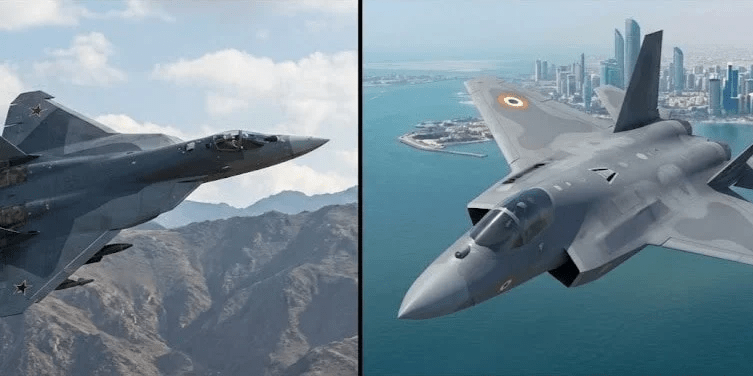
Now the strategic equilibrium of South Asian airspace is facing an intricate, multi-layered hardware dilemma. India’s massive Multi-Role Fighter Aircraft (MRFA) acquisition roadmap, centering on the procurement of 114 Rafale jets from France, has hit severe structural negotiation delays. Therefore, defense planners in New Delhi are quietly assessing alternative defense matrices to safeguard national sovereignty. Meanwhile, the core diplomatic friction stems from a rigid disagreement over source-code sharing and complete independent system control. Following a dangerous depletion in the Indian Air Force’s active fighter squadron strength, resolving this bottleneck has become an urgent priority. Should these bilateral negotiations fall apart completely, turning to overseas fifth-generation platforms or fast-tracking domestic stealth projects remains an absolute tactical requirement.
Also Read | Imran Khan and Bushra Bibi Sentenced to 17 Years in Jail
Algorithmic Sovereignty: The High-Stakes Battle Over Rafale Source Codes
Now the modern combat arena is dictated far more by digital system architectures than pure aerodynamic parameters. In the ongoing MRFA transaction loop, the Indian Ministry of Defence has established an unyielding stance regarding software access. Therefore, external defense developers can no longer expect New Delhi to accept locked black-box operating configurations.
First, Indian officials require unrestricted entry into the weapon control computer systems of the 4.5-generation French platform. Next, this absolute digital clearance allows domestic avionics labs to patch new software routines directly into the primary sensor arrays. Thus, the mechanical necessity of maintaining complete operational freedom underpins every round of talks in New Delhi.
So without this specific system-level clearance, the platform remains entirely dependent on expensive, foreign-certified munitions suites. This baseline layout artificially inflates long-term maintenance budgets while capping the flexibility of tactical field commanders during active sorties. Meanwhile, the Air Force leadership has clarified that physical delivery schedules mean nothing if the underlying computing layers remain under external locks. Therefore, algorithmic sovereignty has transformed into the primary deal-breaker for the current procurement phase.
The BrahMos Disconnect: Why Native Weapon Integration is Non-Negotiable
Now the premier physical asset motivating India’s demand for absolute source-code transparency is a highly potent, domestically manufactured weapon. The air-launched variant of the BrahMos supersonic cruise missile represents the crown jewel of the IAF’s long-range strike capability. Therefore, engineering the ability to deploy this massive payload from any newly acquired foreign aircraft is an absolute requirement.
-
The Munitions Integration Friction Points:
-
Weight Optimization: Adjusting the aircraft’s central fuselage links to carry the heavy BrahMos chassis safely.
-
Radar Handshake: Syncing the French Thales RBE2 AESA radar directly with the missile’s tracking system.
-
Telemetry Exchange: Enabling real-time trajectory updates to pass cleanly from the cabin to the weapon mid-flight.
-
Financial Penalty: Avoiding the multi-million dollar integration fees demanded by overseas contractors for custom updates.
-
First, forcing a premier multi-role fighter to rely exclusively on French-made missiles severely restricts India’s supply chain resilience during active conflicts. Next, the domestic defense complex has already proved its ability to integrate heavy weapons by modifying legacy Russian platforms. Thus, the mechanical necessity of standardizing the BrahMos across all heavy combat wings remains a non-negotiable core policy for Indian designers.
The French Perspective: Technology Exposure Risks and the Russian Factor
Now to understand the gridlock holding back the finalization of the deal, one must analyze the complex strategic anxieties of the French industrial base. Paris and Dassault Aviation view their advanced military software layers as critical, highly proprietary intellectual property. Therefore, international transfer requests are subjected to intense screening protocols by French national security panels.
First, the French side fears that deep software clearance could lead to unintended technology exposure to third-party nations. Next, this specific concern is heavily amplified by India’s extensive, decades-long military-technical collaboration with the Russian Federation. Thus, because the BrahMos missile was jointly engineered with Moscow, French technicians worry that interface data could leak back to Kremlin tracking labs.
So despite explicit, high-level assurances from New Delhi that all technical data will remain strictly confidential, negotiations remain stalled. This diplomatic friction shows that even the closest strategic partnerships hit real boundaries when dealing with core technology assets. Meanwhile, international aerospace monitors are tracking how this stand-off alters France’s broader export positioning across Asia. Therefore, the Russian factor continues to act as a significant obstacle blocking immediate contract sign-offs.
Also Read | Imran Khan and Bushra Bibi Sentenced to 17 Years in Jail
The Two-Front Mandate: Assessing the Growing Sino-Pak Aerial Alliance
Now the primary operational pressure forcing the immediate resolution of these procurement delays is a rapidly changing regional security landscape. The Indian Air Force operates under a permanent, statutory requirement to maintain a balanced deterrent against a combined two-front threat environment. Therefore, the persistent contraction of its active fleet layers introduces considerable long-term planning risks.
[Sanctioned Fleet Ceiling: 42 Squadrons] ──► Maximum Required Two-Front Deterrent Envelope
                                                     │
                                                     ▼ (Severe Structural Attrition)
[Current Fleet Asset Base: 29 Squadrons]  ──► Deep Operational Security Vulnerability Gap
                                                     │
                                                     ▼
[Sino-Pak Deployment Scale: 5G & 4++G]    ──► Demands Rapid Infusion of Advanced Platforms
First, look at the northern border developments: the People’s Liberation Army Air Force (PLAAF) has rapidly scaled up its deployment of advanced fifth-generation J-20 stealth fighters along high-altitude positions. Next, the Pakistan Air Force (PAF) continues to systematically modernize its tactical fleet using advanced Chinese-origin systems like the J-10C. Thus, the widening gap between India’s actual fleet size and its original 42-squadron requirement creates an urgent modernization mandate.
Evaluating the F-35 Option: Washington’s Terms vs. India’s Strategic Autonomy
Now if the French partnership collapses entirely, the alternative platform that dominates public debate is America’s premier stealth asset. The Lockheed Martin F-35 Lightning II represents an incredibly capable, hyper-connected fifth-generation combat platform. Therefore, introducing this low-observable asset would instantly shift the technological balance of power back toward New Delhi.
First, look at the underlying geopolitical costs: the Pentagon attaches intense operational restrictions and surveillance tracking to all F-35 exports. Next, Washington routinely demands that buyers limit their defense links with non-NATO partners, which clashes directly with India’s historic commitment to absolute strategic autonomy. Thus, the mechanical necessity of maintaining independent foreign policy choices makes the F-35 a highly complex political challenge.
So the platform features an incredibly complex logistics tail that relies on continuous, cloud-linked diagnostic syncs with central American servers. This layout introduces severe risks of remote shutdown during localized conflicts that do not align with Washington’s regional priorities. Meanwhile, defense analysts point out that the F-35 is engineered for stealth precision penetration rather than carrying massive payloads like the BrahMos. Therefore, the American alternative presents a highly restrictive framework for India’s long-term defense planning.
The Su-57 Felon Matrix: Can New Delhi Re-Engage the Kremlin’s Stealth Program?
Now the secondary international avenue available to planners involves re-opening communications with India’s legacy hardware provider. The Sukhoi Su-57 Felon represents Russia’s premier operational fifth-generation heavy fighter platform, built to maximize thrust-vectoring agility. Therefore, re-engaging with Moscow could provide a rapid path toward acquiring heavy-payload stealth systems.
-
The Su-57 Strategic Realities:
-
Legacy Synergy: Builds naturally onto the extensive maintenance infrastructure developed for the Su-30MKI.
-
Weapon Compatibility: Naturally engineered to interface with joint Indo-Russian missile systems like the BrahMos.
-
Sanctions Exposure: Triggers immediate risks of severe financial penalties under Western CAATSA legislation.
-
Industrial Delays: Russian manufacturing plants face intense strain due to ongoing conflicts, slowing export delivery dates.
-
First, India previously walked away from the joint FGFA stealth project with Russia due to deep disagreements over engine performance and composite skins. Next, returning to that partnership could disrupt India’s growing technical cooperation with European defense hubs. Thus, while the Su-57 matches India’s payload demands cleanly, the external political fallout creates a highly volatile balance sheet for the defense ministry.
Also Read | Imran Khan and Bushra Bibi Sentenced to 17 Years in Jail
The AMCA Roadmap: Accelerating the Native Fifth-Generation Flight Timelines
Now the ultimate definitive resolution to India’s long-term air power dependency rests on the shoulders of its domestic laboratory networks. The Advanced Medium Combat Aircraft (AMCA) program is India’s flagship project to engineer an indigenous, twin-engine fifth-generation stealth fighter. Therefore, a potential collapse of the Rafale deal could force the cabinet to divert billions of dollars directly into fast-tracking this domestic asset.
First, the Aeronautical Development Agency (ADA) has already finalized the core aerodynamic designs and internal weapons bay layouts for the platform. Next, the project is structured in two distinct phases, with early variants utilizing foreign engines before transitioning to a co-developed 110kN domestic power plant. Thus, building this domestic infrastructure provides absolute immunity against foreign tracking systems and unexpected export embargos.
So transitioning this project from abstract blueprints into active physical squadrons requires a massive upgrade of domestic manufacturing yards. The current timelines project the initial prototype flights near the turn of the decade, leaving a significant capability gap in the near term. This means that while the AMCA represents the ideal long-term solution, it cannot solve the immediate squadron crisis facing the air force today. Therefore, defense ministers must continue to hunt for an interim solution to hold the line.
Interim Patches: Navigating Tejas Mk1A Engine Delays and Super Sukhoi Upgrades
Now with international procurement tracks locked in long-term disputes, the IAF must look inward to patch its immediate tactical lines. The domestic LCA Tejas program remains a vital asset, but its near-term rollout is facing significant friction. Therefore, technical teams are forced to maximize the combat capabilities of the existing heavy fighter fleet.
First, the ambitious Tejas Mk1A program, involving a massive 180-aircraft order book, is facing delays due to engine delivery shortfalls from the United States. Next, while roughly 30 aircraft frames are physically ready, their final deployments are stuck waiting for GE F404 engine shipments. Thus, the mechanical necessity of securing these propulsion units has complicated immediate fleet expansion plans.
So to balance this delay, the ministry has launched the comprehensive ‘Super Sukhoi’ modernization upgrade for its 250 active Su-30MKIs. This massive program installs advanced active electronically scanned array (AESA) radars and upgraded computing frameworks onto the heavy fighters. This structural patch ensures that the backbone of the combat fleet remains highly capable while the larger MRFA questions move through government chambers. Therefore, the 2026 defense landscape requires a delicate balance between near-term technical updates and long-term sovereign manufacturing goals.
FAQ: Understanding India’s Post-Rafale Combat Fleet Realignment
1. Why is India’s 114 Rafale fighter jet deal currently facing delays? Now, negotiations are stalled because India demands full source-code access to independently integrate domestic weapons like the BrahMos missile, while France hesitates to share deep software controls.
2. How severe is the current squadron shortage facing the Indian Air Force? First, the IAF is currently operating with a depleted baseline of around 29 active squadrons, while its formal statutory requirement calls for 42 squadrons to manage a two-front threat.
3. Why is the integration of the BrahMos missile such a critical point for India? So, integrating the BrahMos allows India to maintain independent, long-range supersonic strike options without paying massive integration fees or relying on expensive, foreign-certified weapons.
4. What are the main strategic drawbacks of selecting the American F-35 as an alternative? Next, the F-35 comes with intense operational restrictions, requires continuous connection to US data servers, and lacks the open structural architecture to carry heavy non-NATO payloads like the BrahMos cleanly.
5. What is the status of India’s native fifth-generation stealth project, the AMCA? Now, the Advanced Medium Combat Aircraft (AMCA) project has finalized its core stealth designs, but its multi-year development timeline means it functions as a long-term solution rather than an immediate fleet patch.
6. How is the IAF securing its air defense lines while these major procurement deals are stalled? Finally, the Air Force has launched the comprehensive ‘Super Sukhoi’ upgrade program to modernize its 250 active Su-30MKIs with advanced AESA radars and updated digital mission computers.
Also Read | Imran Khan and Bushra Bibi Sentenced to 17 Years in Jail
End….

