

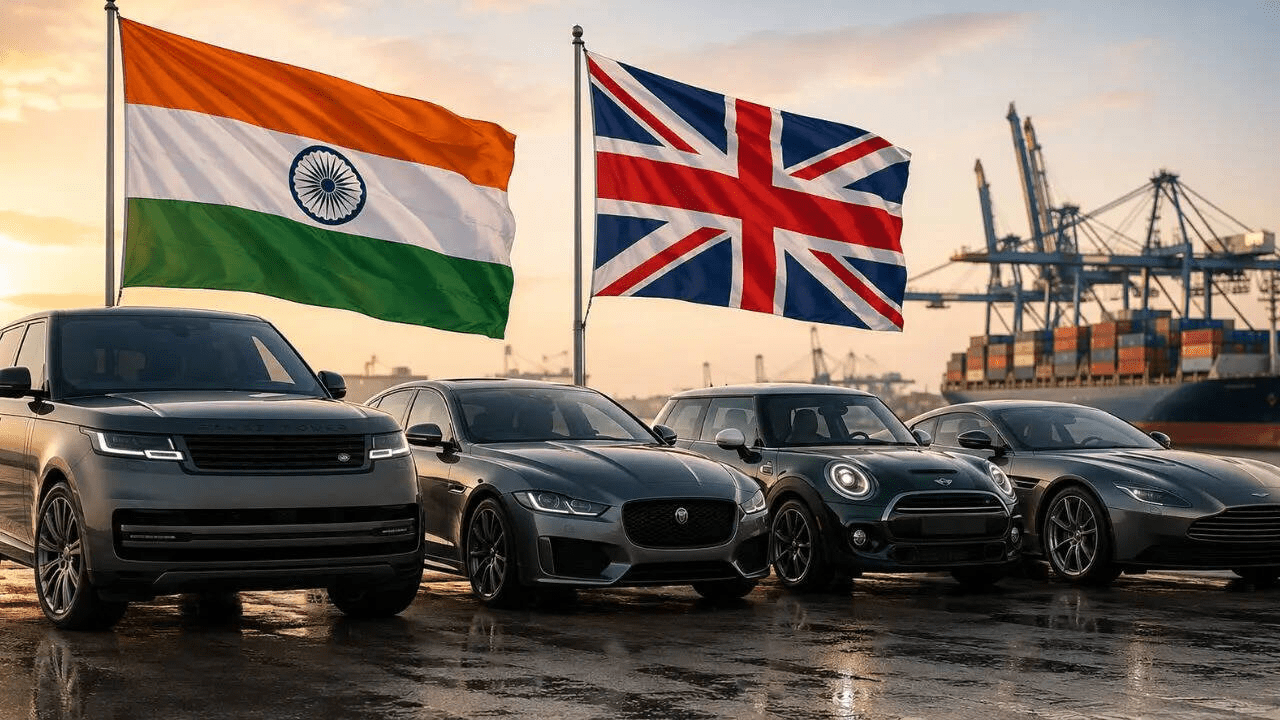
Jaguar Land Rover and McLaren lead the charge with immediate price cuts of up to ₹3.32 Crore, while a new 5-year quota architecture systematically lowers baseline custom outlays down to a mere 10%.
The commercial landscape regulating high-end, imported luxury vehicles in the country is experiencing its most dramatic structural transformation in history. Following the formal announcement from both governments, the historic India-UK FTA car price drop matrix will officially operationalize on Wednesday, July 15, 2026. The implementation of the Comprehensive Economic and Trade Agreement (CETA) systematically dismantles long-standing tax barriers, prompting top-tier British carmakers to announce massive, multi-lakh price cuts across their completely built unit (CBU) lineups.
The trade breakthrough marks a complete rewrite of fiscal rules for luxury auto enthusiasts.
Currently, premium British imports face steep, defensive customs duties of up to 110%, heavily inflating vehicle costs at regional ports.
Under the newly locked-in trade treaty, these base import tariffs will plunge into a sliding, quota-controlled system, giving elite British manufacturing houses an immediate competitive advantage over global rivals.
Also Read | Imran Khan and Bushra Bibi Sentenced to 17 Years in Jail
The Sliding Scale: Understanding the Staged Quota Architecture
The trade framework does not deploy a blanket removal of tariffs; instead, it utilizes a highly sophisticated hybrid system combining phased percentage drops with strict annual volume limits.
During the initial phase, custom cuts are grouped by engine size and fuel type to protect the interests of local manufacturers:
-
High-Capacity Powertrains: Large petrol engines (above 3,000cc) and heavy diesel variants (above 2,500cc) receive an immediate tax drop from 110% down to 30% in year one, managed under a rigid annual cap of 10,000 vehicles.
-
Mid-Range Powertrains: Mid-sized configurations—including petrol engines between 1,500cc and 3,000cc, alongside diesel setups under 2,500cc—will see custom rates ease from 66% down to 50%, operating under a separate 5,000-unit cap.
-
Compact Powertrains: Smaller setups under 1,500cc will also scale down to a 50% custom rate under their own dedicated 5,000-unit window.
Slicing Through the Luxury Fleet Price Drop Matrix
The massive impact of this trade deal is best highlighted by looking at the revised ex-showroom price sheets, with sports car brands moving quickly to pass on savings directly to buyers:
| Imported Brand & Variant | Legacy Pre-FTA Pricing | Anticipated Post-FTA Cost | Total Price Drop | Real-World Tactical Impact |
| McLaren 750S Spider | ₹8.78 Crore | ₹5.46 Crore | ₹3.32 Crore Slid | Represents the single largest supercar discount ever recorded locally. |
| McLaren 750S Coupe | ₹7.94 Crore | ₹4.94 Crore | ₹3.00 Crore Slid | Drops the V8 performance icon below the critical ₹5 Crore threshold. |
| Jaguar Range Rover SV | ₹4.25 Crore | ₹3.50 Crore | ₹75.00 Lakh Cut | Substantially lowers acquisition costs for premium flagship luxury SUVs. |
| McLaren GT Supercar | ₹6.15 Crore | ₹3.83 Crore | ₹2.32 Crore Slid | Repositions the grand tourer against mid-tier continental competitors. |
| Range Rover Sport SV | ₹2.75 Crore | ₹2.35 Crore | ₹40.00 Lakh Cut | Optimizes high-performance track SUV orders ahead of the monsoon. |
Note: While premium luxury SUVs like the Range Rover SV benefit from immediate tariff reductions, popular sister models like the Defender and Discovery will continue to attract full taxes for now. Because those specific lines are built outside the UK at JLR’s facility in Nitra, Slovakia, they remain outside the scope of this treaty, though they may secure relief under the upcoming India-EU trade agreement.
The underlying text of the commerce ministry briefing shows that the country’s negotiators have carefully protected the booming domestic electric vehicle (EV) manufacturing ecosystem.
For the first five years of the deal, alternative-fuel systems—including EVs, plug-in hybrids, and hydrogen fuel-cell models—are entirely excluded from tariff reductions.
Concessions for these advanced green drivetrains will only kick in from the sixth year onward, and will be restricted strictly to premium premium models priced above £40,000 (roughly ₹49.94 Lakh) to prevent cheap, foreign mass-market EVs from disrupting local manufacturing lines.
Also Read | Imran Khan and Bushra Bibi Sentenced to 17 Years in Jail
Five Sequence Steps to Procure an Imported Vehicle Under the New Rules
To take full advantage of the upcoming tariff cuts on July 15 and secure an imported luxury build without running into customs logjams, logistics experts recommend following this verification sequence:
Ultimately, navigating the luxury car market after the historic India-UK FTA car price drop requires recognizing that the industry is entering an entirely new era. While other premium brands like Bentley, Rolls-Royce, and Aston Martin are busy calculating their revised pricing strategies, the initial waves of price reductions from JLR and McLaren have already fundamentally altered market values.
By systematically lowering long-standing trade barriers, the government is successfully balancing international diplomacy with domestic industrial safety.
Taking advantage of these structural adjustments early ensures you can secure a world-class performance machine at unprecedented values, positioning your collection at the very forefront of this historic trade realignment.
FAQ Section
How exactly does the new trade deal trigger an India UK FTA car price drop?
The India-UK Free Trade Agreement replaces old, defensive import tax brackets with a highly efficient, quota-based tariff structure. Starting July 15, 2026, baseline customs duties on eligible British-made internal combustion engine cars will begin a phased drop, eventually sinking from a massive 110% down to a uniform 10% over a five-year period.
Which British luxury models are seeing the biggest immediate price cuts?
High-end sports car and luxury SUV brands have already passed on massive savings. McLaren is leading the rollout, cutting the cost of its 750S Spider by a staggering ₹3.32 Crore and its 750S Coupe by ₹3.00 Crore. Concurrently, Jaguar Land Rover has dropped the price of its ultra-luxury Range Rover SV by ₹75 Lakh and the Range Rover Sport SV by ₹40 Lakh.
Are popular British electric vehicles like the Jaguar I-Pace covered by these new tax breaks?
No. To protect the country’s domestic electric vehicle manufacturing sector, negotiators implemented a strict five-year freeze on alternative-fuel platforms. Electric cars, hybrids, and hydrogen-powered models are completely excluded from custom concessions until the sixth year of the agreement, and will then remain limited to high-end builds priced above £40,000.
Also Read | Imran Khan and Bushra Bibi Sentenced to 17 Years in Jail
End….

