

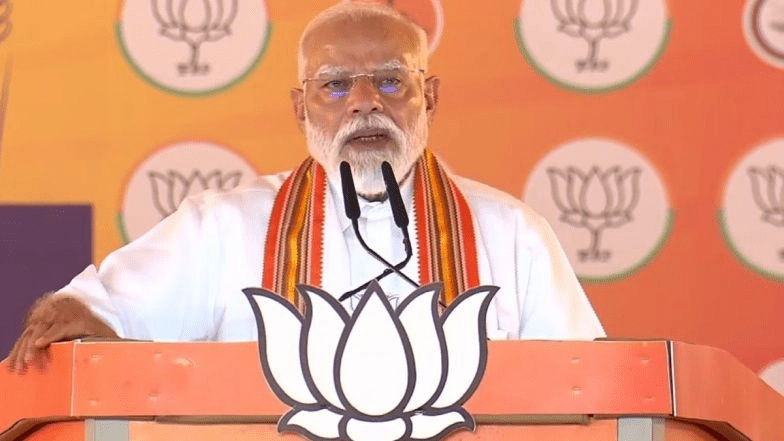
While Prime Ministers Narendra Modi and Christopher Luxon ink a wide-ranging diplomatic upgrade spanning free trade and defense, the MEA defended the Indian leader’s “direct contact” communication style following a local journalist’s question.
AUCKLAND — Marking a major geopolitical shift in the Oceanian corridor, India and New Zealand formally elevated their bilateral relationship to a Strategic Partnership on Saturday during Prime Minister Narendra Modi’s high-profile state visit to Auckland.
The extensive diplomatic upgrade was finalized during restrictive bilateral talks between PM Modi and New Zealand Prime Minister Christopher Luxon. The two leaders reviewed their entire economic and security architecture, pledging deeper integration across defense networks, maritime security, and digital technology frameworks.
1. Diplomatic Friction: MEA Defines Modi’s Communication Style
The high-level diplomatic summit drew unexpected media attention during a joint press briefing when a New Zealand journalist questioned why the Indian Prime Minister seldom engages in open, unscripted press conferences.
Also Read | Cheque Bounce Cases: SC Spares No Room as Delhi HC Orders 3-Month Prison Term for Rajpal Yadav
Bilateral Communication Nodes:
🇳🇿 New Zealand Journalist Query ➔ "Why does the Indian Leader seldom hold open press conferences?"
🇮🇳 MEA Spokesperson Response ➔ "The PM has his own style... He prefers direct contact with the people."
Ministry of External Affairs (MEA) Spokesperson Randhir Jaiswal quickly addressed the query, stating that the Prime Minister utilizes a distinct administrative philosophy that prioritizes unfiltered public interaction.
The Official MEA Stance: “The Prime Minister has his own style of communication,” Jaiswal stated. “He prefers direct contact with the people. He communicates with them directly through various means.”
2. Key Summit Outcomes: Trade, Defense, and the Indo-Pacific
Despite the media exchange, the core focus of the Auckland summit remained fixed on fast-tracking long-stalled economic and security negotiations. Both heads of government reaffirmed their shared commitment to maintaining a free, open, and rules-based Indo-Pacific region—a clear strategic reference to balancing regional maritime assertions.
India-New Zealand Comprehensive Bilateral Matrix
| Sector Initiative | Agreed Strategic Framework | Near-Term Economic & Defense Goal |
| Trade & Investment | Comprehensive Free Trade Agreement (FTA). | Advance locked negotiation rounds to lower dairy, agricultural, and tech tariffs. |
| Defense & Security | Enhanced Maritime Surveillance Data Sharing. | Joint naval exercises and secure supply chain logs across the Pacific rim. |
| Technology & Energy | Critical & Emerging Technologies Initiative. | Collaborative research into food processing systems, green hydrogen, and digital public infrastructure. |
| Mobility & Education | Streamlined Student and Professional Visas. | Enhance research fellowships and accelerate institutional connectivity for skilled Indian workers. |
Chronology of PM Modi’s Three-Nation Tour
The stop in Auckland serves as the definitive anchor for India’s mid-year diplomatic expansion across the Indo-Pacific.
Also Read | Cheque Bounce Cases: SC Spares No Room as Delhi HC Orders 3-Month Prison Term for Rajpal Yadav
Trade analysts suggest that the new Strategic Partnership will inject immediate energy into stalled business linkages, with New Zealand signaling a renewed eagerness to tap into India’s booming consumer market while providing world-class agricultural and educational expertise in return.
Also Read | Cheque Bounce Cases: SC Spares No Room as Delhi HC Orders 3-Month Prison Term for Rajpal Yadav

