

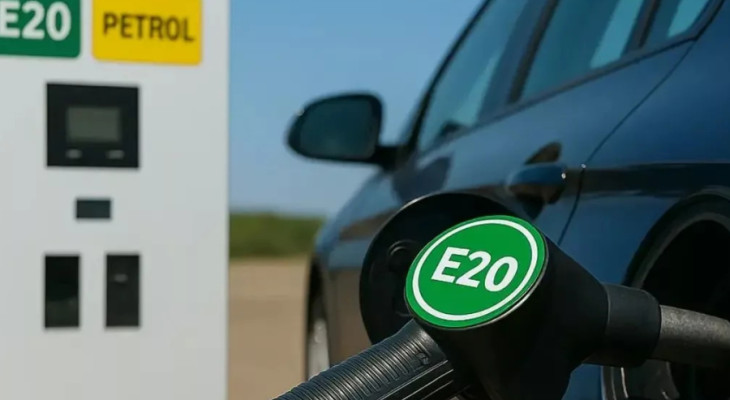
In a newly released FAQ document, the Ministry of Petroleum clarifies that while some vehicles will see a fuel economy drop, the high-octane blend reduces carbon emissions by 40% and acts as a buffer against volatile global oil markets.
NEW DELHI — Addressing growing public criticism and legal challenges regarding India’s mandatory green energy transition, the Ministry of Petroleum and Natural Gas issued a comprehensive Frequently Asked Questions (FAQ) release defending the nationwide rollout of E20 (20% ethanol-blended) petrol.
For the first time, the central government explicitly conceded that the higher concentration of ethanol can result in a 3% to 5% reduction in fuel economy for certain older or non-optimized vehicles. However, officials strongly rejected claims that the policy was a “rushed rollout,” pointing to a two-decade regulatory framework that balances automotive engineering with structural agrarian welfare.
Also Read | Anthropic’s Claude Cowork Moves to the Cloud, Web, and Mobile to Enable Always-On AI Agents
1. The Fuel Trade-Off: Mileage Hit vs. High-Octane Performance
While acknowledging the minor drop in mileage, the petroleum ministry argued that evaluating E20 solely on fuel economy ignores massive mechanical and environmental upgrades.
E20 Performance Balancing Act:
❌ 3-5% Reduction in Fuel Economy (Some Vehicles)
🌱 40% Reduction in Lifecycle Carbon Emissions
🚀 Higher Octane Rating, Faster Combustion, & Smoother Acceleration
According to the government data sheet, ethanol drastically boosts the fuel’s octane rating. This provides superior anti-knock characteristics, smoother engine acceleration, and significantly cleaner engine operations by eliminating the build-up of heavy particulate deposits.
The Environmental Metric: Beyond internal engine performance, E20 fuel reduces overall lifecycle carbon emissions by approximately 40% compared to unblended fossil fuels, while producing negligible tailpipe particulate matter.
Also Read | Anthropic’s Claude Cowork Moves to the Cloud, Web, and Mobile to Enable Always-On AI Agents
2. The Pricing Paradox: Why E20 Isn’t Cheaper for Consumers
A primary source of public frustration has been why a fuel diluted with 20% plant-based additives costs the same as—or more than—pure petrol. The ministry explained that the pricing structure is intentionally designed to provide a financial floor for domestic sugarcane and grain farmers.
The Economics of E20 vs. International Crude
| Global Oil Market Condition | Domestic Production Cost Dynamics | Impact on Consumer Fuel Prices |
| Crude trading at ~$70 / barrel (Current 2026 baseline) | E20 is more expensive to make than pure petrol. Maize ethanol is bought at a fixed floor of ₹71.86/litre before adding GST, transport, and depot handling fees. | Keeps local pump prices stable; prevents predatory pricing from hurting domestic farmers. |
| Crude spiking to $120–$130 / barrel | The financial model flips. Domestic ethanol production becomes dramatically cheaper than importing raw foreign crude oil. | Creates a national shield against global energy spikes, avoiding the massive price surges seen in other nations. |
3. A Two-Decade Policy Evolution
The government firmly pushed back against political critics who claim automotive manufacturers were forced to prematurely adapt to the E20 standards.
The Phased Timeline of India’s Ethanol Blending Program
The transition to E20 petrol is the result of a deliberate, 25-year structural strategy rather than a sudden policy mandate.
Also Read | Anthropic’s Claude Cowork Moves to the Cloud, Web, and Mobile to Enable Always-On AI Agents
By anchoring 20% of the nation’s vehicular fuel grid to domestic agriculture, the ministry emphasizes that India has successfully insulated its broader economy from the erratic price swings of foreign oil producing cartels, ensuring long-term energy sovereignty.
Also Read | Anthropic’s Claude Cowork Moves to the Cloud, Web, and Mobile to Enable Always-On AI Agents

