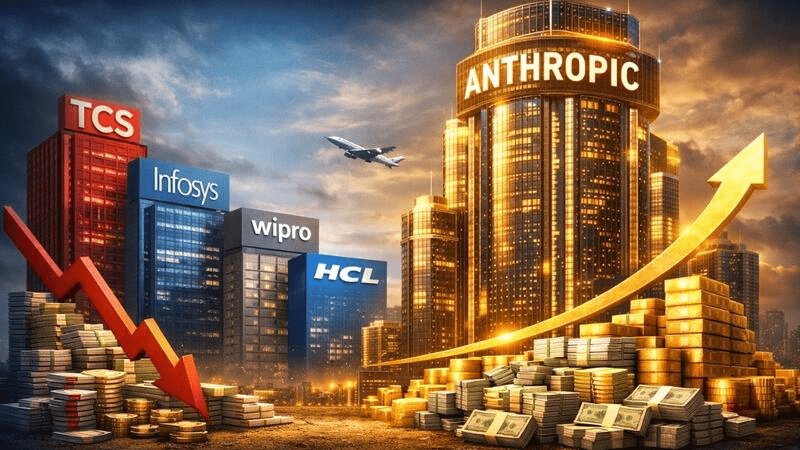
Now the global tech hierarchy is witnessing a massive tectonic shift. Anthropic and OpenAI have officially launched dedicated AI services companies, aiming to bring advanced models like Claude directly into the core operations of mid-sized businesses. Therefore, these ventures are now positioned as direct competitors to Indian IT giants such as TCS, Wipro, and Infosys. Backed by billions in Wall Street capital, these new entities represent a potential “SaaSpocalypse” for traditional software-as-a-service providers.
Also Read | Imran Khan and Bushra Bibi Sentenced to 17 Years in Jail
Anthropic’s $1.5 Billion Bet: The Wall Street Alliance
Now Anthropic is moving beyond being a mere model provider. The AI startup has announced a $1.5 billion joint venture with powerhouse firms including Blackstone, Hellman & Friedman, and Goldman Sachs. Therefore, the new services company is built to act as an “accelerant” for AI adoption in the corporate world.
First, Anthropic and its main partners are each expected to contribute roughly $300 million. Next, the venture is supported by a heavy-hitting consortium including Sequoia Capital and GIC. Thus, the financial muscle behind this project is unprecedented for an AI services startup.
So the mission is to design and maintain enterprise-grade AI deployments. Meanwhile, the firm will leverage the massive portfolios of its investment partners. Therefore, the company has an immediate, built-in customer base ready for Claude’s integration.
How the AI Services Model Challenges Indian IT Giants
Now traditional IT service providers like TCS and Infosys are on high alert. These companies have spent decades building a model based on human-led software maintenance and consulting. Therefore, the rise of “AI-as-a-Service” (AiaaS) threatens their core revenue streams.
First, the new ventures from Anthropic and OpenAI make it easier for clients to get tailored tools without massive consulting overhead. Next, the backing from Wall Street allows these AI firms to reach the C-suite of mid-sized companies more effectively. Thus, the “middleman” role of the traditional IT firm is being squeezed.
So the primary advantage of these new firms is their proximity to the AI researchers. Meanwhile, Indian IT firms must now pivot to prove they can add value on top of these models. Therefore, the competition for enterprise digital transformation has just become much more crowded.
Claude Cowork and the Fear of a ‘SaaSpocalypse’
Now the term “SaaSpocalypse” is making rounds in financial circles again. This fear stems from the idea that AI can automate the very software tasks that IT companies charge for by the hour. Therefore, if Claude can write, debug, and deploy code, the need for large offshore teams diminishes.
First, Claude Cowork had already unsettled Indian IT stocks earlier this year. Next, the formalization of a services company suggests that Anthropic is ready to scale this disruption. Thus, the manual labor of software updates could soon be a thing of the past.
So investors are increasingly cautious about the long-term growth of traditional IT. Meanwhile, the efficiency gains promised by these AI ventures are hard for CFOs to ignore. Therefore, the pressure to cut costs is driving clients toward these new AI-first service providers.
Also Read | Imran Khan and Bushra Bibi Sentenced to 17 Years in Jail
The Workflow: How Anthropic Engineers Build Custom Tools
Now let’s look at how this new firm actually operates. Unlike traditional software installations, these deployments are designed to adapt from the start. Therefore, they work closely with Anthropic’s internal research and product teams.
First, a small team of engineers works directly with a customer to find “high-impact” areas. Next, using the example of a healthcare group, they might automate medical coding and compliance reviews. Thus, the goal is to reduce administrative friction by building tools that fit into existing workflows.
So the clinicians spend less time on paperwork and more on patient care. Meanwhile, the AI models are continuously updated as the research evolves. Therefore, the software never becomes “legacy”—it grows alongside the AI model.
OpenAI’s Rival Move: The Development Company
Now OpenAI is not sitting still. Reports indicate that Sam Altman’s firm is raising funds for a massive rival venture called “The Development Company.” Therefore, the battle for the enterprise market is a two-front war.
First, this venture is seeking a staggering $4 billion from 19 investors. Next, with a $10 billion valuation, it includes backing from Bain Capital, Advent, and Brookfield. Thus, OpenAI is aiming for a much larger scale of deployment than Anthropic.
So while there is no overlap in investors yet, the goals are identical. Meanwhile, both companies are racing to be the primary AI partner for the Fortune 500. Therefore, the summer of 2026 is shaping up to be a defining moment for corporate AI.
Private Equity: The New Frontier for AI Adoption
Now private equity firms are the secret weapon for these AI startups. Investment firms like Blackstone and Apollo manage thousands of companies that are under pressure to improve efficiency. Therefore, these portfolio companies are an attractive, captive target market.
First, the new AI services firms act as a “turnkey solution” for these portfolio companies. Next, it allows the PE firms to implement cost-cutting AI across their entire holdings simultaneously. Thus, the reach of Anthropic and OpenAI is amplified through their investors.
So the adoption curve is likely to be much faster than traditional enterprise software. Meanwhile, mid-sized businesses that were previously ignored by big IT are now the primary focus. Therefore, the “democratization” of high-end AI is happening via the finance sector.
Also Read | Imran Khan and Bushra Bibi Sentenced to 17 Years in Jail
Social Media Alarms: The Response from the Tech Community
Now the reaction on platforms like X has been one of deep concern for the status quo. Industry insiders believe that Indian IT may be in for a very difficult time. Therefore, the lack of preparation for this level of competition is a major talking point.
First, one user noted that Indian IT “just got the competition they weren’t preparing for.” Next, others pointed out that the backing from Wall Street gives these firms an “unfair” advantage in client acquisition. Thus, the sentiment is largely bearish for traditional service providers.
So the conversation is shifting toward how TCS and Infosys can reinvent themselves. Meanwhile, the “SaaS” model itself is being questioned in favor of “Model-as-a-Service.” Therefore, the narrative of the Indian IT success story is facing its first major existential test.
FAQ: Anthropic, OpenAI, and the Future of IT Services
1. What is Anthropic’s new services company? Now it is a $1.5 billion joint venture with Wall Street firms designed to deploy Claude AI models into mid-sized businesses.
2. How does this affect TCS, Infosys, and Wipro? First, it creates direct competition for software services. Next, it threatens to automate tasks that these companies traditionally handle with large human teams.
3. What is OpenAI’s “The Development Company”? So it is a proposed $4 billion venture aimed at enterprise AI deployment, rivaling Anthropic’s new services firm.
4. Why is Wall Street backing these AI firms? Next, investors like Blackstone and Goldman Sachs want to improve the efficiency of their portfolio companies using AI. Thus, it’s a strategic financial move.
5. Will AI replace human IT consultants? Now it is expected to automate repetitive administrative and coding tasks. Meanwhile, high-level strategy will still require human oversight—for now.
6. What is a “SaaSpocalypse”? Finally, it refers to the potential collapse or major disruption of the Software-as-a-Service industry due to the rise of self-coding and self-maintaining AI.
Also Read | Imran Khan and Bushra Bibi Sentenced to 17 Years in Jail
End…