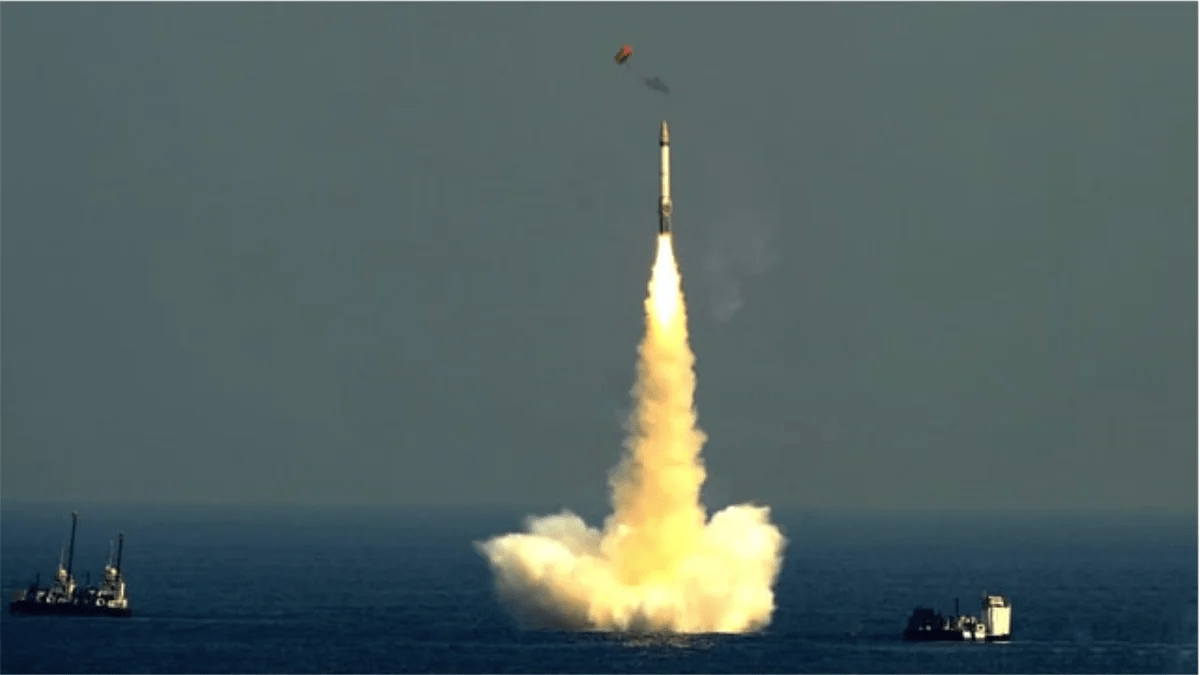
DRDO’s cold-eject gas technology allows the INS Arihant to deploy multi-GNSS guided payloads while remaining completely invisible to international tracking grids.
The architecture governing strategic stability in the Indian Ocean Region (IOR) has reached full maturity through underwater integration. Serving as the primary anchor for the nation’s maritime defense posture, the K 15 Sagarika missile India platform provides a highly survivable, hidden layer of protection. Developed indigenously by the Defence Research and Development Organisation (DRDO), this short-range submarine-launched ballistic missile (SLBM) completes the final leg of the country’s unified nuclear triad.
The system is permanently integrated into the vertical launch systems (VLS) of the country’s first nuclear-powered ballistic missile submarine, INS Arihant (SSBN 80).
Because land-based silos and air-dropped assets remain vulnerable to satellite observation and surprise pre-emptive strikes, moving nuclear capabilities beneath the ocean surface ensures a reliable retaliatory option. This strategic presence guarantees that a decisive second strike remains available even under extreme defensive conditions.
Also Read | Imran Khan and Bushra Bibi Sentenced to 17 Years in Jail
The Cold-Eject Mechanism: Engineering Stealth at Sea
The primary engineering achievement of the K-15 platform is its ability to clear the ocean surface without revealing the exact location of its launch vessel. The missile relies on a highly advanced, two-stage underwater cold-launch sequence.
Rather than igniting its main engines inside the submarine’s hull—which would destroy the launch tube and instantly broadcast the vessel’s thermal signature to enemy satellites—the weapon is pushed out using an independent gas generator.
The high-pressure gas envelope forces the 6-to-7-tonne missile upward through the water columns. Only after the hull clears the surface and reaches a safe altitude do onboard sensors ignite the primary solid-fuel rocket motor, keeping the submarine safely hidden from tracking grids.
Slicing Through the K-Series Technical Architecture
Named in honor of the legendary aerospace scientist and former President, Dr. A.P.J. Abdul Kalam, the K-missile family is engineered using highly reliable solid propellant blocks that keep the systems ready for immediate deployment during extended sea patrols.
| Strategic Design Parameter | Verified Engineering Metric | Operational Advantage | Underlying Technical Component |
| Total Weapon Mass | 6,000 to 7,000 Kilograms | Allows compact integration within submarine hulls. | High-density steel and composite case structures. |
| Physical Length Scale | Exactly 10.0 Meters | Fits cleanly inside standard Arihant VLS vertical cells. | Space-optimized dual-stage rocket architecture. |
| Maximum Warhead Load | Up to 1,000 Kilograms | Accommodates heavy conventional or tactical nuclear warheads. | Specialized strategic shielding assemblies. |
| Standard Striking Range | 750 Kilometers Baseline | Provides localized regional coverage from maritime lines. | Two-stage high-impulse solid rocket motors. |
| Guidance Packages | Sub-10 Meter Circular Error | Delivers precision targeting on high-value coastal centers. | Mid-course INS paired with multi-GNSS tracking. |
Note: While the official baseline range is set at 750 kilometers, defense analysts indicate that reducing the payload mass to a lighter 500-kilogram configuration can extend its reach past 1,000 kilometers, offering greater operational flexibility during open-ocean deployments.
The success of the Sagarika project has allowed DRDO to expand the technology into related defensive systems. Engineers used the core engine designs to build the Shaurya missile, a highly mobile, ground-launched tactical system that flies at hypersonic speeds of Mach 7.5.
Concurrently, to address the short-range limitations of the K-15, which requires submarines to operate closer to shorelines, the Navy is deploying the longer-range K-4 SLBM, which boasts an extended reach of 3,500 kilometers to safely hold distant targets at risk.
Also Read | Imran Khan and Bushra Bibi Sentenced to 17 Years in Jail
Protecting the Balance: The Strategic Doctrine
The deployment of these sea-based weapons is directly shaped by the country’s strict commitment to a No First Use (NFU) nuclear doctrine.
Recent international security briefings from the Stockholm International Peace Research Institute (SIPRI) highlight this shift, confirming that the country’s strategic assets are moving toward a more responsive, integrated posture by keeping specialized warheads permanently deployed aboard its operational submarines.
By combining the natural stealth of a nuclear submarine with the precision of the K-15 Sagarika, India has built a resilient, independent defense shield.
This hidden maritime asset protects the country’s borders from high-altitude coercion and safeguards its territory, ensuring that peace and balance are maintained across the strategic waterways of the Indian Ocean.
FAQ Section
What is the primary function of the K 15 Sagarika missile India platform?
The K-15 Sagarika is an indigenously developed, submarine-launched ballistic missile (SLBM) built to provide India with a secure second-strike capability. Deployed aboard the nuclear-powered INS Arihant, it allows the military to launch a reliable retaliatory nuclear response if land and air bases are ever compromised.
How does the cold-launch mechanism help preserve the submarine’s position?
The cold-launch system uses a high-pressure gas generator to eject the 7-tonne missile from its vertical launch tube, pushing it cleanly out of the water. The primary solid rocket motor ignites only after the weapon clears the ocean surface, preventing the submarine from revealing its exact position through underwater heat signatures or exhaust smoke.
What are the range limitations of the K-15, and how is India addressing them?
The K-15 has a strategic range of roughly 750 kilometers, which limits its ability to engage distant targets without requiring the submarine to venture closer to hostile coastlines. To expand its deterrence options, India is actively deploying the larger K-4 SLBM, which extends the military’s strike reach to 3,500 kilometers.
Also Read | Imran Khan and Bushra Bibi Sentenced to 17 Years in Jail
End…