

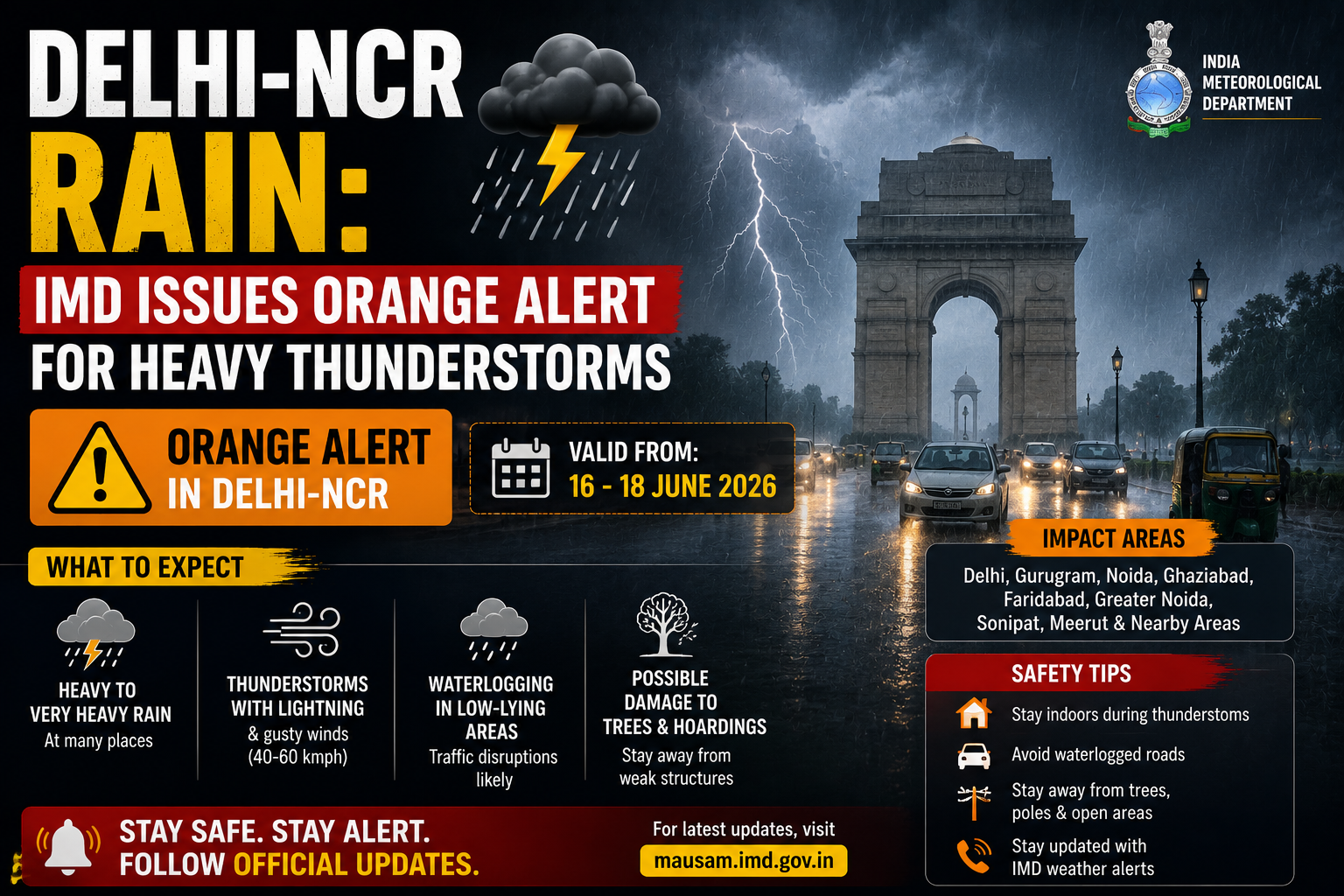
Delhi-NCR Braces for Severe Thunderstorms and Gusty Winds as IMD Issues Regional Orange Alert
NEW DELHI — Following an extended stretch of high humidity and uncomfortable, unsettled weather conditions, the national capital region is preparing for a significant downpour. The India Meteorological Department (IMD) issued an official Orange Alert on Thursday afternoon, indicating that a severe pocket of convective rain and thunderstorms is moving rapidly toward Delhi and its adjoining satellite cities.
The specialized, district-level nowcast indicates that light to moderate precipitation will be accompanied by frequent cloud-to-ground lightning strikes.
Also Read | The Consolidation Milestone: Decoding the TRAI Telecom Subscription Data May 2026
The primary risk factor during this system involves high-velocity atmospheric displacement, with baseline wind speeds of 50 to 60 kmph expected to surge to peak gusts of 70 kmph over the next few hours.
High-Risk Zones and Structural Safety Warning
The immediate path of the storm system covers nearly all administrative sectors of the capital. Residents living across South East Delhi, East Delhi, Shahdara, Central Delhi, North East Delhi, South Delhi, New Delhi, South West Delhi, North West Delhi, and North Delhi are advised to restrict unnecessary outdoor activities.
IMD Immediate Nowcast Parameters:
• Alert Level: Orange Alert (Prepare and exercise high caution during transit).
• Primary Hazards: Moderate rainfall, localized flash flooding, and high-frequency lightning.
• Wind Metrics: Sustained at 50-60 kmph, with localized microburst peaks hitting 70 kmph.
• Atmospheric Driver: Southwest monsoon wind vectors interacting with localized high-heat troughs.
The weather office has highlighted that these wind speeds are strong enough to cause structural complications. Expected impacts include the uprooting of shallow-rooted trees, minor damage to temporary scaffolding or sheet-metal roofs, and immediate visual obstructions along busy shipping and commuting channels.
The Orange Alert status is specifically intended to prompt transport authorities and commuters to prepare for rapidly deteriorating environmental visibility.
Also Read | The Consolidation Milestone: Decoding the TRAI Telecom Subscription Data May 2026
Inter-State Impact and Monsoon Dynamics
The active weather front is part of a broader regional movement as the southwest monsoon advances steadily across the northern plains of India. This movement is pumping vast amounts of oceanic moisture into the upper atmosphere, where it interacts directly with localized heat systems.
As a result, severe weather warnings have been extended well past the borders of Delhi into surrounding agricultural and urban belts:
-
Haryana: Immediate storm cells are forming over Sonipat, Rohtak, Kharkhoda, Mattanhail, Jhajjar, Sohna, and Narnaul.
-
Western Uttar Pradesh: Strong rain bands accompanied by sharp electrical activity are centered over Nandgaon and Barsana.
-
Rajasthan: Multiple western districts—including Tizara, Khairthal, Kotputli, Alwar, Viratnagar, Nagar, Deeg, Laxmangarh, Rajgarh, Nadbai, Bharatpur, Mahawa, Mahandipur Balaji, and Bayana—are managing wind speeds between 30 to 40 kmph.
Safety Advisory from Meteorologists: During active electrical discharges, do not take shelter under isolated trees or stand near metal transmission towers. Secure any unsecured outdoor furniture, and ensure that vehicles are parked away from old brick walls or weak trees.
Motorists across the NCR are being urged to reduce speeds, as sudden, intense rain bursts can quickly compromise tire traction and cause waterlogging in low-lying underpasses.
While the incoming system carries temporary safety risks and transit challenges, the widespread rainfall is expected to break the oppressive summer heat, dropping temperatures significantly across the capital.
Also Read | The Consolidation Milestone: Decoding the TRAI Telecom Subscription Data May 2026
FAQ
What precisely does an IMD ‘Orange Alert’ signify for residents?
An Orange Alert indicates that hazardous weather conditions are highly probable. It serves as an official warning for residents to remain vigilant, prepare for sudden disruptions to power and transport networks, and avoid high-risk outdoor activities.
How do high-velocity winds affect urban driving conditions during a nowcast window?
Winds gusting up to 70 kmph can create dangerous cross-winds for two-wheelers and high-profile vehicles. Additionally, these winds can throw loose debris across lanes and tear down overhead branches, making reduced speeds and defensive driving essential.
Is this thunderstorm system a sign that the monsoon has completely arrived?
The storm is driven by the steady advance of the southwest monsoon across northern India. As moist air masses move into the region and collide with local high-temperature zones, they create unstable conditions that trigger intense, localized thunderstorms ahead of sustained seasonal rainfall.
What should I do if my vehicle gets trapped in a low-lying, waterlogged zone?
If water rises rapidly around your vehicle, avoid driving through the deepest sections to prevent your engine from stalling due to water intake. If your vehicle stalls, abandon it immediately if safe to do so, move to higher ground, and wait for municipal drainage systems to clear the runoff.
Also Read | The Consolidation Milestone: Decoding the TRAI Telecom Subscription Data May 2026

