

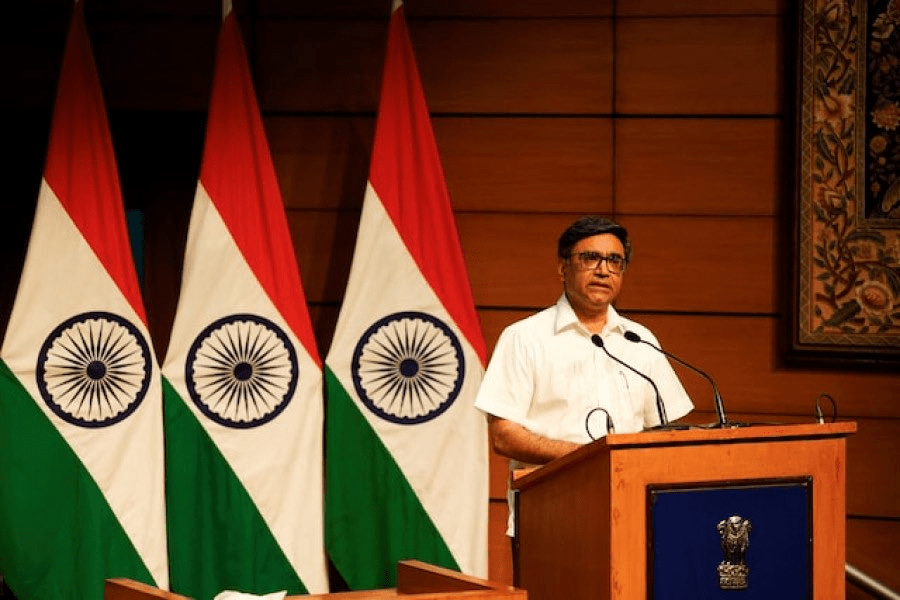
Now the delicate diplomatic balance between India and Nepal has faced another significant tremor. Prime Minister Balen Shah has reportedly refused to meet with India’s visiting Foreign Secretary Vikram Misri, citing what has been described as a “stature gap.” Therefore, the Indian government has moved to cancel the proposed visit entirely, marking a sharp decline in bilateral ties under the Shah administration. Meanwhile, as the two nations navigate historical border disputes and the resumption of the Kailash Mansarovar Yatra, this internal policy shift in Kathmandu suggests a new, more rigid approach to foreign engagement.
Also Read | Imran Khan and Bushra Bibi Sentenced to 17 Years in Jail
The Stature Row: Why Balen Shah Refused the Meeting
Now the controversy centers on a specific protocol shift within the Nepalese Prime Minister’s office. Reports indicate that Balen Shah has shown a persistent reluctance to meet visiting foreign officials who hold a rank below that of a Foreign Minister. Therefore, the scheduled interaction with India’s Foreign Secretary Vikram Misri was viewed as inappropriate for the Prime Minister’s stature.
First, this is not an isolated incident for the Shah administration. Next, Balen Shah had earlier refused to meet the US Assistant Secretary of State, S Paul Kapur, and United special envoy Sergio Gor. Thus, Kathmandu appears to be enforcing a strict hierarchy in its diplomatic engagements, regardless of the importance of the visiting nation.
So while Nepal’s Foreign Minister Shisir Khanal has met with these officials, the Prime Minister remains distant. Meanwhile, Indian observers view this as a strategic distancing move that further complicates an already fragile relationship. Therefore, the “stature issue” is being seen as a mechanical barrier to high-level problem-solving.
Diplomatic Fallout: India Cancels FS Misri’s Visit
Now following the reported refusal from the Prime Minister’s office, New Delhi has taken the decisive step of cancelling Vikram Misri’s visit. FS Misri had been invited by his Nepalese counterpart, Amrit Bahadur Rai, to discuss the immediate priorities of the Shah government. Therefore, the cancellation reflects India’s disapproval of the breach in traditional diplomatic courtesy.
First, Misri was expected to formally invite PM Balen Shah for a visit to India. Next, the visit was intended to address the growing standoff over the Kailash Mansarovar Yatra. Thus, the absence of this dialogue means that critical issues remain unresolved and prone to further escalation.
So the invitation from Nepal’s Foreign Secretary was intended to mend ties amid a “turmoil” that has lasted several years. Meanwhile, the cancellation of a high-level visit of this nature is a rare and serious signal in South Asian diplomacy. Therefore, the ball is now in Kathmandu’s court to restore a functional dialogue channel.
The Lipulekh Conflict: Understanding the Territorial Claims
Now the underlying tension in the relationship is fueled by the long-standing border row concerning the Kalapani-Limpiyadhura-Lipulekh trijunction. Nepal has consistently objected to Indian infrastructure projects in this region, claiming it as Nepalese territory under the 1816 Sugauli Treaty. Therefore, the “Lipulekh issue” has become a flashpoint for nationalist sentiment in both countries.
First, India has dismissed Nepal’s objections, characterizing the territorial claims as an “unilateral artificial enlargement” of its borders. Next, Kathmandu recently expressed readiness to resolve the issue through diplomatic channels rather than public confrontation. Thus, there is a visible struggle between domestic political posturing and the need for a realistic border settlement.
So the Lipulekh Pass remains a critical strategic point for India’s border security and pilgrimage access. Meanwhile, Nepal Airlines recently had to apologize for posting an incorrect map of India, further agitating the situation. Therefore, the map controversy continues to cast a long shadow over every diplomatic interaction.
Also Read | Imran Khan and Bushra Bibi Sentenced to 17 Years in Jail
Kailash Mansarovar Yatra: The Religious and Strategic Divide
Now India and China have recently agreed to resume the Kailash Mansarovar Yatra, a development welcomed by Hindu devotees worldwide. However, Nepal has officially objected to the proposed route via the Lipulekh Pass. Therefore, the pilgrimage has transitioned from a religious event into a major geopolitical dispute in 2026.
First, Kathmandu claims the Yatra passes through territories it considers sovereign. Next, New Delhi maintains that the route through Uttarakhand is entirely within Indian borders and is non-negotiable. Thus, the religious sentiments of millions are currently caught in the crossfire of Himalayan border politics.
So the Nepalese Foreign Ministry spokesperson, Lok Bahadur Chhetri, has publicly stated their readiness for diplomatic talks. Meanwhile, devotees await a clear resolution that ensures the safety and continuity of the Yatra. Therefore, the Kailash Mansarovar standoff remains the most urgent “people-to-people” issue on the bilateral agenda.
Regional Influences: The China Factor and Nepal’s Policy Shift
Now the shift in Nepal’s policy is also viewed through the lens of regional power play. Analysts point to the previous KP Sharma Oli government’s inclination toward China as the starting point for this “turmoil.” Therefore, under PM Balen Shah, the perception of an “anti-India” or “pro-Beijing” tilt continues to dominate the narrative in New Delhi.
First, the “adverse policy decisions” mentioned in reports suggest that Nepal is seeking to diversify its dependencies. Next, the strategic importance of the trijunction area makes it a key interest for Beijing as well. Thus, Nepal’s diplomatic “rigidity” might be a reflection of broader regional rebalancing.
So the Indian government remains vigilant regarding infrastructure developments along the northern border. Meanwhile, Nepal’s assertion of its Sugauli Treaty claims is seen as a way to assert sovereignty in a crowded geopolitical space. Therefore, the China factor remains an unspoken but omnipresent element in the India-Nepal standoff.
IBCA Summit: A Chance for Rapprochement in New Delhi?
Now despite the current standoff, a potential window for dialogue has emerged through environmental diplomacy. India has invited the Nepalese leadership to attend the International Big Cat Alliance (IBCA) summit in July 2026. Therefore, New Delhi is utilizing global platforms to keep the door open for communication.
First, the IBCA summit on June 1—followed by a high-level meeting in July—provides a neutral ground to discuss conservation and cooperation. Next, Nepalese Foreign Minister Shishir Khanal is likely to lead the delegation to India. Thus, the tiger and leopard conservation efforts might ironically be the bridge that brings the two neighbors back to the table.
So while there is no official confirmation of PM Balen Shah’s attendance, the invitation stands as a goodwill gesture. Meanwhile, the platform will focus on protecting seven key species, including the snow leopard and tiger. Therefore, ecological diplomacy could be the first step toward thawing the current frost in bilateral relations.
Also Read | Imran Khan and Bushra Bibi Sentenced to 17 Years in Jail
Nepal’s ‘Diplomatic Readiness’: Official Statements from Kathmandu
Now the official stance from Kathmandu remains focused on “diplomatic resolution.” Following India’s firm dismissal of their border objections, Nepal’s Foreign Ministry spokesperson has reiterated their views on Lipulekh. Therefore, the rhetoric remains firm but is coupled with a call for structured talks.
First, Nepal has made its public views clear regarding the Kailash Mansarovar journey passing through its claimed territory. Next, the readiness for talks suggests that the “stature issue” might be a specific internal policy rather than a total diplomatic blackout. Thus, the possibility of a Foreign Minister-level meeting remains high.
So the upcoming months will determine if the “stature gap” can be bridged through higher-ranking delegations. Meanwhile, the Shah government is under pressure from domestic nationalist groups to maintain a strong stance on border issues. Therefore, the “balancing act” for Kathmandu is becoming increasingly complex.
FAQ: Frequently Asked Questions on India-Nepal Tensions
1. Why did Balen Shah refuse to meet Vikram Misri? Now, reports suggest he cited a “stature gap,” preferring to meet only with foreign officials at the level of a Foreign Minister or higher.
2. What is the main border dispute between India and Nepal? First, the dispute concerns the Kalapani-Limpiyadhura-Lipulekh trijunction, which Nepal claims based on the 1816 Sugauli Treaty.
3. What is the IBCA summit? So the International Big Cat Alliance (IBCA) is a global platform launched by PM Modi to protect seven key big cat species, including tigers and leopards.
4. Has the Kailash Mansarovar Yatra been stopped? Next, India and China have agreed to resume the Yatra, but Nepal has objected to the route passing through the Lipulekh Pass.
5. Who is Vikram Misri? Now, Vikram Misri is India’s Foreign Secretary, a high-ranking official in the Ministry of External Affairs (MEA).
6. Will PM Balen Shah visit India soon? Finally, there is no official confirmation, but he has been invited to attend the IBCA summit in July 2026.
Also Read | Imran Khan and Bushra Bibi Sentenced to 17 Years in Jail
End…

