

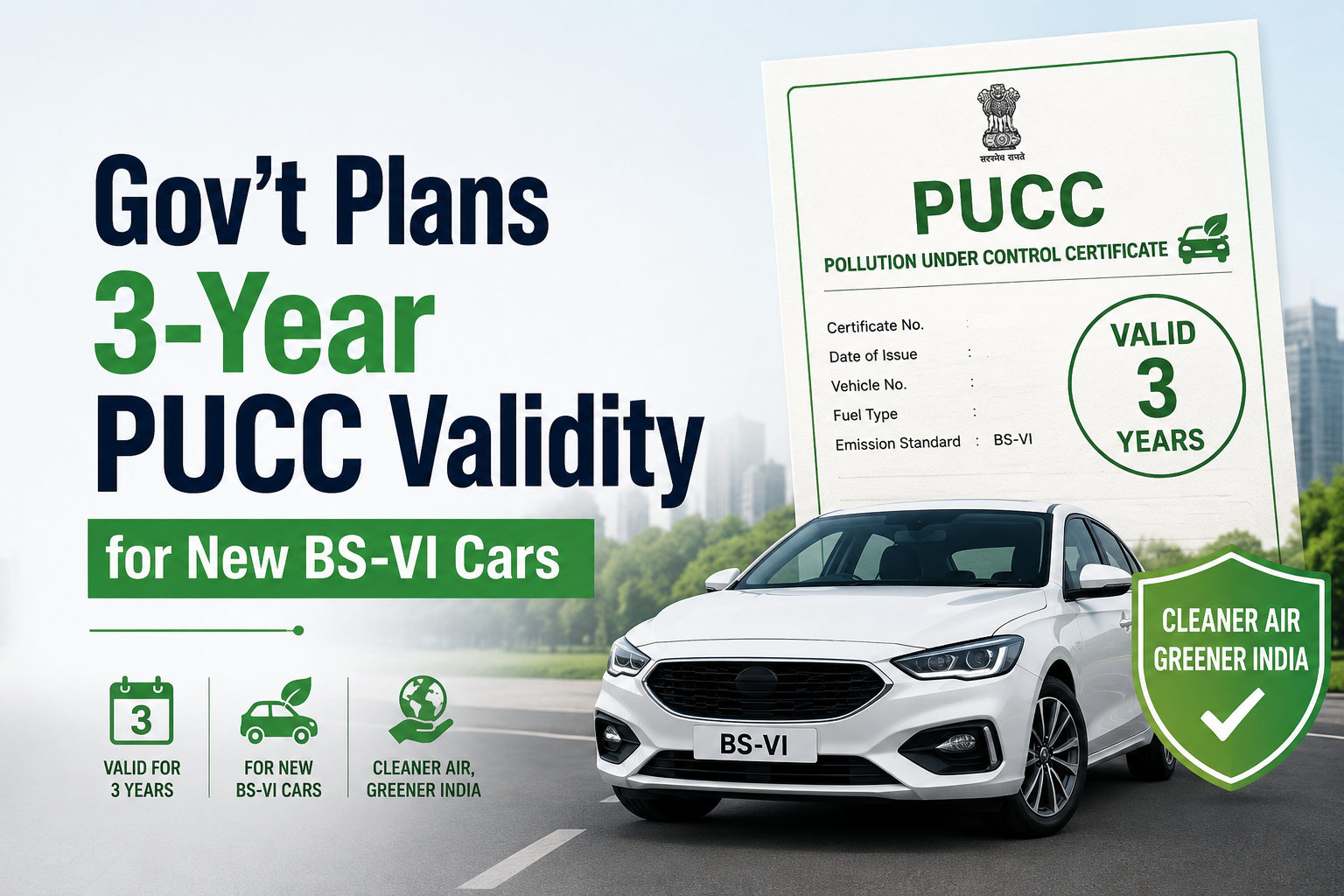
Under the tiered framework, private BS6 cars under six years old would drop annual checks, shifting to a more flexible, long-term renewal pipeline.
New Delhi | Published: June 24, 2026, 8:30 PM IST
The Central Government is evaluating a major policy shift in vehicle emission compliance, aiming to relax the renewal timelines for Pollution Under Control Certificates (PUCC) for Bharat Stage VI (BS-VI) compliant vehicles. The draft framework intends to significantly lower the paperwork and compliance hurdles for owners who purchase newer, structurally cleaner automotive models across India.
The standout change in the proposal is a plan to extend the baseline PUCC validity period for new BS-VI private vehicles from the current one-year mandate to a extended three-year block. Under this system, owners of a brand-new BS6 private car would only need to stop at an emission testing kiosk twice during the first six years of the vehicle’s lifespan.
Also Read | Imran Khan and Bushra Bibi Sentenced to 17 Years in Jail
                           [Proposed BS-VI PUCC Validity Blueprint]
                                               │
         ┌─────────────────────────────────────┼─────────────────────────────────────┐
         ▼                                     ▼                                     ▼
 [Private: Age 0 to 6 Years]          [Private: Age 6 to 10 Years]          [Private: Age 10+ Years]
 • Validity: 3 Years                  • Validity: 1 Year (Annual)           • Validity: 6 Months
 • Target: Minimizes routine kiosk    • Target: Normalizes checking cadence • Target: Tightens oversight on aging,
   stops for new vehicles.              as engine components mature.          potentially high-polluting engines.
Tiered Structural Frameworks and Commercial Allocation Rules
The proposed framework drops the traditional one-size-fits-all approach to emission testing, replacing it with a clear, age-dependent compliance path. While private vehicles enjoy a three-year validity window during their first six years on the road, the schedule shifts as the vehicle ages: cars between six and 10 years old will move to annual renewals, while vehicles older than 10 years must clear testing every six months.
[Commercial BS-VI Fleet] ──► Fleet Assets Under 6 Years of Age
                                           │
                                           ▼
[Two-Year PUCC Extension] ──► Extended Validity Window Acknowledging High-Mileage Wear
Recognizing the demanding operating conditions of business fleets, the government is also drawing up distinct guidelines for commercial BS-VI vehicles:
-
Commercial Fleets (0 to 6 Years): Eligible transport and commercial vehicles will see their initial PUCC validity extended to two years.
-
Commercial Fleets (Beyond 6 Years): Once a commercial asset crosses the six-year operational mark, it aligns directly with the standard private vehicle tier, requiring more frequent checks.
Also Read | Imran Khan and Bushra Bibi Sentenced to 17 Years in Jail
Technical Benchmarks and Regulatory Debate
The core justification for this regulatory update lies in the superior engineering of the BS-VI platform. Compared to older BS-IV iterations, BS-VI-compliant engines produce up to 82 percent less particulate matter (PM) and roughly 25 percent less nitrogen oxides (NOx). This massive reduction in tailpipe output makes newer vehicles inherently less threatening to regional air quality.
While transport policy experts have voiced solid support for the changes—pointing out that the structural cleanliness of new engines warrants longer certification windows—automotive safety advocates urge caution. Some transport experts note that poor vehicle maintenance and irregular servicing can cause even a relatively new engine to burn fuel inefficiently, potentially creating hidden high-emission spikes if oversight is removed for three years at a time. To balance these risks, the government is working to upgrade the technology at local testing centers to ensure greater data accuracy and prevent any manipulation of emission readings.
FAQ
Q1: Will my current BS-IV vehicle qualify for the new three-year PUCC validity extension?
No. This proposal applies strictly to Bharat Stage VI (BS-VI) compliant vehicles. Legacy BS-IV and older models will continue to follow their current, more frequent testing schedules because their engines produce significantly higher baseline particulate matter and nitrogen oxide emissions.
Q2: How does the PUCC renewal schedule change as a private BS-VI vehicle gets older?
The proposed rules use a tiered approach: vehicles up to 6 years old get a 3-year certificate validity; vehicles between 6 and 10 years old transition to an annual (1-year) check; and cars older than 10 years must be tested every 6 months to monitor aging components.
Q3: What steps is the government taking to make sure long-term certificates aren’t abused?
To prevent poorly maintained, high-emitting vehicles from flying under the radar during the three-year validity window, the government is simultaneously rolling out stricter testing infrastructure upgrades. This includes deploying tampermany-proof digital verification software at testing kiosks to block manual data overrides.

