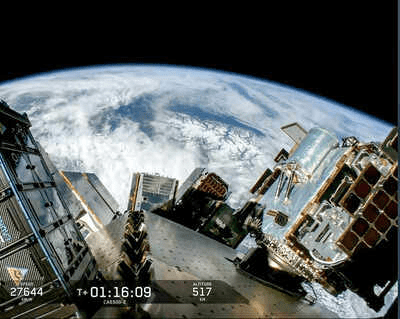
Now India’s private space sector is celebrating a massive breakthrough. Bengaluru-based startup GalaxEye successfully launched its “Mission Drishti” satellite Sunday morning. This platform is the world’s first “OptoSAR” satellite, combining optical and radar imaging. Therefore, it can provide clear images even through thick clouds or total darkness. Meanwhile, the mission marks a new era for Indian defense and disaster relief capabilities.
Also Read | Imran Khan and Bushra Bibi Sentenced to 17 Years in Jail
What is OptoSAR Technology?
Now we must understand what makes this satellite unique. Traditional satellites usually carry one type of camera. Therefore, they have specific limitations depending on the environment.
First, Mission Drishti combines two systems into one platform. These are electro-optical (EO) and synthetic aperture radar (SAR). Next, the company calls this “OptoSAR” technology. Thus, it is the first of its kind in the global commercial market.
So why does this matter? One sensor provides high-resolution colors, while the other “sees” through obstacles. Meanwhile, the integration allows for a continuous stream of data. Therefore, the satellite never goes “blind” due to weather.
Optical vs. Radar Imaging: The Hybrid Advantage
Now let’s look at the science behind the sensors. Electro-optical sensors work like a powerful camera. Therefore, they capture beautiful, detailed images when the sun is out.
First, these sensors fail during rain, fog, or night. Next, Synthetic Aperture Radar (SAR) uses radar pulses to create images. Thus, it doesn’t need sunlight to work.
So by combining both, Mission Drishti offers the best of both worlds. Meanwhile, it generates “decision-grade” intelligence. Therefore, governments can rely on the data 24/7 without interruption.
Mission Drishti’s Role in Defense and Security
Now the strategic importance of this launch is clear. For defense and border surveillance, visibility is often a life-or-death issue. Therefore, OptoSAR technology provides a critical edge.
First, the satellite can monitor borders during heavy cloud cover. Next, it offers nighttime tracking of movements in remote areas. Thus, it fills a major gap in India’s current surveillance network.
So regions with poor weather will no longer be hidden. Meanwhile, the dual-use system supports both tactical and strategic planning. Therefore, security agencies gain a more reliable eye in the sky.
Also Read | Imran Khan and Bushra Bibi Sentenced to 17 Years in Jail
Transforming Disaster Relief and Agriculture
Now the civilian applications are equally impressive. For disaster management, speed is everything. Therefore, Mission Drishti could save lives during cyclones or floods.
First, the radar sensor can map flood zones even during heavy rain. Next, it helps track wildfires and evaluate damage after earthquakes. Thus, rescue teams can deploy resources much faster.
So agriculture will also benefit from this data. Meanwhile, the system tracks crop health and soil moisture consistently. Therefore, farmers can improve their yields through better irrigation patterns.
The Shift Toward India’s Private Space Sector
Now this launch reflects a massive policy shift in India. For decades, ISRO was the only player in the game. Therefore, private companies were largely sidelined.
First, recent regulatory reforms opened the door for start-ups. Next, GalaxEye spent five years on indigenous research and payload validation. Thus, Mission Drishti is a product of Indian private innovation.
So the achievement places Bengaluru on the global space map. Meanwhile, policy changes now allow private firms to build their own launch systems. Therefore, the ecosystem is growing at an incredible speed.
Future Plans: The 10-Satellite Constellation
Now GalaxEye is not stopping with just one satellite. The company has a roadmap to scale up its operations. Therefore, they plan to build a constellation by 2030.
First, the goal is to have 10 satellites in orbit. Next, this network will provide high-frequency observation of the entire planet. Thus, India could have a sovereign, real-time insights network.
So this will support both domestic and global markets. Meanwhile, the company is targeting “decision-grade” data for businesses. Therefore, the commercial potential is enormous.
Also Read | Imran Khan and Bushra Bibi Sentenced to 17 Years in Jail
Global Standing of Indian Space Start-ups
Now India is entering a small group of global players. Lt Gen AK Bhatt (Retd) noted that few companies can integrate EO and SAR. Therefore, GalaxEye’s success is a major technical win.
First, this mission aligns with India’s broader Earth observation goals. Next, ISRO already has 29 active observation satellites. Thus, the private sector is now adding to this national strength.
So the Falcon 9 launch from California is just the beginning. Meanwhile, international investors are looking closely at Indian tech. Therefore, more breakthroughs are expected soon.
FAQ: Mission Drishti and OptoSAR
1. What is an OptoSAR satellite? Now it is a satellite that combines optical cameras and radar sensors on one platform.
2. Who developed Mission Drishti? First, it was developed by GalaxEye, a Bengaluru-based start-up.
3. Why is it better than traditional satellites? So it can see through clouds, rain, and darkness. Thus, it provides continuous 24/7 monitoring.
4. How will it help in agriculture? Next, it tracks crop health and soil moisture regardless of the weather. Therefore, it provides consistent data.
5. How many satellites will be in the constellation? Now the goal is to have 10 satellites in orbit by the year 2030.
6. Where was it launched from? Finally, it was launched aboard a SpaceX Falcon 9 rocket from California.
Also Read | Imran Khan and Bushra Bibi Sentenced to 17 Years in Jail
End…