

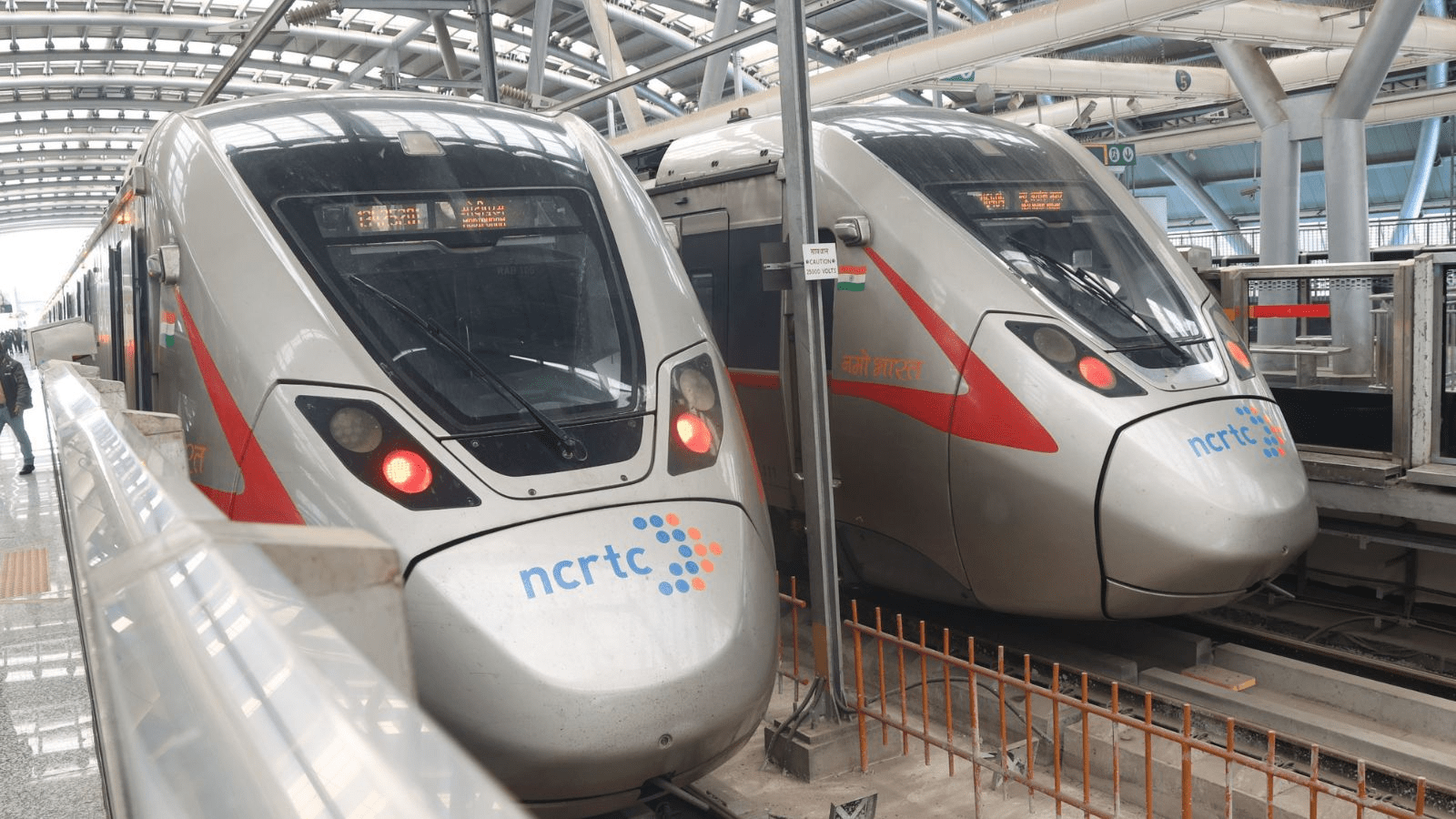
Now the industrial and logistical connectivity of the National Capital Region is entering an incredibly progressive expansion phase. The state of Rajasthan has officially joined the next-generation ‘Namo Bharat’ Regional Rapid Transit System (RRTS) network following a historic bilateral consensus achieved with the Haryana government. Therefore, the long-delayed planning blockades limiting transit acceleration between New Delhi and Alwar have been successfully dissolved. Official updates published by the Rajasthan Chief Minister’s Office on Monday, May 18, 2026, confirm that rapid technical surveys have achieved total alignment clearance. Meanwhile, this high-speed, 196-kilometer corridor will serve as a vital economic lifeline. Following a designed operating velocity of 160 kmph, this technical ecosystem acts as a mechanical necessity to boost manufacturing output across major special investment zones.
Also Read | Imran Khan and Bushra Bibi Sentenced to 17 Years in Jail
At a Glance: Namo Bharat Delhi-Alwar Corridor Framework
| TRANSIT GRID PARAMETER | DESIGNED COMPLIANCE SPECIFICATION | STRATEGIC INFRASTRUCTURE SIGNALS |
| Total Corridor Length | 196 Kilometers of Dedicated Alignment | High-Speed Trans-Provincial Link |
| Maximum Operational Speed | 160 kmph Capabilities via Electric Rakes | Three Times Faster Than Traditional Metro |
| Rajasthan Spatial Share | 91 Kilometers of Dedicated Route Tracks | Extensive Internal Territorial Penetration |
| Total Station Matrix | 22 Major Transit Stations Planned | Comprehensive Regional Interactivity |
| Rajasthan Station Nodes | 6 Proposed Stations Built Across Borders | Anchoring Core Industrial Corridors |
| Central Exchange Hub | Sarai Kale Khan Terminal (New Delhi) | Master Convergent Interoperable Node |
The Inter-State Consensus: Unlocking the Delhi-Gurugram-SNB-Alwar Grid
Now the bureaucratic logjams that historically restricted high-speed rail integration across northern India have completely dissolved. Executive coordination teams from Jaipur and Chandigarh successfully finalized a shared financial and administrative framework to expand the semi-high-speed rail lines. Therefore, the National Capital Region Transport Corporation (NCRTC) has received immediate clearance to deploy earth-moving machinery along the revised alignment.
First, this political agreement establishes an unyielding framework for proportional cost-sharing regarding structural acquisition liabilities. Next, the state finance departments have issued immediate priority codes to release early funding tranches for initial civil infrastructure installation. Thus, clearing this complex cross-border regulatory boundary acts as a massive validation of synchronized regional development policies.
So land management blocks across both states are already setting up specialized fast-track registration counters to clear title deeds. This rapid intervention avoids the long legal delays that traditionally slow down heavy infrastructure corridors. Meanwhile, engineering units are establishing localized testing yards to calibrate high-voltage traction systems before active track-laying begins. Therefore, the inter-state consensus establishes an exceptionally confident baseline for the project’s next phase.
Mapping the Fleet Path: Tracking Key Station Nodes from Sarai Kale Khan
Now analyzing the technical route profile reveals a highly sophisticated layout designed to pass through the region’s dense commercial hubs. The primary corridor originates at the mega Sarai Kale Khan terminal in New Delhi before moving southwest through high-density urban zones. Therefore, the alignment has been engineered to capture maximum rider volumes from both residential and commercial sectors.
First, the trains will exit the capital via critical underground and elevated stations at Munirka and Aerocity. Next, the high-speed tracks will span across Gurugram and Bawal before reaching the crucial Shahjahanpur-Neemrana-Behror (SNB) urban complex. Thus, the mechanical necessity of linking these separate manufacturing communities into a single transit loop is fully satisfied.
[Sarai Kale Khan Hub] ──► [Munirka & Aerocity Nodes] ──► [Gurugram Commercial Center]
                                                                    │
                                                                    ▼
[Alwar Terminal Grid] ◄── [Khairthal Junction Base]  ◄── [SNB Master Strategic Hub]
So an advanced secondary spur expanding from the SNB node will target Sotanala through the Neemrana and Behror industrial layouts. Within Rajasthan’s boundaries, the rail alignment will cover exactly 91 kilometers and include six world-class stations. Meanwhile, local urban development bodies are re-zoning land surrounding these future station footprints to facilitate high-density transit-oriented communities. Therefore, the route map delivers a precise blueprint for future regional movement.
Also Read | Imran Khan and Bushra Bibi Sentenced to 17 Years in Jail
The Industrial Windfall: Catalyzing Growth Across Bhiwadi and Neemrana
Nowhere does the structural impact of the Namo Bharat expansion manifest more powerfully than within the state’s premier manufacturing zones. Major manufacturing landscapes, including Bhiwadi and Neemrana, have faced logistical constraints due to their reliance on congested highway infrastructure. Therefore, introducing a highly reliable, high-frequency rail network will transform local supply chain economics.
-
Ecosystem Advantages for NCR Industrial Hubs:
-
Workforce Mobility: Allowing technical professionals from Delhi and Gurugram to commute to factories within 45 minutes.
-
Inbound Capital: Escalating the corporate attractiveness of Alwar districts for global manufacturing investments.
-
Real Estate Value: Driving high-density residential developments around the six designated Rajasthan stations.
-
Carbon Reduction: Shifting millions of daily commuter miles away from fossil-fuel-dependent road transit lines.
-
First, this vertical logistical improvement reduces the absolute operational costs borne by multi-national electronics assembly units. Next, the access to an expanded talent pool allows manufacturing operations to scale up their technical excellence models cleanly. Thus, the rapid rail network functions as a reliable engine driving fresh industrial growth deep into the state’s borders.
Phase One Horizons: Cross-Referencing Meerut and Panipat Milestones
Now to appreciate the systemic timeline governing these modern transit corridors, one must look at the broader regional rapid network. Under the comprehensive Integrated Transport Plan, three primary transit routes were designated for immediate development in the opening phase. Therefore, the Alwar corridor benefits directly from the engineering lessons learned on parallel lines.
First, the landmark Delhi-Ghaziabad-Meerut alignment has already completed its public inauguration phases, proving the real-world efficiency of the rolling stock. Next, the northern Delhi-Panipat-Karnal corridor is actively progressing through its final structural installation reviews. Thus, the mechanical necessity of building out the Alwar route represents the final major piece needed to complete the tri-directional transit shield.
So the unified construction standards ensure that identical, aerodynamic aerodynamic rakes can move across separate provincial routes without experiencing track errors. This massive standardization across hundreds of kilometers minimizes long-term spare-parts procurement costs for the central exchequer. Central monitoring hubs are transferring real-time tracking software architectures from the Meerut line to accelerate local system configuration. Therefore, the phase one horizons demonstrate a mature, highly repeatable infrastructure playbook.
The Interoperability Mandate: Building Seamless Interchange Architectures
Now the defining engineering characteristic that separates the Namo Bharat ecosystem from legacy standalone rail lines is absolute system interoperability. All three independent rapid corridors have been meticulously engineered to function as a single, fully integrated transit machine. Therefore, a commuter can transition between diverse regional routes without changing platforms or buying separate ticketing assets.
The Interchange Synergy Matrix:
-
The Core Interchange Hub: Anchored directly at Delhi’s massive, multi-level Sarai Kale Khan station.
-
The Software Substrate: Utilizing unified European Train Control System (ETCS) Level-2 digital signaling arrays.
-
The Platform Interface: Standardized platform-screen doors matched to identical train boarding limits.
-
The Financial Loop: Operating single open-loop smart cards that process cross-corridor fares seamlessly.
First, this integrated design allows trains from the Alwar line to run directly onto the Meerut tracks during peak morning travel windows. Next, the high-speed signaling automation adjusts train spacing dynamically down to a few seconds, completely preventing localized traffic bottlenecks. Thus, the interoperability mandate successfully removes historical transit walls between neighboring states.
Also Read | Imran Khan and Bushra Bibi Sentenced to 17 Years in Jail
Multimodal Integration: Linking Aviation, Bus Fleets, and Metro Lines
Now the true systemic utility of the incoming rapid rail lines relies heavily on their smooth integration with existing transport assets. The NCRTC is building expansive multimodal transit hubs where elevated rail paths interface directly with pre-existing transit infrastructure. Therefore, long-distance travelers can switch between different modes of transport without exiting the climate-controlled station perimeters.
-
Multimodal Integration Matrix:
-
Aviation Connectivity: Directly linking Aerocity station with Indira Gandhi International Airport terminal networks.
-
Inter-State Buses: Providing direct pedestrian bridges connecting platforms straight into major bus terminuses.
-
Intra-City Metros: Establishing seamless, high-speed underground transfer walks to the Delhi Metro grid.
-
Local Transport: Creating optimized pickup bays for electric auto-rickshaws and micro-mobility fleets.
-
First, this comprehensive linking system eliminates the traditional “last-mile” friction points that frequently discourage commuters from using public transit. Next, it allows professionals to manage complex travel schedules across multiple states with absolute precision. Thus, building these connected hubs satisfies a critical requirement for creating truly modern, livable smart cities.
RRTS vs. Legacy Metros: The Evolution of Next-Gen Inter-City Transit
Now macro-level urban transportation planners are highlighting why standard intra-city metro expansions cannot replicate the economic benefits of the RRTS. While conventional metro frameworks are engineered to handle dense, short-distance urban travel patterns, the rapid transit system targets regional mobility. Therefore, the underlying engineering parameters are optimized for completely different operational profiles.
First, look at the performance gaps: Namo Bharat trains maintain operational speeds nearly three times faster than typical metro rakes. Next, the stations are positioned at much wider intervals, allowing the aerodynamic train bodies to sustain maximum velocities over long stretches. Thus, the rapid system effectively compresses regional geography, turning distant industrial towns into accessible suburbs.
So this geographic transformation encourages major corporations to decentralize their corporate offices away from hyper-congested city centers. This re-allocation of commercial activity balances real estate pricing matrices across the entire national capital territory. Meanwhile, the manufacturing communities of Rajasthan are gaining a highly direct digital and physical connection to the national center of power. Therefore, the technological jump from standard metro lines to the RRTS defines the modern phase of India’s transit revolution.
FAQ: Navigating the 2026 Namo Bharat Extension into Rajasthan
1. Which major cities will the new Namo Bharat RRTS corridor connect? Now, the newly cleared Regional Rapid Transit System corridor will directly link New Delhi with Alwar, passing smoothly through Gurugram and key industrial nodes.
2. What is the total length and speed profile of the proposed rail network? First, the entire transit corridor will span 196 kilometers globally, featuring state-of-the-art trains capable of reaching top speeds of 160 kmph.
3. How much of the Namo Bharat project falls within the state of Rajasthan? So, within the state’s borders, the project will cover exactly 91 kilometers of alignment and include six proposed high-speed stations.
4. What specific industrial hubs in Rajasthan will benefit from this rail line? Next, the corridor will directly anchor and stimulate economic growth across major manufacturing zones including Bhiwadi, Neemrana, and Behror.
5. Where will the primary interchange station for all three rapid corridors be located? Now, all three interoperable corridors will converge cleanly at the Sarai Kale Khan station in New Delhi, serving as the master multimodal hub.
6. How does the RRTS differ fundamentally from standard city metro systems? Finally, metro networks handle short, localized urban travel with frequent stops, whereas the RRTS connects separate, distant cities quickly with three times higher operational speeds.
Also Read | Imran Khan and Bushra Bibi Sentenced to 17 Years in Jail
End…

