

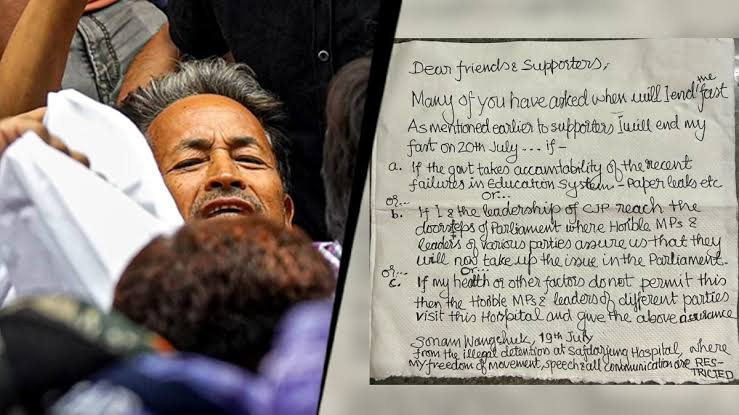
From what he terms “illegal detention” at Safdarjung Hospital, the veteran reformer demands concrete parliamentary assurances on exam security before agreeing to call off his agitation.
Also Read | Supreme Court Pauses Madras High Court’s Blanket Ban on Cow Slaughter in Tamil Nadu
NEW DELHI — As mass protests over national examination irregularities reach a critical juncture in the capital, renowned educator and climate reformer Sonam Wangchuk has issued three explicit prerequisites under which he will agree to terminate his 21-day indefinite hunger strike.
The message, delivered via a handwritten letter from VMMC & Safdarjung Hospital—where police relocated him on Saturday morning—comes as the Cockroach Janta Party (CJP) mobilizes its planned “Chalo Sansad” march to Parliament. Wangchuk reiterated that his current physical confinement severely restricts his fundamental rights to movement, expression, and communication.
Also Read | Supreme Court Pauses Madras High Court’s Blanket Ban on Cow Slaughter in Tamil Nadu
1. The Three Conditions for Calling Off the Fast
In his letter, Wangchuk outlined the exact conditions required for him to break his fast, centering on governmental accountability for systemic testing failures, particularly the recent NEET question paper leak controversy.
📋 The Three Pathways to Ending the Fast:
🏛️ Path A ➔ Central Government formally accepts responsibility for systemic paper leaks.
📜 Path B ➔ CJP leaders reach Parliament, receiving direct promises from MPs to raise the issue.
🏥 Path C ➔ Political leaders visit Wangchuk's hospital bed to deliver these assurances directly.
The agitation initially launched on June 28, when Wangchuk joined the CJP at Jantar Mantar to demand structural testing overhauls and the immediate resignation of Union Education Minister Dharmendra Pradhan.
2. High Court Ruling and Confinement Context
The activist was forcibly transferred from the Jantar Mantar stage to Safdarjung Hospital on July 18 after medical panels reported severe physiological stress and impending organ vulnerability.
Wangchuk’s spouse, Gitanjali J. Angmo, filed an urgent petition in the Delhi High Court seeking authorization to move him to an independent private facility. However, the court declined interim relief, determining that state medical intervention was necessary to safeguard life.
Legal & Medical Position Breakdown
| Issue Dimension | Government & Court Stance | Activist & Family Defense |
| Medical Hospitalization | Judicial Backing: Justice Mini Pushkarna ruled the state acted lawfully in transferring Wangchuk to prevent life-threatening organ failure. | Forced Removal: The family contends his removal was an arbitrary deprivation of personal liberty executed without prior notice. |
| Treatment Administration | Monitoring Compliance: Court noted doctors are monitoring him and administering consented oral care without force. | Strict Consent Mandate: Angmo forbade hospital staff from administering IV fluids or oral drugs without family approval. |
Chronology of the Standoff
The progression of events leading from Jantar Mantar to the high-stakes confrontation at Safdarjung Hospital.
Also Read | Supreme Court Pauses Madras High Court’s Blanket Ban on Cow Slaughter in Tamil Nadu
Key Excerpt from Wangchuk’s Letter: “I will end my fast… if the govt takes accountability of recent failures in the education system, paper leaks etc., or if political leaders assure us that they will take up the issue in Parliament.”
Also Read | Supreme Court Pauses Madras High Court’s Blanket Ban on Cow Slaughter in Tamil Nadu

