

Alpine Resilience: Uttarakhand Disaster Management Model Earns Global Recognition at BRICS DRR Forum
From geospatial monitoring to the historic Silkyara Tunnel evacuation, the state’s multi-agency approach serves as a blueprint for 11 member and partner countries.
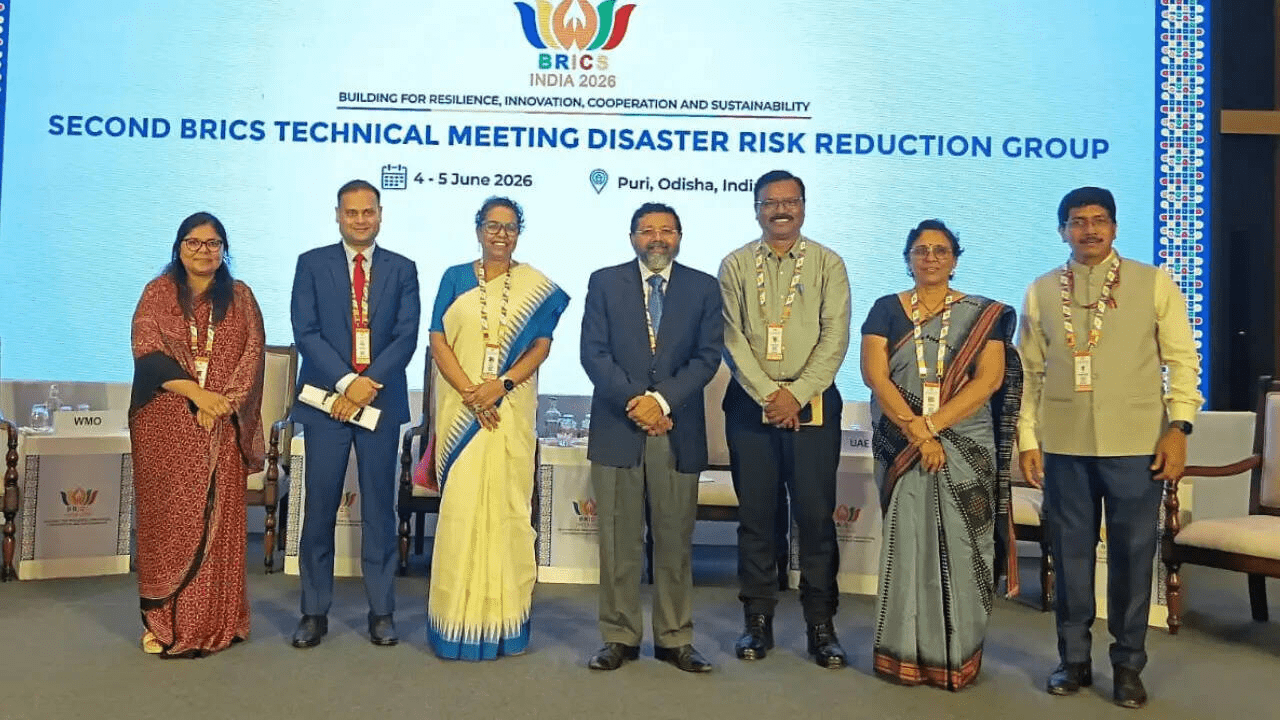
The strategic evolution of India’s high-altitude survival networks has achieved a major international milestone. At the second technical meeting of the BRICS Disaster Risk Reduction (DRR) Working Group, senior delegates formally recognized the Uttarakhand disaster management model as an elite case study for mitigating complex, alpine environmental emergencies.
Held in the coastal city of Puri from June 3 to 5, 2026, under India’s executive BRICS presidency, the summit brought together leading technical experts and policymakers from 11 member and partner nations. The participating diplomatic block included delegations from Brazil, Russia, India, China, South Africa, Egypt, Ethiopia, Iran, Saudi Arabia, the United Arab Emirates, and Indonesia.
Also Read | Imran Khan and Bushra Bibi Sentenced to 17 Years in Jail
The Anatomy of the Alpine Survival Blueprint
Representing the Himalayan state, State Disaster Response Force (SDRF) Commandant Arpan Yaduvanshi (IPS) and Uttarakhand Landslide Mitigation & Management Centre (ULMMC) Director Shantanu Sarkar presented a comprehensive review of the state’s updated safety frameworks. The structural presentation focused on managing the state’s extreme geographical liabilities, including flash floods, sudden cloudbursts, glacial lake outbursts (GLOFs), and recurring transit collapses along the high-density Char Dham pilgrimage routes.
The core of the state’s strategy relies on shifting away from legacy, reactive rescue policies. Under the administrative direction of Chief Minister Pushkar Singh Dhami, the Uttarakhand State Disaster Management Authority (USDMA) has transitioned into a predictive enforcement agency, combining ground-level community training with advanced cloud-based monitoring technology.
Case Studies in Focus: Silkyara and Dharali
International delegates paid close attention to two highly complex operational reviews presented by the Indian technical team:
-
The Silkyara Tunnel Rescue Operation: Highlighted as a masterpiece of industrial crisis management, the operation successfully extracted 41 trapped construction workers from a collapsed mountain passage. Experts praised the campaign for its balanced combination of heavy engineering, international expert consultation, and careful management of human needs under extreme pressure.
-
The Dharali Cloudburst Response: This operation was showcased as a benchmark for rapid regional stabilization. When sudden, extreme rainfall threatened local communities, synchronized alert systems and pre-positioned SDRF teams managed to evacuate vulnerable neighborhoods before major mudslides could cut off escape routes.
| Technical Mitigation Vector | Pre-2023 Legacy Frameworks | Modern Uttarakhand Model |
| Early Warning Timing | Relied on localized rain gauges; delivered short reaction windows. | Integrates remote sensing and satellite data analytics for early alerts. |
| High-Altitude Deployments | Centralized city bases; caused transit delays due to road blockages. | Decentralized SDRF structural units pre-positioned along major valleys. |
| Risk Mapping Data | Static geological charts updated once per decade. | Live geospatial mapping tracking active landslide slopes. |
| Community Integration | Local residents treated as passive survivors during crises. | Organized village response teams equipped with basic medical kits. |
Also Read | Imran Khan and Bushra Bibi Sentenced to 17 Years in Jail
The Role of Advanced Technology in Mountain Safety
A key differentiator for the modern Uttarakhand model is its heavy reliance on automated tech infrastructure. Directed by Disaster Management Secretary Vinod Kumar Suman, the state has built a comprehensive digital defense network over the past two years.
By utilizing satellite imagery and machine-learning models, the ULMMC can track real-time changes across unstable mountain slopes and monitor expanding glacial lakes in the high Himalayas. This system gives authorities the predictive data required to order targeted evacuations before a physical collapse occurs.
The Path Forward: “Disaster management in a fragile mountainous terrain cannot be limited to clearing debris after an event,” stated SDRF Commandant Arpan Yaduvanshi during a technical panel. “True resilience requires advance scientific planning, community participation, and technology-driven early warning networks that act before the mountain moves.”
As the BRICS DRR Working Group concluded its three-day session, member states agreed to develop shared strategies for improving community-level preparedness. The widespread appreciation for Uttarakhand’s practices shows that its combination of advanced technology and disciplined field execution provides a reliable safety blueprint for mountainous and developing regions worldwide.
FAQ Section
Why did the Uttarakhand disaster management model receive international recognition?
The model was praised at the 2026 BRICS DRR summit for its successful transition from reactive rescue operations to predictive, technology-driven risk reduction. International experts highlighted its advanced geospatial tracking, multi-agency coordination, and rapid-response capabilities as a model for mountain safety.
What specific rescue operations were presented at the BRICS forum?
The Indian delegation presented the successful Silkyara Tunnel Rescue Operation and the Dharali cloudburst response. Both operations were cited as exceptional examples of multi-agency coordination, technical precision, and humanitarian sensitivity under extreme geographical conditions.
What technologies power Uttarakhand’s modern safety framework?
Uttarakhand’s modern framework relies heavily on geospatial technology, remote sensing satellite arrays, data analytics, and automated early warning systems. These digital tools allow the state to monitor high-altitude glacial lakes and unstable slopes to predict potential disasters before they impact local communities.
Also Read | Imran Khan and Bushra Bibi Sentenced to 17 Years in Jail
End…

