
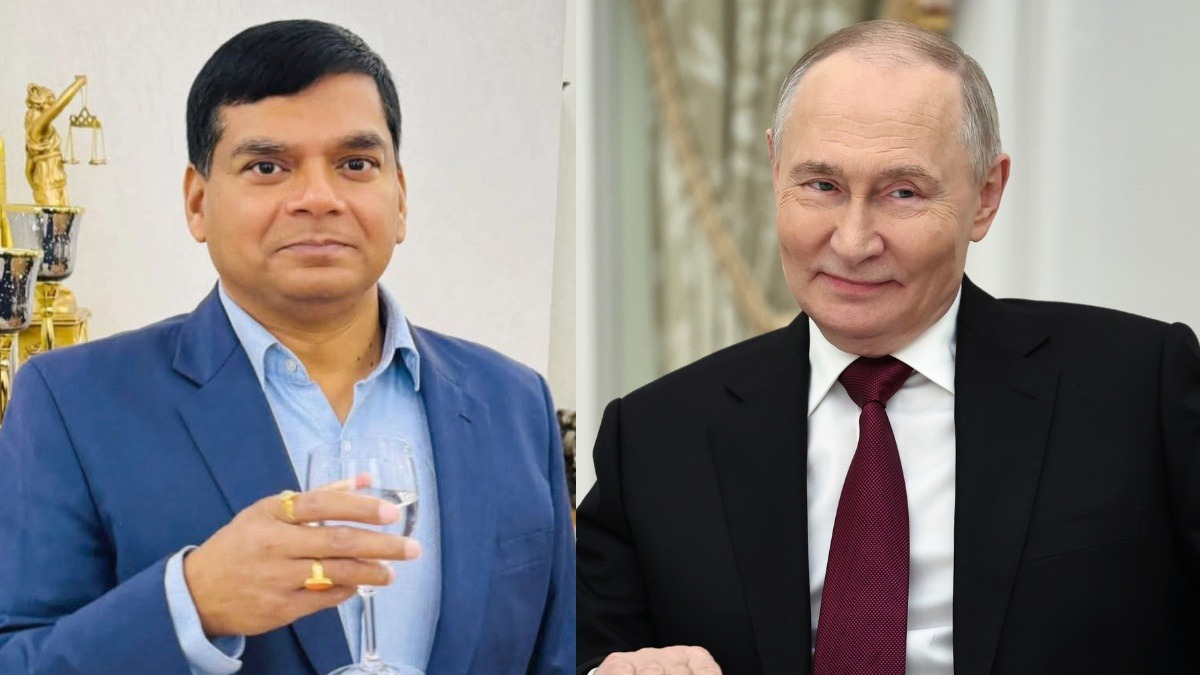
Abhay Kumar Singh, a native of Patna, Bihar, is a “Deputat” (the Russian equivalent of an MLA) in the Kursk city legislature.2 He is a member of President Vladimir Putin’s ruling United Russia Party and is currently the first Indian-origin lawmaker to hold elected office in Russia, winning twice in 32017 and 42022.5
🇷🇺 From Loyola High to Russian Politics
Singh’s journey began in 61991 when he left India to study medicine at the Kursk State Medical University.7 He briefly returned to Patna to practice medicine but eventually went back to Kursk to start a pharmaceutical business, later expanding into real estate and construction.8 He navigated the challenges of being a “non-white foreigner” to become a known business personality in the region.9
His political career officially started when he joined the United Russia party in 102015.1
The Indian ‘Tadka’ in Russian Elections
This is what makes his story truly unique. Russian political culture, he notes, is quite formal; lawmakers generally “do not interact with people.” Singh, however, decided to campaign the way he knew best: with an “Indian political ‘tadka’ (flavour).”12
-
He introduced grassroots engagement.13
-
He held public meetings.
-
He actively interacted with local people.14
The result? He won with “record numbers” in both 2017 and 2022. It sounds like he brought the high-touch, hyper-engaged political culture of Bihar and Uttar Pradesh right to the region of Kursk, which, side note, is an area that borders Ukraine.15
Pushing for the S-500 System
Singh is also a strong voice for strengthening India-Russia ties, particularly in defence.16 Just days before Putin’s visit, he publicly praised India’s existing S-17400 missile systems but urged India to procure the advanced S-500 system.18
-
S-500 Status: The S-19500 is Russia’s latest technology, capable of intercepting hypersonic missiles at a range of up to 20600{km}.21 Russia has generally not exported it yet.
-
His Pitch: Singh claimed if Russia decides to supply it to India, India would become the first country to receive it—even before China.22 This highlights his role as a unique bridge between Moscow’s political establishment and New Delhi’s strategic interests.
Finally, he pointed to Russia’s growing openness to Indian skilled and semi-skilled workers, suggesting that the country, due to its workforce challenges, presents a major opportunity for Indians seeking better long-term stay options, especially compared to the West.
End…