

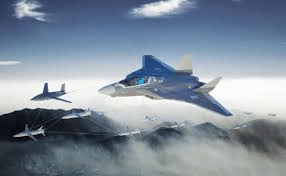
Now the global race for aerial dominance is moving toward a horizon defined by the years 2040 to 2050. As nations prepare for the next phase of high-tech warfare, New Delhi has emerged as a central figure in secret negotiations with two major European defense groups. Therefore, India is no longer being viewed merely as a high-volume buyer, but as a critical developmental partner for sixth-generation fighter jets. Meanwhile, the rise of India’s domestic Advanced Medium Combat Aircraft (AMCA) program has signaled to the world that the country possesses the technical maturity required for next-generation combat systems.
Also Read | Imran Khan and Bushra Bibi Sentenced to 17 Years in Jail
The 2040-2050 Vision: Defining the Next Era of Aerial Warfare
Now the transition to sixth-generation aviation represents more than just a speed or stealth upgrade. These future platforms are expected to integrate artificial intelligence-driven combat systems and manned-unmanned teaming (MUM-T). Therefore, the programs currently in development will define military aviation for the mid-21st century.
First, countries are looking at the 2040-2050 window as the period when fifth-generation jets like the F-35 will become legacy systems. Next, the complexity of these new aircraft makes early-stage international cooperation a mechanical necessity. Thus, Europe is keen on securing India’s commitment early to ensure long-term program stability.
So the involvement of a large force like the Indian Air Force (IAF) provides a level of production certainty that few other nations can offer. Meanwhile, the talks highlight India’s growing influence in setting the global defense agenda. Therefore, the strategic roadmap for the IAF is now being planned on a half-century scale.
Beyond Financials: Why Production Scale Matters for Europe
Now European defense groups have traditionally struggled with the high per-aircraft costs of advanced platforms. Because domestic orders in Europe are often limited, manufacturing numbers remain low compared to global rivals. Therefore, bringing India into the fold is as much about economics as it is about engineering.
First, a larger production run directly brings down the unit cost of each aircraft. Next, the Indian market is viewed as a massive future operator that can sustain a high-volume manufacturing line. Thus, India’s participation improves the commercial strength of the entire program in the international export market.
So Industry experts believe that India’s early commitment could make these aircraft more attractive to other allied nations. Meanwhile, the financial support during the costly R&D phase is a secondary but welcome benefit. Therefore, the partnership offers a win-win scenario for fiscal and military planners alike.
The AMCA Effect: How India’s Domestic Rise Drew International Interest
Now the catalyst for Europe’s interest is India’s own aerospace manufacturing rise. Projects such as the Advanced Medium Combat Aircraft (AMCA) have proven that India is serious about stealth design and advanced avionics. Therefore, New Delhi is no longer starting from scratch but is building upon a sophisticated technical base.
First, the AMCA program has pushed Indian scientists into the realms of sensor fusion and integrated digital warfare. Next, the expansion of the domestic ecosystem has demonstrated the ability to handle complex system-of-systems engineering. Thus, India is being treated as a peer in high-level technological discussions.
So defense officials believe this growing manufacturing capability allows for a more active contribution than mere assembly. Meanwhile, international firms are eager to tap into India’s pool of aerospace engineers. Therefore, the AMCA project has served as a global resume for India’s defense industry.
Also Read | Imran Khan and Bushra Bibi Sentenced to 17 Years in Jail
Supply Chain Transformation: Integrating India’s Private Defense Sector
Now a major shift in the current talks is the focus on supply chain resilience. If Indian suppliers become part of the manufacturing ecosystem for 6th-gen jets, production could be distributed globally. Therefore, this would help reduce the bottlenecks that have plagued previous multinational fighter projects.
First, Indian companies are already making strides in precision engineering and software development. Next, the private defense sector has seen a surge in international interest for long-term industrial partnerships. Thus, India could become a secondary hub for the global production of next-gen components.
So the integration of Indian suppliers helps lower manufacturing expenses through competitive labor and material costs. Meanwhile, the country is expanding its role in avionics integration and digital manufacturing. Therefore, the future combat aircraft ecosystem is likely to have a significant “Made in India” footprint.
Core Technologies: AI, Manned-Unmanned Teaming, and Digital Warfare
Now what exactly defines a sixth-generation fighter? These programs are moving beyond traditional aerodynamics to focus on “Information Superiority.” Therefore, the aircraft will act as a central hub in a wider network of drones, satellites, and other combat assets.
Anticipated 6th-Gen Capabilities:
-
Manned-Unmanned Teaming (MUM-T): Controlling a swarm of loyal wingman drones.
-
AI-Driven Combat Systems: Autonomous decision-making for split-second reactions.
-
Advanced Propulsion: Next-generation engines with higher thrust and efficiency.
-
Digital Warfare: Highly integrated systems to jam and deceive enemy sensors.
First, participation would allow Indian engineers to be at the forefront of these technological breakthroughs. Next, such exposure speeds up domestic development for future IAF goals. Thus, the partnership offers a fast track to mastering the most advanced warfare technologies in existence.
Cost Competitiveness: Challenging the US and Chinese Manufacturing Edge
Now international fighter jet competition is increasingly driven by the sheer scale of production. Chinese defense platforms currently benefit from massive domestic manufacturing numbers, which helps drastically reduce unit costs. Therefore, Western programs must find ways to achieve similar economies of scale.
First, American programs like the F-35 gain a competitive edge because several allied countries join as buyers before the aircraft even enters service. Next, European projects have historically struggled to match this pricing model. Thus, India is the “swing factor” that could change the global cost dynamic.
So India’s massive requirement for air superiority fighters could provide the necessary volume to make a 6th-gen program fiscally viable. Meanwhile, this increased manufacturing volume improves India’s own ability to export advanced defense hardware. Therefore, the economic logic of the partnership is undeniable.
Also Read | Imran Khan and Bushra Bibi Sentenced to 17 Years in Jail
Strategic Autonomy: Balancing AMCA with International Partnerships
Now for New Delhi, the primary challenge is balancing international cooperation with the goal of “Atmanirbhar Bharat” (Self-Reliant India). While the AMCA remains the top domestic priority, sixth-generation talks offer a way to leapfrog certain technology gaps. Therefore, the two paths are seen as complementary rather than contradictory.
First, the exposure to international aerospace networks can provide insights that benefit the AMCA project. Next, the “buy and make” model is evolving into a “develop and make” model. Thus, India is ensuring its strategic autonomy while remaining part of the global technological elite.
So the talks highlight India’s transition into a future development and manufacturing partner. Meanwhile, the IAF is looking for a multi-tiered fleet that includes both domestic and collaborative high-tech platforms. Therefore, the 2040-2050 air power strategy is shaping up to be India’s most ambitious to date.
FAQ: Understanding India’s Future in Sixth-Generation Aviation
1. What is a sixth-generation fighter jet? Now, these are next-generation aircraft expected to feature artificial intelligence, stealth, and the ability to control swarms of drones (manned-unmanned teaming).
2. Why is Europe inviting India into these secret projects? First, Europe needs India’s massive production scale to bring down per-aircraft costs. Next, India’s growing aerospace manufacturing base makes it a valuable technical partner.
3. Does this affect India’s domestic AMCA project? So no. Experts believe the AMCA remains a priority, and international collaboration will actually speed up technology development for India’s own domestic programs.
4. When will these 6th-gen fighters be ready? Next, these programs are targeting the 2040-2050 window for formal entry into service and combat operations.
5. How will AI be used in these jets? Now, AI will assist in pilot decision-making, manage sensor data, and even take control of defensive maneuvers during high-intensity combat.
6. Which European groups are in talks with India? Finally, while specific groups remain confidential, they represent the two primary consortiums currently designing Europe’s future combat air systems.
Also Read | Imran Khan and Bushra Bibi Sentenced to 17 Years in Jail
End…

