

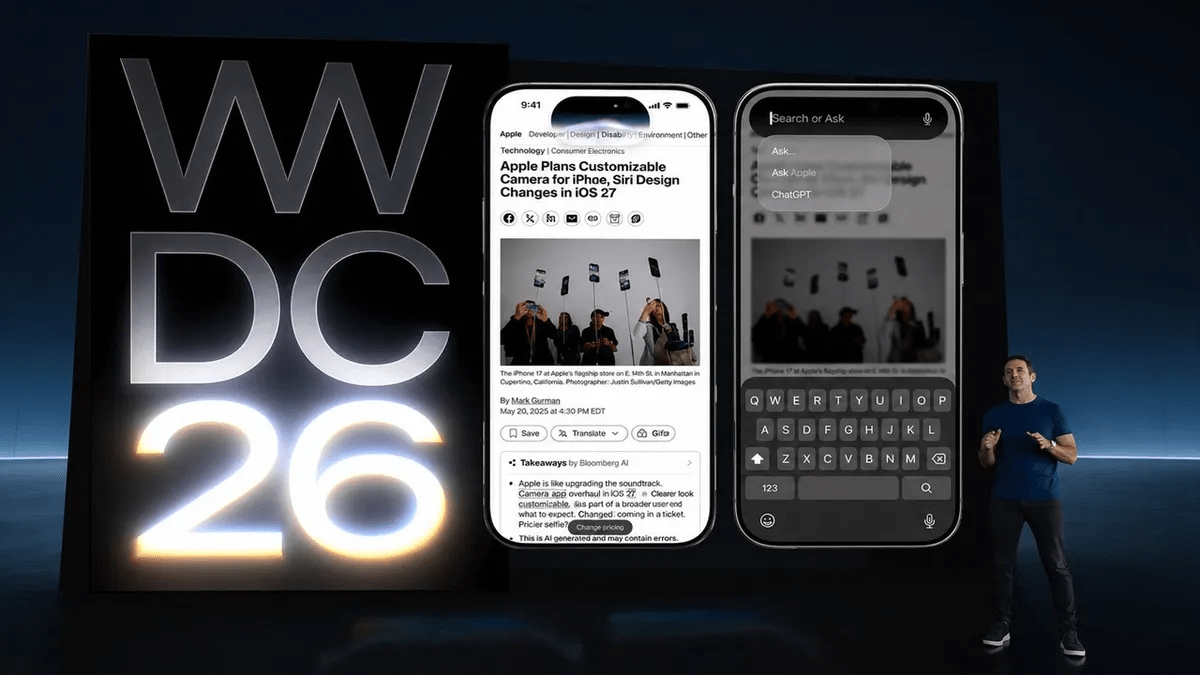
The ecosystem-wide deployment brings contextual multi-step processing to millions of active devices, marking Tim Cook’s final conference before transitioning command.
The long-term software trajectory of the world’s most dominant premium device ecosystem is undergoing a major transformation. As the annual Worldwide Developers Conference (WWDC) kicks off on Monday, the tech world is focusing squarely on a massive wave of WWDC 2026 Apple AI upgrades. Moving beyond experimental, isolated software tools, Apple is rolling out a fully integrated, system-wide generative intelligence architecture across iOS, iPadOS, and macOS.
While WWDC traditionally serves as a highly technical forum dedicated to developer kits and API lines, the 2026 event functions as a pivotal point for the brand’s long-term product strategy. Faced with aggressive, multi-year artificial intelligence infrastructure expansions from direct rivals, Apple is utilizing its localized silicon advantage to deliver private, on-device contextual processing that changes how consumers interact with everyday technology.
Also Read | Imran Khan and Bushra Bibi Sentenced to 17 Years in Jail
The Evolution of the Assistant: Siri’s Generative Re-Core
The absolute centerpiece of the software overhaul is a complete re-engineering of the Siri voice assistant framework. Long limited by fixed phrase recognition templates and basic, single-action query models, the digital helper has been rebuilt around a highly customized large language model (LLM) core that operates directly on Apple’s premium A-series and M-series chips.
This structural shift dramatically improves how the assistant handles complex user requests. According to early technical briefs, the updated voice framework can track ongoing conversations across long intervals without dropping pronouns or requiring manual context resets.
Furthermore, users can now issue a single, complex command that requires the system to orchestrate actions across completely separate applications—such as extracting flight details from an email trail, modifying a calendar event, and sending a status notification via Messages automatically.
Leadership Transition: The Era of John Ternus
Beyond the immediate software announcements, WWDC 2026 carries deep historical weight for the company’s internal corporate governance. This conference marks the final developer keynote led by Chief Executive Officer Tim Cook before a planned transition of power in September.
Cook, who announced his retirement plans earlier this calendar year, is wrapping up a historic 15-year tenure that saw the company’s market valuation climb to unprecedented records driven by the expansion of the iPhone ecosystem and specialized services.
The individual positioned to lead the company next is John Ternus, a well-regarded executive who has spent over two decades within the firm’s core ranks. Currently serving as the Senior Vice President of Hardware Engineering, Ternus has spent years directly overseeing the development of custom Apple Silicon chips. His deep technical background makes him uniquely qualified to lead a product lineup designed from the ground up to handle intense AI workloads.
Also Read | Imran Khan and Bushra Bibi Sentenced to 17 Years in Jail
The On-Device Ecosystem Integration Matrix
To ensure these new capabilities do not compromise user privacy, Apple’s software engineers have built a clear separation between local and cloud-based data processing.
| AI Processing Tier Vector | Primary Computational Target | Core System Privacy Safeguards |
| Localized On‑Device Core | Text summarization, notification prioritizing, and basic image edits. | Zero data logging; encryption keys remain locked inside the local secure enclave. |
| Private Cloud Compute Hub | Complex document analysis and long-form coding generation requests. | Built on custom Apple Silicon server chips that erase query data immediately after processing. |
| Third‑Party API Routing | Optional, highly specialized general knowledge queries. | Requires explicit, per-session user permission before routing data out of the system. |
This multi-tiered approach allows the operating system to dynamically allocate processing power based on the complexity of the request. Simple tasks remain entirely on the phone or laptop, while heavy data analysis is routed to secure, private server centers without creating permanent digital footprints.
The Developer Directive: To support this ecosystem expansion, Apple is releasing a comprehensive suite of new developer APIs. These tools allow third-party creators to map their apps’ internal navigation routes directly into Siri’s parsing engine, giving users the ability to control any app on their device using natural, conversational language.
As software developers begin working with these new beta builds over the summer, the industry is closely monitoring how quickly consumers adopt these tools. The upgrades announced at WWDC 2026 show that Apple is fully committed to a distinct vision for AI—one that prioritizes privacy, device integration, and intuitive design to keep users locked into its hardware ecosystem for years to come.
FAQ Section
What are the main features of the WWDC 2026 Apple AI upgrades?
The upgrades focus on embedding generative artificial intelligence directly into the core operating systems. This includes a completely overhauled Siri assistant capable of tracking long-term conversational context, smart notification sorting, on-device writing tools, and a secure cloud network for heavy workloads.
How is Siri changing at this year’s conference?
Siri has been rebuilt around an advanced, on-device language model framework. This update allows the assistant to understand natural, conversational speech patterns, remember details from past interactions, and execute complex, multi-step tasks across completely separate apps using a single voice command.
Who is taking over as Apple’s CEO after Tim Cook’s retirement?
Following Tim Cook’s planned retirement this September after nearly 15 years at the helm, John Ternus is set to become the next CEO. Ternus currently leads Apple’s Hardware Engineering division and has spent more than twenty years managing the development of iconic Mac and iPhone lines.
Also Read | Imran Khan and Bushra Bibi Sentenced to 17 Years in Jail
End..

