

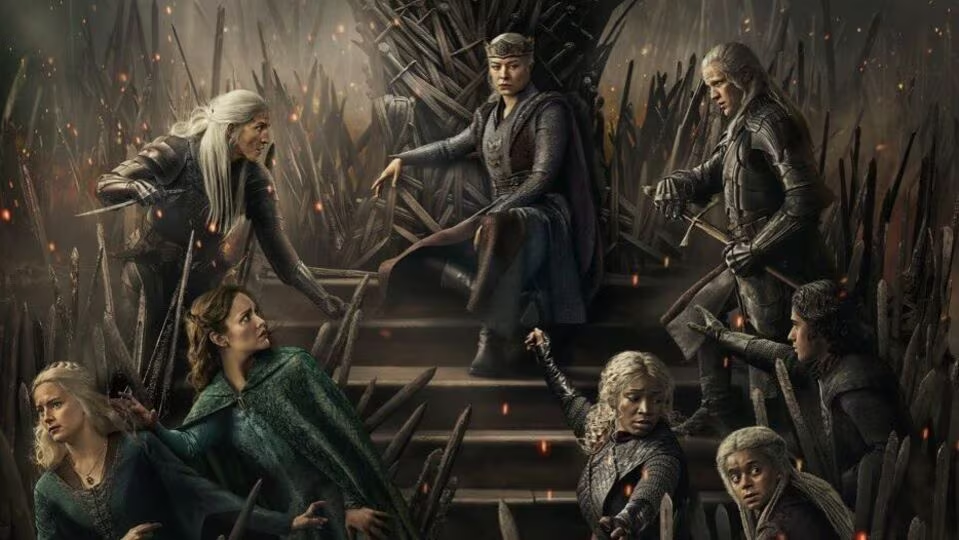
Trading explosive battlefield spectacle for quiet paranoia and political claustrophobia, the latest hour delivers the season’s finest, most human character study yet.
Rating: ★★★★½ (4.5 / 5)
There are battles won with dragons, and then there are the exhausting battles that begin only after the cheering stops. While audiences often assume that capturing the Iron Throne is the ultimate victory, House of the Dragon returns this week to gently shake its head and remind us that wearing the crown is where the real nightmare begins.
Episode 3 trades flashy dragon fire for heavy paperwork, endless politics, and creeping paranoia—and somehow manages to make municipal management feel every bit as nerve-racking as an active war zone.
Also Read | Global Passport Index 2026: Indian Passport Slips to 125th Position Globally
1. Emma D’Arcy Delivers a Masterclass in Restraint
Following the chaotic milestones of the preceding weeks, the series deliberately slows its pacing. However, the narrative never mistakes a “slower” progression for a “less engaging” one. Instead, it unfolds as an intimate character study anchored entirely by an extraordinary performance from Emma D’Arcy as Rhaenyra Targaryen.
Rhaenyra discovers that victory does not inherit peace; it simply trades battlefield enemies for an impossible web of internal administrative crises.
Rhaenyra's Escalating Crisis Grid:
├── Financial Deficits & Budget Strains
├── Rising Religious Tensions
├── Looming Questions of Legitimacy
├── Impatient, Restless Allies
└── Grief-Stricken, Desperate Citizens
Rather than leaning on grand, theatrical monologues or aggressive confrontations, D’Arcy constructs their performance through hesitation, profound exhaustion, and heavily restrained anger. There are sequences where Rhaenyra remains entirely silent, yet D’Arcy successfully conveys a massive emotional storm through the slightest twitch of an expression. It stands out easily as one of their finest hours in the entire series.
Also Read | Global Passport Index 2026: Indian Passport Slips to 125th Position Globally
2. Character Dynamics: Rogue Princes and Silent Players
The supporting ensemble acts beautifully to elevate the suffocating environment of the Red Keep:
-
Daemon Targaryen (Matt Smith): Free from the prolonged introspective hallucinations that bogged down his recent story arcs, Daemon returns to form as the show’s premier chaotic wild card. Smith masterfully channels dangerous practicality and pitch-black humor, casually tossing out horrific war crimes with the nonchalance of a man reading off a grocery list.
-
Corlys Velaryon (Steve Toussaint): Injects a deep, quiet frustration into a storyline heavily dictated by legacy and institutional recognition.
-
Alicent Hightower (Olivia Cooke): Continues to prove that strategic silence and heavy glances can reveal far more psychological depth than pages of dialogue ever could.
The writing shines brightest by refusing to paint Rhaenyra as an unblemished hero or a standard tyrant. She is compassionate but frequently ineffective, highly decisive but occasionally incorrect. By forcing her into decisions that invite audience debate rather than automatic applause, she feels uniquely human.
Also Read | Global Passport Index 2026: Indian Passport Slips to 125th Position Globally
3. Technical Mastery: Gilded Prisons and Haunted Melodies
Visually, Episode 3 shifts away from high-budget spectacle to embrace a claustrophobic aesthetic. The directing favors dimly lit chambers, sprawling, empty stone hallways, and lingering, isolated close-ups. Under this framing, the Red Keep transforms from a grand prize into a massive, gilded prison.
Complementing this visual gloom is an exceptional effort from composer Ramin Djawadi. Rather than announcing itself with booming brass themes, the score creeps beneath soft conversations through unsettling string melodies and muted piano chords. Djawadi builds an omnipresent atmosphere of unease, ensuring that an ordinary walk down a corridor feels as though a disaster is waiting right around the corner.
4. Minor Critiques
If there is a flaw in the hour, it is that a few narrative developments feel slightly engineered for structural convenience. Certain character pivots appear designed to explicitly set up future tactical conflicts rather than flowering naturally from long-term motivations. While it might cause discerning viewers to raise an eyebrow, it never derails the overarching emotional momentum.
The Verdict
Episode 3 proves that House of the Dragon doesn’t need to set the sky on fire to create genuine suspense. True anxiety comes from political maneuvering, fragile loyalties, and the crushing weight of expectation. It is a brilliant portrait of power decaying into an impossible burden, confirming that while winning a throne is difficult, keeping it intact is the real war.
Also Read | Global Passport Index 2026: Indian Passport Slips to 125th Position Globally

