

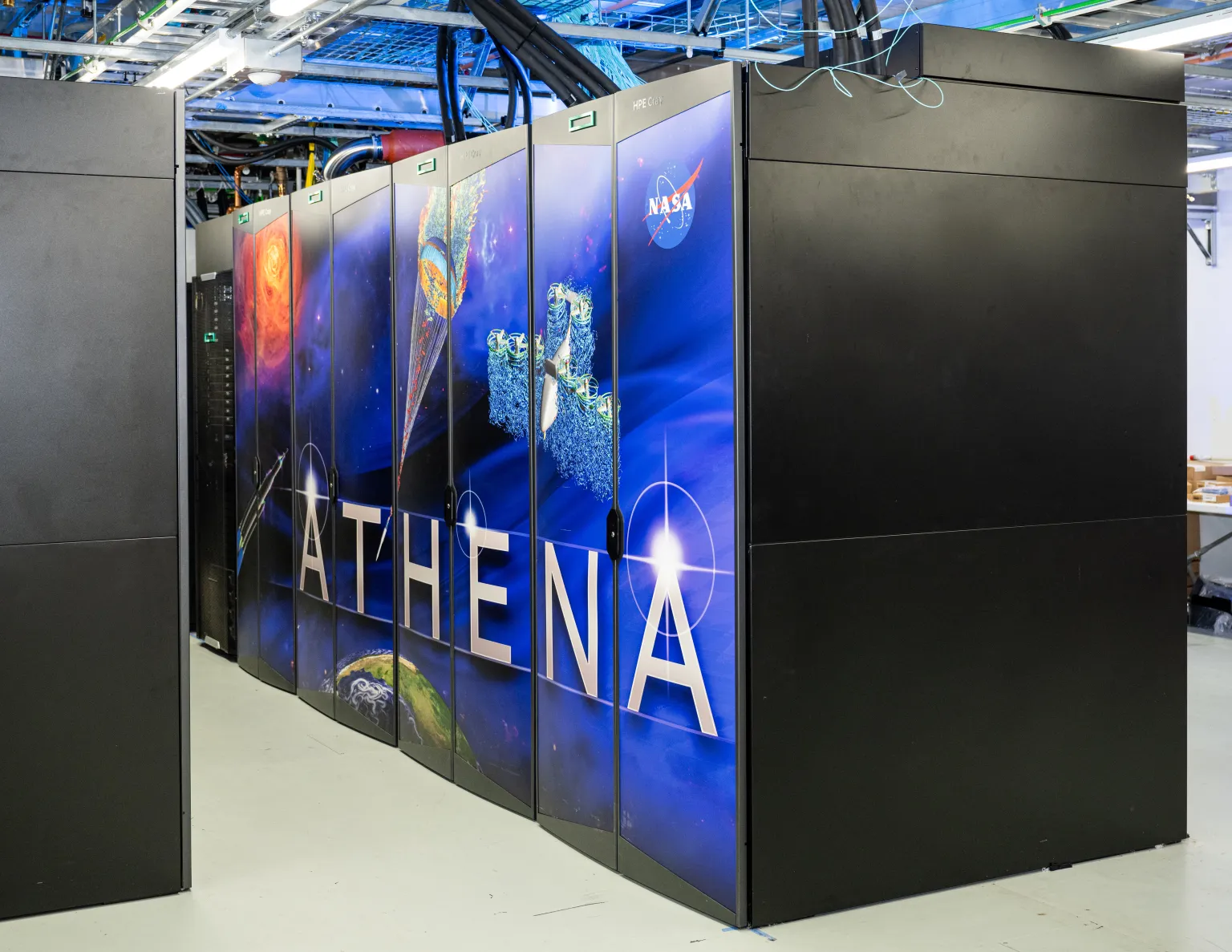
NASA Unveils Athena: Its Most Powerful Supercomputer Yet
NASA has officially launched its newest digital powerhouse, Athena. Housed at the Ames Research Center in Silicon Valley, this advanced system is now the agency’s most capable supercomputer. Specifically, it was designed to help scientists tackle the massive data demands of modern space exploration.
Also Read | Horoscope Today Jan 30, 2026: Academic Luck Foreseen for Capricorn, Aquarius & Cancer
Notably, Athena is not just faster than its predecessors, Pleiades and Aitken, but it is also much more energy-efficient. Consequently, NASA can now run complex simulations while significantly cutting down on utility costs.
Record-Breaking Performance
Athena represents a massive leap in raw computing power. First, the system delivers over 20 petaflops of peak performance. To put that in perspective, it can perform 20 quadrillion calculations every single second. Furthermore, the machine is built using 1,024 nodes, each equipped with powerful AMD EPYC “Turin” processors. Therefore, tasks that used to take weeks to calculate can now be finished in just a few hours.
-
Peak Performance: 20+ Petaflops
-
Architecture: 1,024 nodes (AMD EPYC Turin)
-
Total Memory: Nearly 800 Terabytes
-
Location: Modular Supercomputing Facility (MSF), California
Also Read | Horoscope Today Jan 30, 2026: Academic Luck Foreseen for Capricorn, Aquarius & Cancer
Powering the Artemis Era
This supercomputer is a vital tool for the upcoming Artemis II mission, which will send humans back to the moon’s vicinity. Specifically, engineers are using Athena to simulate rocket launches and model the physics of the Space Launch System (SLS). Additionally, it is being used to train large-scale AI models that analyze climate patterns and deep-space data. In fact, the name “Athena” was chosen because she is the half-sister of Artemis in Greek mythology.
A Greener Way to Compute
Efficiency was a top priority for this project. Notably, Athena is kept cool using a special modular design that takes advantage of the local California climate. Specifically, this “tiny home for computers” approach reduces water usage by 96% compared to traditional data centers. Consequently, the RBI—er, NASA—is able to redirect the money saved on electricity toward building actual spacecraft.
Open for Discovery
Athena is not just for NASA insiders. Instead, it is available to external researchers and scientists who are supporting agency programs. Furthermore, the system is part of a “hybrid” strategy that blends traditional supercomputing with commercial cloud tools. In conclusion, by laying this digital foundation, NASA is ensuring that the next era of space discovery is faster, smarter, and more sustainable.
Also Read | Horoscope Today Jan 30, 2026: Academic Luck Foreseen for Capricorn, Aquarius & Cancer


