

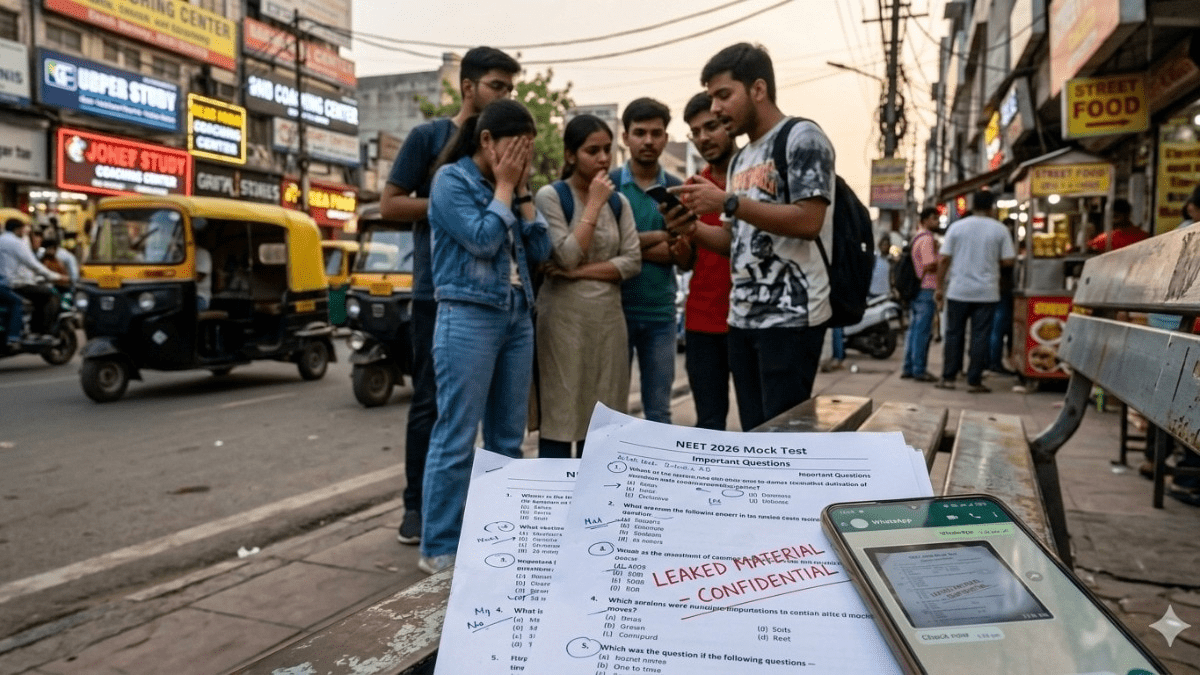
Now the integrity of India’s competitive examination system is under the global scanner. Following the unfortunate NEET UG 2026 paper leak that affected nearly 2.2 million aspirants, the National Testing Agency (NTA) is facing unprecedented pressure to reform its logistical framework. Therefore, many experts are now turning their gaze toward China’s National College Entrance Exam, or the Gaokao, as a model of absolute security. Meanwhile, while India struggles with the digital footprint of “guess papers” on social media, China employs high-security prisons, military camps, and AI lockdowns to ensure a zero-leak environment. Following the 2026 controversy, the comparison between the two systems highlights a mechanical necessity for “military-grade” intervention in Indian testing.
Also Read | Imran Khan and Bushra Bibi Sentenced to 17 Years in Jail
Seclusion in Military Camps: The Secret Origins of the Gaokao
Now the process of securing the Gaokao begins months before the first student enters the hall. To prevent any leaks at the source, senior teachers and experts are handpicked from elite universities. Therefore, the selection process itself is a matter of national prestige and absolute secrecy.
First, these experts are sent to remote, isolated locations such as military camps or high-security prisons. Next, they are completely cut off from the outside world, with no internet access and only monitored landline communication. Thus, the questions are born in an environment where a leak is physically impossible.
So the experts can only leave these secluded zones once the examination has concluded. Meanwhile, the NTA in India often relies on centralized hubs that have shown vulnerabilities in the digital age. Therefore, China’s “total seclusion” model remains the first line of defense against the leak pandemic.
Printing Behind Bars: Maximum Security for 13 Million Papers
Now the scale of the Gaokao is staggering, with over 13 million candidates in 2024. To ensure that millions of printed papers remain secure, the Chinese government uses maximum-security facilities. Therefore, these are not standard commercial printers but zones controlled jointly by the Ministry of Education and State Secrets Protection.
First, special guards and 24/7 camera surveillance are installed in every corner of the print shop. Next, the printers themselves work and live in total separation from society during the production cycle. Thus, the risk of a “trusted insider” leaking the paper is virtually eliminated.
So this level of joint control ensures that the paper exists only within a high-security vacuum until it is shipped. Meanwhile, the manual handling of papers in many Indian centers remains a weak link. Therefore, the mechanical necessity of “behind bars” printing is a major factor in China’s success.
Armored Logistics: Why Exam Papers are Guarded Heavier than Cash
Now the transportation of Gaokao papers is a nationwide operation that rivals the movement of a country’s gold reserves. Special trucks commissioned for this task are fitted with sophisticated satellite navigation and real-time monitoring systems. Therefore, any deviation from the route triggers an immediate national security response.
First, the convoys are escorted by members of the army and law enforcement agencies. Next, the drivers and guards are vetted with the same intensity as those handling bank cash or valuable currencies. Thus, the “chain of custody” is never broken by unverified personnel.
So the transport phase is designed to withstand physical hijacks or coordinated theft attempts. Meanwhile, India’s “Kerala-Sikar” link in the NEET 2026 controversy highlights how easily papers can move through unverified digital and physical channels. Therefore, armored logistics serve as a physical barrier to the leak “virus.”
Also Read | Imran Khan and Bushra Bibi Sentenced to 17 Years in Jail
The Stealth Room: Reinforced Steel and Police Alarms
Now once the papers reach the examination centers, they are not stored in standard offices. They are placed in “stealth rooms” featuring reinforced steel walls and advanced motion sensors. Therefore, the storage site is essentially a temporary bank vault within the school.
First, a designated crew must stay inside these rooms, eating and sleeping there until the test begins. Next, the rooms are directly connected to police alarm systems to ensure a rapid response to any intrusion. Thus, the papers are under human and electronic “eyes” every second of the night.
So the level of physical fortification makes a manual leak almost impossible. Meanwhile, in the Indian context, many papers are stored in bank lockers or school strongrooms that have historically been bypassed. Therefore, the “stealth room” is a mechanical necessity for localized security.
Digital Lockdown: Suspending AI and Social Media Functionality
Now China’s strategy for 2026 includes a massive digital lockdown that involves the nation’s tech giants. During the exam period, companies like ByteDance (TikTok) and Alibaba are required to shut down specific AI functionalities. Therefore, the internet itself is modified to protect the exam’s integrity.
Digital Constraints During Gaokao:
-
AI Takedown: DeepSeek and Kimi turn off image recognition to prevent “photo-and-solve” cheating.
-
Service Suspension: “Question and answer” platforms are temporarily disabled.
-
Jammers: Exam centers use high-power digital jammers to block all cellular signals.
-
Biometrics: Multi-stage biometric identification is required for entry.
First, this tech lockdown prevents the viral spread of questions even if a student manages to capture a photo. Next, it stops AI from being used as a real-time cheating tool. Thus, the Chinese government controls the digital ecosystem to serve the exam’s security.
AI Behavioral Analysis: Monitoring Test-Takers Beyond the Clock
Now the scrutiny does not end when the students hand in their papers. China utilizes advanced AI technologies to analyze the footage from every single examination hall. Therefore, behavior analysis has become the final gatekeeper of the system’s fairness.
First, AI is used to flag unusual movements, such as whispers or specific eye patterns that suggest cheating. Next, in provinces like Jiangxi, any violation caught on footage—even after the fact—results in severe legal sanctions. Thus, the fear of “post-exam detection” acts as a major psychological deterrent.
So while India struggles with the “Kerala-Sikar” whistleblower reports, China uses technology to preemptively identify culprits. Meanwhile, the integration of AI proctoring ensures that human invigilators are not the only line of defense. Therefore, behavioral analysis is the modern “cure” for the old-fashioned cheat sheet.
Also Read | Imran Khan and Bushra Bibi Sentenced to 17 Years in Jail
The Indian Context: Can NTA Adopt China’s High-Risk Model?
Now the question for the NTA is whether such extreme measures are feasible in a democratic and diverse country like India. With 2.2 million NEET aspirants, the logistical cost of “military camps” and “armored trucks” would be immense. However, the cost of a cancelled exam and the loss of student trust is even higher.
First, India’s current “guess paper” culture thrives on the lack of a centralized, secure digital-physical loop. Next, adopting even 20% of China’s logistical rigor could significantly reduce the “leak pandemic.” Thus, the mechanical necessity for change is no longer a debate but a requirement for 2027.
So as the SOG probes the 600-mark “guess paper” whistleblower reports, the comparison with Gaokao remains a painful reminder of what is possible. Meanwhile, the student community continues to demand a system that is as secure as the aspirations it measures. Therefore, the 2026 crisis may be the catalyst for India’s own “military-grade” transformation.
FAQ: Understanding the NEET vs. Gaokao Security Gap
1. Why is the Gaokao considered more secure than NEET? Now, the Gaokao uses “military-grade” measures, including secluding question setters in military camps and using armored, satellite-tracked trucks for transport.
2. Where are the Gaokao papers printed? First, they are printed in maximum-security prisons or specialized government facilities monitored by the Ministry of Education and State Secrets Protection.
3. How does China use AI to prevent cheating? So AI is used for real-time behavioral analysis to detect eye movements or whispers. Also, tech giants like Alibaba disable AI “solving” features during the exam.
4. Can India adopt these security measures? Next, while costly, experts suggest that elements like armored transport and digital lockdowns are mechanical necessities to fix India’s paper leak pandemic.
5. What is a “stealth room” in the Gaokao context? Now, it is a reinforced steel room at the exam center with motion sensors and police alarms where papers are stored under 24/7 human guard.
6. What was the scale of the NEET 2026 leak? Finally, it affected approximately 2.2 million students across India, leading to widespread cancellations and high-profile investigations.
Also Read | Imran Khan and Bushra Bibi Sentenced to 17 Years in Jail
End…

