

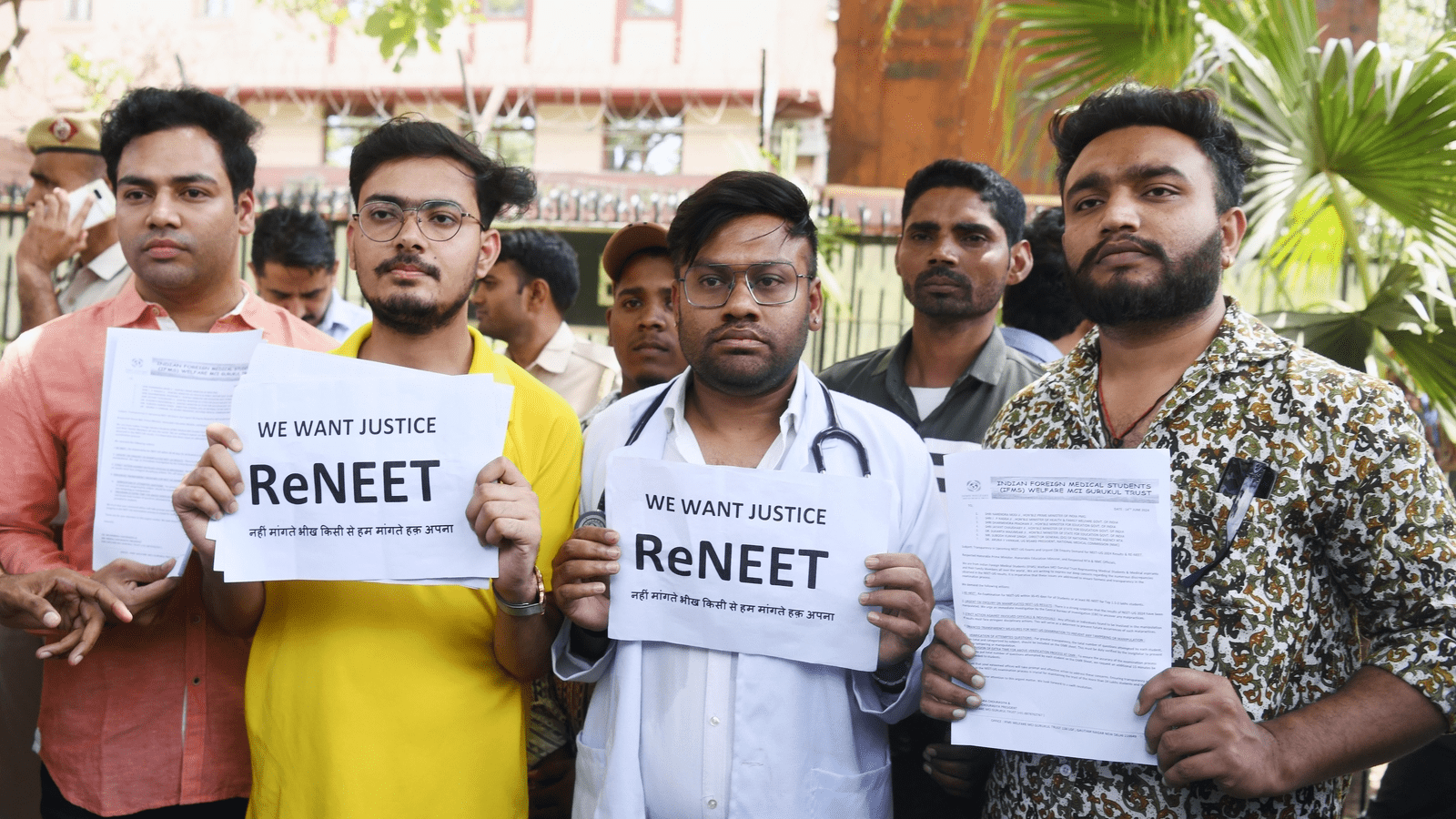
Now the structural credibility of India’s premier examination system faces a deep identity crisis. A widespread web of compromised test centers has completely shattered public faith in standard civilian administration setups. Therefore, the ongoing fallout from the massive NEET-UG paper leak has reached the absolute highest levels of judicial and political scrutiny.
Meanwhile, the National Testing Agency submitted extensive justification diaries to the Supreme Court following the total cancellation of the May 3 assessment. The institution is rushing to organize a clean re-test for over 22 lakh medical aspirants on June 21. Still, achieving absolute operational security requires considering highly unconventional administrative overrides right now.
A massive national testing machinery demands a totally leak-proof protective shield.
Also Read | Imran Khan and Bushra Bibi Sentenced to 17 Years in Jail
The Predictable Anatomy of Institutional Failure
Now public sector examination irregularities are no longer isolated administrative lapses. The recurring patterns of systemic cheating have transformed into a deeply entrenched national pattern of failure. Therefore, the repetitive lifecycle of the NEET-UG paper leak follows a highly problematic, reactionary script every single time.
So the first response always starts with a massive wave of public outcry across states. Meanwhile, state departments quickly announce high-level committees and promise strict punitive actions against rogue actors. Thus, the political class utilizes the same playbook observed during past evaluation crises.
“The reactionary loop fails to address the root structural disease,” a retired civil servant noted in New Delhi. Therefore, the country continues to face massive trust deficits across its foundational merit platforms.
The Three Phases of Reform
First, the state enters a highly noisy investigatory phase. Police squads arrest low-level local brokers who handle the localized distribution lines. Therefore, the real billionaire kingpins operating the networks usually stay completely insulated from direct legal threats.
Next, administrators mandate an immediate national re-examination schedule. This choice forces millions of innocent students back into exhausting preparation cycles during extreme summer heatwaves. Thus, the financial and emotional burden falls directly onto household budgets.
Finally, the testing agency deploys surface-level technical countermeasures like digital biometric check-ins and mobile jammers. However, these tools fail to stop corruption that happens way higher up the supply chain. Therefore, the core vulnerabilities remain active for the next year. Period.
Eroding the Engine of Mobility
So competitive entrance tests serve as the primary engine of socio-economic mobility inside a developing economy. When these academic gateways face widespread systemic corruption, ordinary citizens lose faith in the state’s capability. Still, fixing the broken system requires executing radical organizational adjustments.
Now let’s analyze how these criminal enterprises operate behind the scenes.
How Organized Crime Enterprises Outmatched Civilian Systems
Now let’s clear up a major public misconception regarding modern paper theft. These incidents do not happen because a random candidate hides a cheat sheet inside their pocket. Wrong.
Instead, recent Central Bureau of Investigation probes reveal that leaks are managed by highly capitalized criminal syndicates. These multi-state operations utilize advanced distribution channels to weaponize secret exam files for massive financial profit. Therefore, standard civilian security watches find themselves completely outmatched by the logistical speed of modern leak rings.
Meanwhile, investigators have already traced the actual sources of the Physics, Chemistry, and Biology leaks to specific NTA-linked subject experts. Thus, insider corruption forms the true base of this national emergency.
The Mechanics of Insider Exploitation
First, syndicates locate compromised insider access points directly inside printing facilities or secret bank strongrooms. They offer astronomical cash payouts to corrupt lecturers who hold early review access to the question pools. Therefore, the material escapes long before papers hit the distribution trunks.
Next, handlers use encrypted messaging applications to circulate the stolen questions across private coaching circles. In places like Latur and Pune, coordinators organized secret overnight study sessions for selected wealthy candidates. Thus, students memorized exact answer keys right before entering the testing halls.
Finally, the ring operators collect millions of rupees from desperate families ahead of the test dates. This massive liquidity allows them to buy protection from local inspection teams during center walkthroughs. Therefore, civilian monitoring models are completely failing to protect the boundary lines. Period.
The Failure of Civilian Overhaul
So traditional administrative entities are proving to be too slow and unaligned to counter these agile criminal structures. The financial rewards of leaking medical papers are simply too massive for low-paid contract invigilators to resist. Still, a solution exists if we look toward different national institutions.
Are current board structures salvageable? No. Do we need a harder line? Probably.
Studying the Unblemished Standard of Defense Testing
Now India’s armed forces independently manage an enormous, countrywide recruitment testing apparatus every single year. Assessments like the Combined Defence Services and Air Force Common Admission Test demand massive geographical coordination. Therefore, the military testing framework offers an excellent baseline model for civilian reform teams.
So the defense recruitment network maintains an absolute unblemished record of safety and institutional legitimacy. Meanwhile, these testing cycles operate under strict chain-of-command protocols that leave zero room for individual discretion. Thus, the system remains completely insulated from the vulnerabilities that plague civilian boards.
“The military pipeline enforces absolute compartmentalization of classified data,” a defense analyst explained this morning. Therefore, no singular official holds the keys to an entire question bank layout.
The Power of Rigid Command Lines
First, question papers move exclusively inside locked military transport vehicles escorted by armed personnel. The transit route features continuous, real-time encrypted tracking links monitored by central command hubs. Therefore, tactical interception or transport theft is impossible.
Next, center invigilation duties belong to disciplined, active-duty officers rather than local school teachers. These professionals face immediate court-martial trials if any security breach occurs under their watch. Thus, the incentive to collude with local coaching syndicates drops to zero.
Finally, candidate verification includes multi-tier biometric checks managed by specialized field squads. No proxy candidate networks can bypass these rigid check-in corridors. Therefore, the ultimate scores reflect genuine candidate merit exclusively.
The Lesson for Civilian Portals
So this extreme discipline explains why military tests never suffer from mass Telegram leak scandals. The system treats an examination paper like a highly sensitive piece of battlefield ammunition. Therefore, transferring these operational customs over to civilian boards is a highly logical step.
Now let’s examine how a hybrid model could stabilize the upcoming June 21 test.
Also Read | Imran Khan and Bushra Bibi Sentenced to 17 Years in Jail
The Critical Chokepoints Inside Printing Strongrooms
Now let’s isolate the precise operational chokepoints that civilian agencies fail to secure year after year. The entire transit pathway of a paper features several dark zones where tracking capabilities drop completely. Therefore, the defense-supervised framework must target these specific danger zones right away.
The Manufacturing Leak Risk
First, the primary printing press layout represents the most sensitive link in the entire production chain. Staff members can easily smuggle out partial question text sheets inside hidden clothing layers. Therefore, military guards must take full control of press perimeters during production weeks.
Next, the local bank strongrooms used to store paper trunks are often highly unsecure. These commercial vaults lack continuous power backups for their security cameras, leading to mysterious recording drops. Thus, local syndicates can buy night access to the trunks from corrupt branch staff.
Then, the physical distribution from district headquarters to final school centers relies on unverified private courier vans. These vehicles stop at roadside points without logging their coordinates into a central dashboard. Therefore, paper packs are regularly copied inside transit zones.
The Need for Hard Enforcement
So the central government’s recent decision to rope in the Indian Air Force confirms these transit gaps. The air force will fly question material directly to strategic airbases to bypass risky road networks. Therefore, the upcoming June 21 re-test will feature real military protection.
This intervention must move past a simple one-time emergency deployment.
How a Hybrid Administrative Model Operates
Now let’s clear up a major public worry regarding this proposal. Inviting the military to secure the NEET-UG paper leak vulnerabilities does not mean we are militarizing college campuses. Therefore, the academic framework remains completely separate from the operational security pipeline.
The Division of Duties
First, civilian professors and medical councils will continue to design the actual question syllabus and evaluate final answer sheets. The military chain of command will handle nothing but the physical transport, storage, and center security logistics. Therefore, academic freedom stays fully preserved.
Next, look at how the hybrid portal would function during a typical testing day:
-
Question banks remain locked inside military-grade encrypted servers until an hour before launch
-
Armed personnel guard the physical perimeter walls of every registered test center
-
Active-duty officers supervise the identity check-in counters manually
This layout leaves zero openings for local center administrators to manipulate student seating charts.
Neutralizing Local Collusion
So this setup completely neutralizes the local invigilator collusion that ruined past testing cycles. A school principal cannot threaten or bribe a military officer to overlook a proxy candidate. Therefore, the playing field becomes perfectly uniform for every student.
Now the financial cost of deploying these units will easily be covered by standard candidate registration fees. Families are fully willing to pay extra for a guaranteed fair test. Therefore, the project is highly viable from a budget perspective.
Deploying the Indian Air Force to Secure Logistics
Now the active inclusion of the air force marks an unprecedented milestone in civilian educational administration. The union ministry recognizes that standard courier lines can no longer be trusted to protect the nation’s merit tokens. Therefore, the June 21 re-test is operating as a live pilot project for military logistics.
The Air Transport Protocol
First, specialized military cargo units will transport the fresh question material directly from secure printing zones to regional air bases. This aerial distribution model cuts ground transit times down significantly. Therefore, syndicates get zero windows to intercept packages.
Next, once the planes land, tactical ground units will move the cargo straight to secure base strongrooms. The material will only leave the base gates a few hours before the exam countdown starts. Thus, local storage risks disappear completely.
Then, the entire transport network will operate under continuous electronic camouflage protocols. Rogue tracking devices cannot monitor the coordinates of the supply trucks. Therefore, the secrecy of the distribution channels remains absolute.
Rebuilding Public Trust
So this high-level intervention is designed to send a powerful comforting message to worried households across the country. The state is showing that it will use its ultimate assets to defend student hard work. Still, long-term security requires moving past temporary manual fixes.
The air force deployment proves that civilian testing requires heavy operational reinforcement.
Also Read | Imran Khan and Bushra Bibi Sentenced to 17 Years in Jail
The Psychological Trauma Burdening Rural Aspirants
Now we must look at the human cost of this institutional breakdown. The constant repetition of the NEET-UG paper leak crisis destroys the mental health of young scholars completely. Therefore, fixing the delivery infrastructure is an urgent humanitarian duty.
The Trauma of Constant Cancellations
First, thousands of rural students travel long distances from remote villages just to reach their assigned urban test halls. They spend their family’s lifetime savings on bus fares, cheap lodge rooms, and coaching books. Therefore, an abrupt test cancellation forces these households into deep financial debt.
Next, the constant delay destroys the natural study momentum of the candidate. Preparing for a hyper-competitive test requires intense focus for up to 14 hours every single day. Thus, forcing a student to repeat this routine three times in a row causes severe burnout.
Then, the fear of competing against wealthy cheats ruins the confidence of honest candidates. They start believing that merit is completely useless within a corrupt system. Therefore, the nation risks losing its finest minds to depression or alternate career lines.
Restoring the Meritocratic Dream
So the implementation of a leak-proof system is essential to preserve the foundational meritocratic dream of the country. Young minds must step into the testing halls with absolute confidence in the fairness of the system. Therefore, structural safety remains the ultimate goal for planners.
The student community demands concrete actions rather than simple political apologies.
The Long Road Toward Computer-Based Testing
Now let’s analyze the long-term technological roadmap defined by the education ministry. While manual military guards provide immediate protection, the future of national testing must lean on modern digital tools. Therefore, the system is preparing for a total digital evolution.
The Computer-Based Test Mandate
First, Education Minister Dharmendra Pradhan confirmed that the medical entrance test will transition to a Computer-Based Test framework starting next year. This layout completely eliminates the need to print, pack, and ship millions of physical paper sheets. Therefore, transit theft risks drop to zero.
Next, digital testing allows the deployment of unique, dynamically randomized question sets for every individual computer screen. Even if a single question leaks out early, it will not match the layout of the adjacent machine. Thus, bulk mass-cheating loops become fully unviable.
Then, the platform will utilize advanced cloud servers protected by military-grade encryption keys. These networks will download the question items mere seconds before the countdown timer hits zero. Therefore, insider printing leaks are stopped permanently. End of story.
Frequently Asked Questions
Now let’s resolve immediate questions from aspirants and parents regarding the national testing crisis. These answers explain rules, timelines, and military updates clearly. Therefore, read them carefully.
Why was the original May 3 medical entrance examination cancelled?
The initial test faced total cancellation by the testing agency on May 12 after multi-state police probes uncovered a massive paper leak. Organised syndicates had circulated a leaked “guess paper” matching the actual questions over digital networks. Thus, a re-test was ordered.
When exactly will the NEET-UG re-examination take place?
The National Testing Agency is officially conducting the nationwide re-examination on June 21, 2026. The test will run in offline pen-and-paper mode from 2:00 PM to 5:15 PM IST across verified centers. Therefore, prepare accordingly.
Why is the Indian Air Force being roped into a civilian academic exam?
The Union Ministry of Education enlisted the Indian Air Force to handle the transport logistics of the fresh question packets for the June 21 re-test. This choice bypasses vulnerable road courier systems to prevent syndicate interventions. Therefore, safety remains absolute.
What is the core proposal regarding a hybrid defense-supervised testing model?
The proposal suggests handing over the physical logistics, secure storage, and test center security enforcement to disciplined military personnel. Meanwhile, civilian academic boards will continue to design the syllabus and mark scores. Thus, it stops local invigilator corruption.
When will the entrance test transition to a Computer-Based Test (CBT) model?
The central ministry announced that the medical entrance exam will formally transition to a secure Computer-Based Test model starting from the 2027 academic cycle. This shift completely eliminates physical printing and transit vulnerabilities.
Are other national-level defense recruitment exams safe from paper leaks?
Yes. Military recruitment tests like the CDS, NDA, and AFCAT maintain an unblemished security record. They operate under strict chain-of-command protocols, automated tracking, and complete data compartmentalization. Therefore, they remain completely leak-proof.
How can eligible candidates download their admit cards for the June 21 re-test?
The testing agency will release the official re-exam admit cards on June 14, 2026, on the portal at neet.nta.nic.in. Candidates must enter their application number and secure password to print their mandatory entry slips.
Also Read | Imran Khan and Bushra Bibi Sentenced to 17 Years in Jail
End..

