

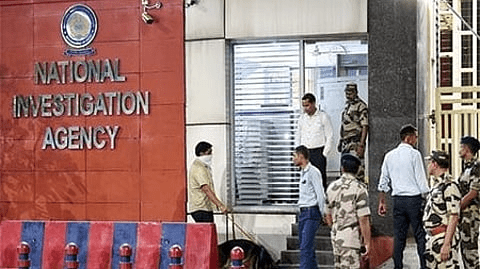
Now the brutal infrastructure of cross-border digital extortion has faced a major legislative crackdown by Indian federal agencies. The National Investigation Agency (NIA) has officially filed a comprehensive chargesheet against five individuals, including the suspected mastermind, deeply embedded in a transnational human trafficking and cyber slavery syndicate operating out of Cambodia. Therefore, this criminal network is accused of systematically luring vulnerable Indian youths abroad under the false pretext of lucrative corporate placements. Meanwhile, the legal paperwork was formally submitted before the specialized NIA special court in Patna, Bihar, on Friday. Following intense coordinate tracking, federal investigators have exposed a dark operational matrix where tech-savvy citizens were effectively sold into digital captivity.
Also Read | Imran Khan and Bushra Bibi Sentenced to 17 Years in Jail
The Mastermind Revealed: Profiling Kingpin Anand Kumar Singh
Now the central target of the federal investigation has been unmasked as a highly evasive coordinator. The NIA investigation has named Anand Kumar Singh, popularly known across criminal channels as Munna Singh, as the undisputed kingpin of the human trafficking framework. Therefore, capturing this absconding asset has become a high-priority directive for domestic intelligence.
First, Singh engineered the entire operation by constructing a layered network of localized sub-agents across multiple states. Next, he utilized these elements to identify and target educated, tech-literate youngsters seeking upward mobility. Thus, his structural role acted as the primary bridge connecting domestic recruitment lines to international illicit compounds.
So while Singh remains on the run along with four specific co-accused allies, his operational layout has been fully documented. Meanwhile, lookouts have been distributed across all major maritime and aerial exits to block further escape paths. Therefore, his formal naming in the Patna court document sets the stage for international extradition steps.
The Scam Compound Trap: Passport Seizures and Coerced Labor
Now the tragic reality facing the victims upon crossing into Southeast Asian territory highlights an extreme human rights violation. The syndicate intentionally lured these individuals by manufacturing fake job advertisements promising handsome salaries and premium corporate housing. Therefore, applicants boarded their flights completely unaware of the physical danger ahead.
First, immediately upon their arrival on Cambodian soil, the handlers executed an absolute seizure of the victims’ passports and travel documents. Next, they were transported to isolated, heavily guarded corporate zones and forced to execute digital financial frauds against global targets. Thus, the mechanical necessity of basic communication was stripped away to ensure absolute compliance.
So any sign of internal resistance or refusal to meet daily calling quotas was met with severe physical and mental torture. The NIA statement confirmed the routine deployment of electric shocks, forced isolation, and the complete denial of basic food and water. This extreme leverage kept the captives working long hours inside the localized “scam factories.”
The Financial Pipeline: Analyzing the Per-Head Bounty Model
Now the economics backing this modern form of cyber slavery reveal a highly lucrative, corporate-style human monetization pipeline. Mastermind Anand Kumar Singh managed this system by treating human capital as a pure transactional commodity. Therefore, each trafficked youth represented an immediate cash windfall for the central syndicate.
The Human Traffic Pricing Index:
-
The Per-Head Bounty: Singh extracted between $2,000 and $3,000 for each citizen delivered.
-
The Buyers: Illicit shell entities operating clandestine scam call centers inside Cambodia.
-
The Distribution: Capital split dynamically between regional sub-agents and logistics providers.
-
The Profit Margin: Highly elevated due to the minimal operational overhead of forced labor.
First, this fixed pricing mechanism incentivized local sub-agents to accelerate their domestic recruitment drives. Next, the funds were routed through complex digital layers and cash-delivery networks to obscure the paper trail from financial intelligence units. Thus, breaking this economic backbone remains a key goal for investigators.
Also Read | Imran Khan and Bushra Bibi Sentenced to 17 Years in Jail
Airport Interceptions: Tracking the Transit Terminations and Arrests
Now the breakthrough that provided the NIA with critical inside testimony occurred during a highly synchronized airport interception. Three key co-accused operatives were successfully apprehended earlier this year as they attempted to re-enter Indian territory. Therefore, these arrests effectively broke the operational continuity of the ring.
First, operatives Abhay Nath Dubey and Rohit Yadav, both hailing from Uttar Pradesh, were flagged alongside Abhiranjan Kumar of Bihar. Next, the team caught them in February 2026 the moment their transit flight from Cambodia touched down at the New Delhi international terminal. Thus, their immediate detention provided a wealth of electronic data for forensic analysis.
So a fifth suspect, identified in records as Prahlad Kumar Singh, remains out on bail under close geographic monitoring. Meanwhile, the data extracted from the seized mobile terminals has allowed the NIA to map out the entire layout of the Cambodian scam zones. Therefore, these successful airport pickups have significantly accelerated the prosecution’s momentum.
The Legal Substrate: Moving the Prosecution Through Patna Special Court
Now the formal filing of the chargesheet marks a major transition from active field intelligence to structured judicial prosecution. By placing the detailed dossier before the NIA Special Court in Patna, prosecutors are demanding the maximum penalties allowed under anti-trafficking law. Therefore, the legal scaffolding of the case has been built to withstand long courtroom challenges.
First, the prosecution is leveraging heavy sections of the Indian Penal Code and specialized transnational crime protocols. Next, they are submitting physical forensic evidence, including recovered email trails, fake employment letters, and bank account statements. Thus, the judicial channel is being utilized to issue formal warrants for the remaining absconding agents.
So the court is expected to schedule the opening arguments and frame charges over the next few weeks. Meanwhile, state protectors are ensuring that the victims who survived the camps receive absolute security during the testimony phases. Therefore, the Patna filing represents a solid baseline for institutional accountability.
Transnational Logistics: The Role of Compromised Travel Sub-Agents
Now the horizontal layer that enabled this network to function seamlessly across international borders involves compromised travel agencies. These rogue sub-agents acted as the essential frontend, masking human smuggling activities as standard tourist or business transits. Therefore, clean business operations were utilized to bypass immigration alarms.
-
The Modus Operandi of Sub-Agents:
-
Lead Generation: Advertising non-existent data entry and technical support positions online.
-
Visa Processing: Utilizing standard tourist visa channels to bypass strict overseas employment screenings.
-
Transit Logistics: Booking specific staggered flights to avoid triggering bulk travel alerts at regional airports.
-
Handover Coordination: Issuing arrival confirmations directly to Cambodian handlers awaiting the targets.
-
First, these corrupt agents received hefty commissions sliced directly from the primary bounty money. Next, they intentionally misled applicants regarding the physical locations and legal status of their employers. Guided by these findings, the NIA is widening its tracking parameters to audit independent travel desks across northern India.
Also Read | Imran Khan and Bushra Bibi Sentenced to 17 Years in Jail
Evolving Cyber Threats: How Indian Tech Talent is Target-Profiled
Now macro-level security analysts are warning that the intersection of human trafficking and cyber crime presents a fresh challenge for South Asia. Syndicates are specifically target-profiling young Indians who possess basic IT skills and English fluency. Therefore, the victims are forced to build fake profiles to execute complex crypto and romance scams.
First, the captive workforce is trained under duress to exploit social engineering vulnerabilities across global digital communities. Next, this means that the victims themselves are forced to act as the primary tools for international digital theft. Thus, the mechanical necessity of surviving daily torture transforms innocent citizens into forced cyber criminals.
So the Indian government is collaborating with Southeast Asian diplomatic missions to locate and dismantle these specialized compounds. Meanwhile, public awareness campaigns are being rolled out to educate job seekers about verifying foreign corporate listings. Therefore, combating this threat requires a unified defense combining tech awareness and active border enforcement.
FAQ: Understanding the NIA Cambodia Cyber Slavery Probe
1. What is the main allegation in the NIA Cambodia chargesheet? Now, the NIA has chargesheeted five individuals for running an organized human trafficking syndicate that lured Indian youths to Cambodia under fake job pretexts and forced them into cyber slavery.
2. Who is named as the primary kingpin of this operation? First, Anand Kumar Singh alias Munna Singh has been identified as the mastermind who coordinated with international associates and is currently absconding.
3. How did the syndicate coerce the trafficked youths? So, upon arrival, the handlers seized the victims’ passports, confined them, and used severe physical torture, including electric shocks and food deprivation, to force them to run digital scams.
4. How much did the mastermind charge for each trafficked youth? Next, the investigation revealed that the kingpin charged a bounty of $2,000 to $3,000 for each individual sold to the Cambodian scam companies.
5. Where were the key arrests executed by the agency? Now, three co-accused operatives were arrested at the New Delhi international airport in February 2026 immediately upon their return from Cambodia.
6. Which court is currently processing this trafficking case? Finally, the official chargesheet was formally presented before the specialized NIA Special Court located in Patna, Bihar.
Also Read | Imran Khan and Bushra Bibi Sentenced to 17 Years in Jail
End…

